Thursday, May 18, 2006

Abigail is Laying

newsprint dividing hiveThis past week has not been a good one. I have felt out of sorts and worried, all because this does not seem like last Spring, where triumphant life exploded out of two screened boxes full of bees. This is a lower energy year, with mite problems and queen problems and an odd nectar flow, and I am still waiting for that burst of exultation that took me so totally by surprise twelve months ago.

It has been six days since the box with young Queen Abigail was placed over the Twain colony, with that sheet of newsprint you see here dividing the new monarch from her foster daughters. For the first three days, nothing happened: looking in quickly, no bees had chewed around the slits I cut in the paper (or even started), and no eggs were present in the Queen's box. The workers were just hanging around, with little flying in or out. Acting queenless.

So I removed two relatively bee-less honey supers off the hive, moved the newspaper sheet down — so the new queen would be directly over the core population of remaining workers — replaced the Queen's box and then the honey supers, and closed the hive up. I was hoping that, by placing her closer, the Eau de Abigail pheromones would be stronger and might get the workers organized. I closed the bottom board, too, to boost concentrations. And I decided to wait three more days before interfering again.

Gets you wondering: exactly which Queen died last week? The imported one or the home-grown princess? If the virgin queen was triumphant, there would be a delay in her laying. And a delay we had. A virgin would have hung around a few days, taken a mating flight, and then started to lay. I have no explanation for why a mated queen would wait. So perhaps Eleanor's genes live on, and the outsider queen died. This does not make me feel better, somehow.

Today was the day to check again (even though I had no plan if I discovered the worst). Inside, there were a few new chew holes in the paper, and new eggs on one frame of comb. Nice laying pattern, too! The bees had filled up most of the rest of the nearby drawn comb with nectar and pollen, so I put a frame of permacomb nearby to give some space for more eggs. Hope that was a good idea!

This means that I need to watch for a few things, and should anticipate a couple of options. First, sometime in about 3-4 days I need to see how those new eggs are capped. If they are all big-domed drone larvae, I have a problem. You see, when you let a virgin queen be raised and mated naturally, she may not mate well or very many times (she may not even survive her flight). She needs to mate anywhere from a couple to a dozen times to get enough sperm to lay her 250,000 lifetime eggs. A queen who has not mated (or mated enough) lays drones.

For the past few days, I have been counting in my head all the known beehives within a three mile radius, and figure where there might be overlaps that promote a Drone Congregating Area (DCA). This is no joke: drone bees hang out together like youths at the gas station/convenience market in a small town. They are sexually mature, have nothing else to do, are anxious to mate, and are hanging out in mobs to identify likely females.

If those eggs turn out to be drone larvae, the Queen is a bust and I get to play executioner again. I would probably wait another week, though, on the off chance that she just got a weird start. If she is a bust, I can either buy another queen, or introduce some really new eggs from the Wilde colony, and let Twain try to raise their own again. Or I can close up shop in that hive for a year, and start over next year. I will probably try to find another queen (and give them some eggs besides).

If those eggs turn out to be worker larvae, however, I'm opening some champagne. I will probably give Twain a frame of Wilde's larvae (to help with the dwindling they have experienced) and feed them like the Dickens all summer long, since they will have missed out on the nectar flow. The colony that was gangbusters last year will be the dependent one this year.

But this story does not have an ending yet, and every time there is an ending some question arises to draw uncertainty and suspense along, like an insect serial drama.

If I do get to pop that cork, my first toast will be to bee years that are good for all one's buzzing communities, and that 2007 will be one of those.

Friday, May 12, 2006

Eleanor is Dead

Queen Eleanor was not laying, and was moving very slowly around her new domain, so I dispatched her today. She was born in Georgia, shipped to one midAtlantic state, lived in another, and died in a third. It was time to stop subjecting her to the whims of humans, and to let her return to nature.

She was buried with a buttercup and the hope that I gave her no more pain.

Today, it no longer seems so sure that her daughter was the queen who died, but it is certain that the Twain colony was reunited today, with a single queen. The nuclear colony was placed on top of the main colony, with a sheet of newsprint paper between (sliced in a few places to allow bees to start chewing through).

Mother's Day weekend here has seen a transition of generations among the bees, with mothers gone by and mothers-to-bee.

Over time, as little as a couple of days, the bees will become bewitched with the aroma of a young new queen wafting through the paper (a perfume for which they have probably been yearning for days) and will forget about the old monarch. But I won't.

Thursday, May 11, 2006

The Anguished Accession of Abigail

Princess Joan, deceased virgin queen bee Here is the sad tale of a dead princess, and a queen in waiting, and the beekeeper who vexed them both. Long story short: Twain will have a foreign queen instead of the young virgin they bred up for themselves, and the beekeeper is a little less ignorant at the price of being a little more sad. I have posthumously named the dead virgin queen bee you see here "Joan," after the princess daughter of Eleanor of Aquitaine who died on the way to her wedding.

The story of all this is confused and long. Something was not quite right with the hives starting a couple of weeks ago – or, more accurately, it was NOTICED a couple of weeks ago – and so began the process of requeening the Twain colony, my first time (and poor Queen Eleanor's last, or so I thought).

With new Queen Abigail (after Abigail Adams) and a jar for old Queen Eleanor in hand last Friday, I found that Twain had hatched its own successor instead. In the world of bees, a newborn queen spends a week to ten days running around inside the hives, probably finishing the development of her wings and getting ready for the only extended flight of her life. While she does this, no eggs are laid, and a gap in the brood cycle develops. Right now, the main nectar flow for the year is on, so this gap will be reflected in a poor honey harvest. Also, virgin queens are not much bigger than workers, and are hard to spot, making it hard for the beekeeper to be sure where they are in all this.

Bad beekeeper, BAD beekeeper! Now I had a virgin and a caged queen (and a dowager, who basically no longer mattered), and when I asked for guidance, I was informed that the bees would kill the outsider queen if I released her. (If only I could express to you how downhearted this kind of thing makes me, time after time.) The best advice I got was to take my new queen, make a little nuclear colony for her to live in next door while we waited to see how the virgin would make out. Sometimes they don't come back from their mating flights, sometimes they don't find many drones to mate with. Therefore, it's a good idea to have a backup.

Yesterday, I went to the nuc to release Queen Abigail from her cage, because those bees should have been content to have her now — but she took flight! Oh no! Sometimes this means that the queen knows she will not be accepted, sometimes this means she has been freaked out by a beekeeper placing her in one hive and then another. In any case, she can't really go far, so I tried to find her. Watching every place my foot might fall, I crept around, and found her clinging to the side of a planter. Taking her gently in my hand, I placed my palm over the hole in the inner cover, and she slowly crept in. When I lifted the cover, she had a small circle of attendants. Good sign.

When I checked the Twain colony next door, it looked listless, and I could not find the virgin queen. This bothered me, all night long actually. In a way, therefore, it was no surprise to find poor Joan dead...in front of the nuclear colony, with two worker bees still trying to attend to her. You see, when I made the small colony to house Abigail, Joan must have inadvertently had hitched a ride.

Do you know, in the back of my mind little warnings about this went off, but I had no way to look out for it? In the royal battle that ensued, Joan died. In the world of bees, the main law is this: One queen, at least one, and no more than one. Joan herself actually killed at least one queen pupa after she emerged (yes, friends, I missed TWO capped queen cells). I checked the nuc after finding poor Joan, and Abigail is trucking along inside.

The picture of poor Princess Joan is included here not as morbid proof of the deed, but to help other beekeepers get a look at a virgin queen bee. I could not find a single picture online to help me (excuses, excuses). The hints I would give are this: the abdomen of a queen is almost always paler than the workers' and it comes to more of a point. There is a segmented smooth patch on the back of the thorax just like on a mated queen. Other bees will be very attracted, even to a virgin.

As we stand tonight, with a thunderstorm coming in and no time to make things right until the next time the sun shines, Twain has no queen, and the nuc which had two is back to normal.

So tomorrow, perhaps, I will be reuniting the nuc with the main Twain colony. Eleanor's genes will slowly disappear over the next 5 weeks or so. She was a good queen, and I would have kept her daughter. To heck with the honey harvest.

Wednesday, May 10, 2006

Beewaves

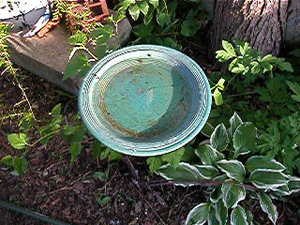
bees wings make ripple in birdbathDuring week after week of idyllic Spring days, humans may exult, but bees are more practical. They seek out water, and they bring it home. Even so, it makes a bit of unexpected magic.

The force of their wing beats makes beautiful and fleeting ripples on the water's surface, a delightful surprise. Bees have to work hard to fly, and they look a bit like they are hanging from borrowed wings sometimes when they do.

If you click on the picture, you can download an 18 MB, one minute Quicktime movie of honeybees over the bird bath. At 11 and 28 seconds, and again right near the end, you can see ripples where no bee touched the water. Try to imagine jewel-like sunshine and a steadier camera hand, and maybe you can be there, too.

Saturday, May 06, 2006

Eleanor is Exiled

Yesterday, I drove out to a town that was once a small farming community, and is now a suburb, and spent the whole morning working with two brother beekeepers who would sell me a queen. Larry and David were gentle, knowledgable, respectful... and skeptical of my story. They said they would nonetheless sell me a queen. In their opinion, whether through a swarm I missed or a natural supercedure, there is a new virgin queen running around in Twain. These are difficult to spot. Then they asked if I had my veil and wanted to spend some time looking at queens while they worked. I said YES, listened and watched and learned until my head spun, and then headed home with a bag of home-grown asparagus, some apples, and some squash. I also bought some Permacomb to help out my congested girls. More on Permacomb later.

Friday afternoon, I went into Twain, found Eleanor, and could not kill her, not yet. I placed her successor, Abigail, as Larry and David instructed me: in her queen cage with a hole in the candy, but the cork still in place for a while. I intend to name her Abigail, after Abigail Adams, if she survives my introduction.

I put a mark on Eleanor (for practice) and put her in a ball jar with some of the burr comb I'd cut. It also has some honey in it. I also grabbed a few attendants: I can always put them back, after all.

Eleanor managed to get out of the jar (lid was crooked) after I set her down: thought she was a goner then, but found her clinging to a curtain. Poor terrified thing. Even harder to kill her now.

I decided to think about it overnight. And what a difference a day makes! MaryEllen emailed me urgently – her observation colony needs a queen who does not lay so much! A perfect new kingdom for Eleanor!

So Eleanor will go on to a life in public relations, much like the British monarchy. I will keep you posted on the further adventures of Abigail.

Thursday, May 04, 2006

The Queen Must Die

Made a quick check of both Wilde and Twain today, mostly to see whether the start of the nectar flow had led to any bee needs. Long story short: Twain needs a new queen. There was almost no brood, the population of bees is pretty low, and you can feel the lack of life in the hive. This is hard, but this is life: the queen must die, long live the new queen.

I've found a beekeeper not too far away who can sell me a new Italian queen, and I will try to get her installed tomorrow. It's a sad day. Sam has offered to do the deed to poor Queen Eleanor to spare my heart, but I'm going to stand up to this responisbility. I may try to hang on to her to help a new beekeeper learn to mark a queen. Or not – not if if means keeping her terrified in a box without proper attendants for a day or so.

Anyway, more details to follow.

Tuesday, May 02, 2006

Saints of Field and Flower

This is no place – and I am no authority – to rule on matters of organized religion, but honeybees possess some kind of theological magnetism, and recent circumstances have me thinking in a saint-ly vein.

With two new colonies at our city's Franciscan monastery, it seemed churlish not to count blessings and offer thanks. Therefore, the colonies at the monastery have been named after my two benefactors, MaryEllen and Doug, and their queens will be named after appropriate saints.

Now, the question of "appropriate saints" got interesting fast. Honeybees have been with us longer than Christianity, and people have been quite grateful for them all along. Therefore, it appears that there are a bouquet of bee-oriented patron saints out there, each beloved of a certain nation. A quick look turned up(Saint/patronage/location):

St. Ambrose/honey and beekeeping/Italy
St. Alexios/bee keepers/Greece
St. Bartholomew/mead-making/Britain
St. Bernard of Clairvaux/bee keepers and candlemakers/France
St. Haralampi/healing properties of bees and honey/Bulgaria
St. Isidore of Seville/bees and hives were his emblem/Spain
St. Modomnock (or Domnock, or Dominic)/bees/Ireland
St. Sossima/beekeeping/Ukraine
St. Valentine/bee keepers/silly people
St. Urban/bee keepers/Hungary

There are almost certainly more buzzing saints. The strategy below, however, is how we are going to start playing the name game:

Hives Doug and MaryEllen

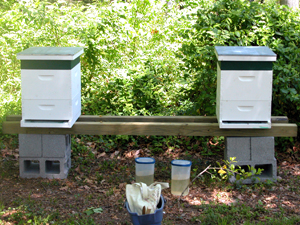
Of the two new colonies, MaryEllen is on the left, and Doug is slightly to her right. This is only right, if you know them. Please note the green woodland goodness that surrounds.

Saints Francis and Clare by GiottoThe queens of the Doug and MaryEllen hives will be Frances and Clare, respectively. It seems deeply right to name a queen after the patron saint of animals, and (for her part) Saint Clare was closely linked to Frances, and committed to a cloistered life of work and the ownership of no personal property. Very bee-like.
Other saints abound, unhonored, even so. There could be a Saint Joe (or two), a Saint Ann, and a Saint Ben as well, since so many volunteers with the Franciscan garden guild have made us feel so very welcome. Joe in particular faces a brilliant future as a beekeeper: he not only skips the gloves, he does not even want to wear a veil when he helps me. He also has a queen eye to beat the band!

In final note, it could not have tickled me more to learn that "St. Urban" was into bees as well. We city beekeepers can totally see it.

Thursday, April 27, 2006

Before the Deluge

tulip poplar blossomWith all the reallocation of bees that has been going on, you might think that the girls on the roof had somehow slipped my mind. Hardly! Two things occupy me on their behalf: number one is the timing and preparation for the Spring nectar flow; and two is whether the wonderful queen of Twain, Ms. Eleanor, will soon be experiencing regicide. The flood of nectar and the effectiveness of queens are major concerns at the tipping point of Spring, and none of the new colonies is yet much affected by these changes.
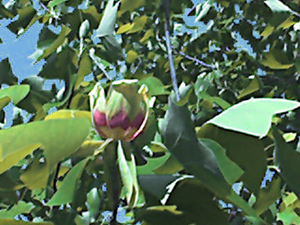
The picture you see here today was taken on Monday (with my cell phone, yielding the unique graphic quality we have come to expect from that medium), and what you see is a Tulip Poplar bloom, harbinger of the sudden and intense nectar flow that characterizes the months of May and June here.

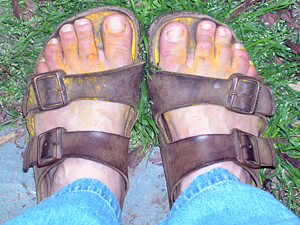
buttercup toesI walk the canine portion of our menagerie (which includes indoor and outdoor fish, roof bees, bird feeders, one cat, three dogs, and a couple of uninvited squirrels) in an old cemetery in our neighborhood. While they bounce around, I look for pollinators and wild birds. Today the buttercups turned my toes yellow while we were mooning around. On Monday, a young Tulip Poplar in the cemetery set forth that first bloom, and I began to strategize.
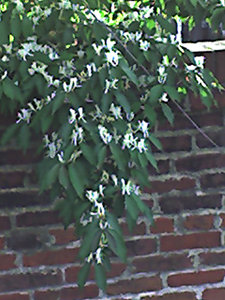
buttercup toesThe "waste" areas and the fences and the walls around the cemetery are filled with blooming bush honeysuckle. The blooms smell like heaven, but remind me of popcorn. As they age, the white turns to a medium yellow, like the popcorn at the movie theatre. The bushes are full of pollinators in late afternoon, which means they must be absolutely teaming in the morning. I tried to get pictures of the three or more native bees that were working them today, not to mention the butterflies. I have seen honeybees there that are almost certainly not my girls: I suspect another local beekeeper.
But back to my own roof! The first point in my nectar flow game plan: the honey supers on both Twain and Wilde are once again in the wrong order. I should have placed the ones with the bare foundation beneath the ones with mostly drawn honeycomb. I had my reasons (I want the bees to move the brood nest up into that fershlugginer deep box that got filled with honey last year) but these efforts were – once again – sincere but misdirected.

When I made the splits, I stuck lots of bare frames in the lower boxes, so that has probably occupied alot of honeybee time and energy in the interim, but it is probably time to set things right, with all the boxes deployed appropriately. Also, I had a medium super with drawn brood comb in the basement, but the wax moths had begun to set up shop in it. I froze the moth-eaten frames, cleaned them up some, and put them back in, too. They need to be checked, nonetheless: if the girls are using the damaged comb to raise drones, I should pull them once they are capped as a varroa control measure. If they are not using them, I should be sure that the wax moths are really truly dead, or maybe (ouch) just cull the frames. Finally, I might need to pull out all the frames that, like my buttercup feet, are full of pollen, because they are just gumming up the works and the bees will only take fresh now anyway.

Every day I go up to visit and to worry, but the girls seem to be buzzing along as usual. Making the splits was an opportunity to commit any amount of mayhem (smooshing queens, disrupting the brood cycle, annihilating the transferred bees through jerky driving). I could not find Eleanor in the Twain colony during all this, but the master beekeepers I talked to on Saturday said that the nail polish I used to mark her was likely to have been groomed off within the hour. The bees and I therefore have something in common: we neither of us have particular use for the stuff, and "pollen yellow" suits our tootsies better.

Friday, April 21, 2006

Adventures in Bruising: Monastery Garden Bees

Just last month, I got a (welcome) phone call. As some of you may know, this blog has gone on endlessly about whether or not to split the Twain and Wilde colonies of rooftop bees ever since it was discovered that they were the opposite of dead: there was in fact a bit of a population boom. During this time of false starts and endless speculation on how exactly to go about splitting one's bees, our beekeeping club got a call from the volunteer garden guild of a nearby Franciscan monastery: they wanted to know if it was possible to place bees in the garden.

It's a lovely garden, dear friends, and it would make a wonderful home for bees. The site offered is actually at the edge of a grove of Tulip Poplar trees, the main sentinel of the honey flow in these parts! On April 10, my bees checked out as ready to split. MaryEllen got me two new Italian queens from Wilbanks on April 18, and therefore I spent the 19th setting up the site. Setting up mostly involved buying and hauling 8 cement blocks and two 8 foot, 4 by 4 landscaping timbers, as well as bunches of rocks to level out this construction. For you SUV aficionados, please note that our Toyota Matrix handled it all, and more. Me, I got covered in scrapes, slivers, and bruises. A normal day, really.

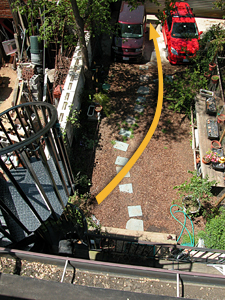
route from roof to car via spiral staircaseTo prepare the bees on the home front, I needed things like window screen material for blocking entrances, and ratcheting cinch straps to keep the boxes together in transit. Luckily, there is an awesome independent hardware store near my home, and a Home Depot for emergency items en route between home and monastery! So I should have been ready to spend the 20th moving in the bees. Or should I say we would spend the 20th moving the bees...
The picture above shows you the one complication in the scheme that kept me up at night. Access to my roof apiary is via a two-story wrought iron spiral staircase. Get down that, then take a few steps to get off of the back porch, and follow it with a simple trip across the yard containing the three energetic dogs and you're done! Did I mention that each colony weighed between 80 and 100 pounds? Oh yeah, and I hoped to do the whole thing by myself.

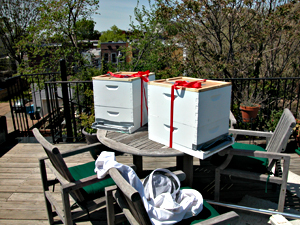
splits ready to goI started assembling splits at 8 AM. This is as far as I got as a soloist. Twice I picked up a split, got to the top of the stairs, and feared for my life. At 10 AM, I had to leave for an appointment (for which I was late, and during which I kept trying not to think about trapped bees baking in the rooftop sun.)
By 11:30, I was calling MaryEllen and begging for help (actually, in my head, I was screaming for it). Who else would be available on a weekday, with no notice and no terror, to haul 200 pounds of bee stuff down 20 feet of spiral staircase? No brainer, right? Joe, the president of the garden guild, had asked to be included in the installation, so I was also feeling a bit of time pressure and had slightly messed up my placement of the hive supports already. He was waiting, I did not know him so well, and I was truly desperate.

And so she came. By the way, even before this I had decided to name the monastery colonies "MaryEllen" and "Doug" (her husband) due to all their help and kindness. I'm a little stumped about what to name "the Queen of Doug," but I am taking suggestions.

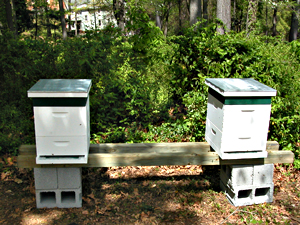
new hives at monasteryWhen we arrived at the monastery, Joe was there, and so was Ann, a frequent volunteer, We lent them veils and everyone hung around while we moved the splits into place, removed the straps, opened the entrances, installed the new queens, placed and filled the hive top feeders, and closed them up. There were lots of good questions (the bees always seem to inspire exceptional mental acuity, if you ask me) and Joe even participated. Rock on, Joe! MaryEllen confirmed the excellence of this apiary location.
MaryEllen helped me pack up the empty sugar syrup containers, smoker, veil, tools, straps, and endless accoutrements of bee wrangling, and I took her to a late lunch, then to the subway (her car was parked at a station in the suburbs).

So there is a new home for bees in the world, and maybe some new friends of Apis mellifera. I am sore and covered with bumps, but this is a new level in beekeeping. I now have two apiaries, and 4 families of bees to look after. I hope that the expansion does not dilute the wonder, or undercut the caring for their challenges and world. This bee thing only serves to make my universe grow.

Note: This is yet another post that was published several days after the fact. At least I am catching up, OK?

Tuesday, April 18, 2006

Transatlantic Bee Tourist

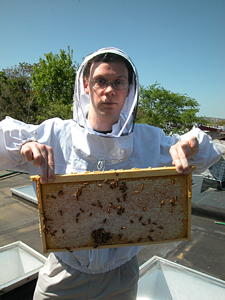
Etienne James Hunter Pollard holds honey framePlease meet Etienne James Hunter Pollard, Consummate Houseguest, Credit to Britain, and (now) Experienced Bee Wrangler. Jamie (we call him this, but you probably aren't allowed) has been a friend of the family longer than me, meaning that his parents knew my husband before I did. Nonetheless, it has been my pleasure to see him grow from secondary school through a round the world trip all the way through university and on to success in business, and I celebrated this by shoving a frame full of bees into his gloveless hands.
Just before being whisked off to the airport after his two week visit to many parts of the U.S., he was asked about (and showed enthusiasm for) a visit to the bees. He got to wear my better veil (hey, we here in the States try to know a little bit about hospitality, too!) and was very attentive and asked good questions when I popped the top off of Twain. Perhaps I should have asked him, or could have paid more attention to the little gasp that might have been emitted, before I pulled a frame and gave it to him.

To my mind, there is nothing like a frame full of honey and contented bees to spur the imagination. It's heavier than you think, it smells good, and it's hard to be afraid of an animal that so studiously ignores you while you manipulate its world.

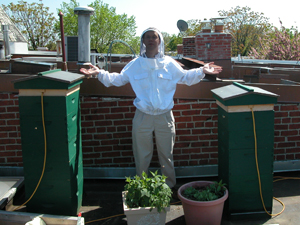
Etienne James Hunter Pollard and coloniesFinally, our final photo shows Mr. Pollard as he stands fearlessly between two colonies of perhaps 50,000 bees each. One might mention a "stiff upper lip," "one more into the breach," and so forth, but I think the girls had actually shown him a good time.
Note: the management admits that this post and the pix were conceived on the date given, though published well after. We also know that we misquoted Tennyson. Sorry.

Monday, April 17, 2006

Beeswax and Bath Soap

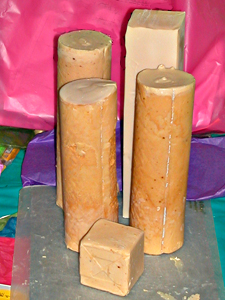
curing soapMuch has been happening in the the three weeks since I last wrote (much of it inside my head, and therefore hardly relevant), but what one mostly has to show for it is soap. Kind of a lot of soap.
Since March 19th, I have made beeswax soap three times, and have done so with a range of other people, and none of them twice. In short, I have been a saponifying flibbertygibbet, a faithless converter of bee products into bathsuds. It just seemed like the thing to do.

On March 19th, my dad was dying and I did not know. That day, Kameha (a new friend from the beekeeping club) and I made beeswax and palm oil soap that turned an unearthly golden shade of brown. On March 25th, my sister and I got together (with my friend Gerry, too) to sort-of sort-out all manner of confused feelings, and made some beeswax and lavender soap. By mistake I put in twice as much lavender as required, but people seem to like it. Last Saturday, MaryEllen came over and we made a very simple beeswax and honey soap for sale at an upcoming event. That is the soap pictured here. I made molds out of PVC pipe, half-and-half containers and a box in which some fancy Calvados came years ago, and you see all that soap in its pre-cutting up phase in the picture above.

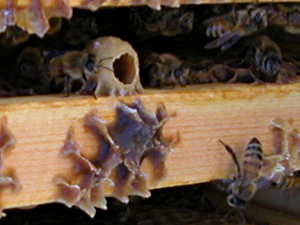
empty queen cupYou would almost think there were no bees anymore, only beeswax, but that's not true. I visited the girls on April 10 to check on swarming tendencies, and whether we were still on target to make splits this Spring. We are. The second picture here is of an empty queencup, evidence of crowded conditions but no swarm yet: it would have to be filled and capped for a swarm to be imminent.
There is nonethless so much news, so much going on, and it's a little anxious making. Last Thursday, MaryEllen and I drove to a Dadant beekeeping supply store, a humble little place, taking all day to do it. I purchased all the woodenware necessary to become a mother of five (colonies of bees, that is: getting two more hive set-ups in addition to the two already on the roof and the one out at a park in the suburbs).

Did I tell you about the park in the suburbs? Well, if not, I must have totally neglected the fact that (in addition) I will be placing two more colonies at a monastery only a few miles from my house. Finally, just a week ago, three new beekeepers installed two packages of brand new honeybees just a mile or so from there, with some advice from me. One of them told me he became interested in beekeeping due to an article I wrote for a local food co-op. That felt so wonderful, I am so grateful to them for joining the world of the bee-lovers.

Tomorrow, two new queens should arrive, and I will have everything I need (and no more excuses) for moving ahead with the two new monastery colonies. The bees for the park will arrive later in the month, in a much less intimidating fashion.

I've tried not to hassle the bees too much lately, but I also think I am sort of anxious about what I am getting myself into...so many bees. But it's not really the bees, it's worry about how a life is spent, and about concentrating on universes so small and orderly, rather than the big scary one from which I am taking a sabbatical of sorts.

Writing this blog is a way of picking up the threads and gathering them together again, of deciding what to think and what to do. This is the first blog entry of my second year of beekeeping, an activity that has come to mean more to me than I ever would have guessed. Soap and philosophy and friends and flowers. A lot of thoughts about life and death, and visits from both. Sometimes it seems like it's just too much, and sometimes not enough.

Wednesday, March 29, 2006

More Fiddling on the Roof

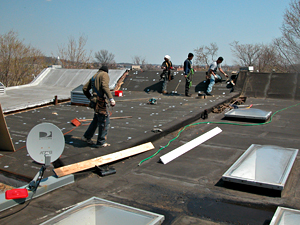
more roofersLet's review, shall we?

I'm in the city, I want to keep bees, and I want to annoy (and become known to) as few people as possible. Therefore, my bees are on a roof deck, and the only people who should be able to see me up there are the folks in an apartment house about a block away (who should not care) and some people with a roof deck just around the corner, whom I avoid.

So in less than a year, BOTH neighbors have their entire roof decks replaced, and it's not just the supporting joists that get exposed. My northside neighbor had told me that roofers would be coming, supposedly two weeks ago, and that she would call me the night before "so I would not be alarmed by the noise." I wondered then if she already knew, but I got information from the BeeSource folks about how to block the girls in (safely) for a day, so I figured all would be well.

But today the roofers arrived without warning, and so they get to see my girls in action! I decided to ask them if I could take their picture, and they said yes, and that was probably a good thing. As I was standing there, bees were bumping into my head and buzzing all around me on their way in and out, and I was barefoot. If a crazy yuppie woman showed so little fear, it appeared as if the macho factor was gonna keep these guys from objecting!

It's probably a good thing that just yesterday, ahead of a short drizzly rain, I did my interim check on the girls. I have hung back for the past two weeks, in part to try to gain perspective and calm down, and in part to allow them to recuperate from my many disruptions. This is the time of year to be careful about food stores, and to apply any Spring varroa mite treatments, and to decide whether any surplus stored honey should be removed in advance of the Spring nectar flow. So I just popped the covers and pulled the bottom boards for an in-progress scan.

bee carrying pollenThis girl was hanging out nearby as I lit my smoker, so it seemed like she wanted to pose with her sporty pollen packs. Those little yellow cuffs on her legs, near the ends of her wings, are probably maple pollen, and she seemed kind of heavily laden and taking a break. After a couple of pictures (the others were out of focus) she flew home.
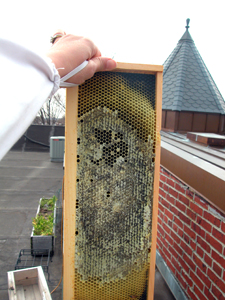
The Wilde colony got the first check. When I popped the top, a wave of warmth and sweet smell reached me. The girls are definitely raising brood in there, and keeping the temps high for the bees to be.

semi-nibbled honey storesThe Wilde girls still have a decent amount of food, and the frame picture at right seems to indicate that they are sort of pecking away at their honey stores, and maybe bringing in a bit of the nectar that is now available in the wild. MaryEllen says that the bees prefer fresh nectar – that the honey they store is about as appealing as canned veggies are to us, and I suppose that it could get old after 4 or 5 months of winter – and that they will ignore honey when flower juice is available. The pattern on this comb seems to show that sometimes they eat fresh, and sometimes they are still plugging away at the comb honey. There seemed to be enough honey to support this pattern for a while, and the weather is supposed to continue in a pro-bee fashion this week, so I closed up and left them alone.
The Twain hive seemed a better candidate for extracting, based on the fact that I left them over 100 pounds of honey this winter, and the first deep frame I pulled was still full of honey. Toward the center of the deep box, however, I found that the cluster had moved into the bottom part of the middle frames: they might not need all this honey, but they'd probably be wanting some. So I decided to let it ride here, too. I moved the full frame to the middle (it's safer to move honey frames around than brood comb), took off the hive top feeder for cleaning, and closed it up.

For the past two Fridays, without telling you, I have been restarting the oxalic mite treatments because there are still several workers with deformed wings appearing each day, and the temperatures have been too low to use ApiLife Var. When I pulled the bottom boards, it does seem like the mite drop is receding, but the virus itself might not need the mites anymore if enough bees are transmitting it directly. Who knows? They say that the worst sign is if drones emerge with deformed wings – they are supposed to have greater resistance – and I have not seen any of them. I can only take what care is available, and be gentle.

Finally, with the Spring have come a number of invitations to place bees in new locations, including a monastery a bit over 3 miles (a perfect distance) from my roof. MaryEllen and I are collaborating on yet another bee project at a public historical park in the suburbs, and we gave a presentation to the other volunteers there not long ago. We'll make all this the subject of another post, since this one is so long.

Finally, I am sorry for the gap in posting, for those of you who wonder about such things. There has been a death in my family, not a terribly happy family, and I sometimes wonder if my love for the bees and their tight and collaborative world has anything to do with these long-past heartaches. Nonetheless, I've been in a pointlessly thoughtful fog, and welcome the needs and rhythms of the bees to bring me back to the world of the real and the alive.

Monday, March 13, 2006

Packing in the Pollen

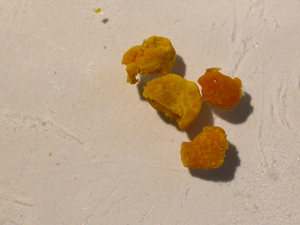
maple pollen packsSpring has continued its early arrival in these parts with an 85 degree F day, which I celebrated by pulling the sliding panels out from the screened bottom boards of the hives. This gives the honeybees additional ventilation, and I get to look at what's been falling through lately. They also don't care at all about this operation, and are not disrupted in the least.
I was supposed to do a mite count on Friday, but I forgot, so I just poked through the stuff on the panels in order to find pollen packs. These are the multicolored lumps that the bees pack onto the pollen baskets on their rear legs, and they give a good idea of what the bees have been up to. The picture above is maple pollen, deduced from blooming information at www.pollen.com and the knowledge that maple pollen is a lovely golden yellow. The bees get pollen all over their furry little selves, and they use their front and middle legs to comb it back, mix it with some nectar (to make it stick), and pack it on their back legs. That rounded shape is actually the largest arc that can be described by a bee arm: it's a more graceful shape than what we manage when we attempt to soap our own backs. The biggest pack here is about 2mm by 4mm, and things are looking a little greasy because of the oil on the bottom board. The pollen packs are also easy to squash, and have deformed a little.

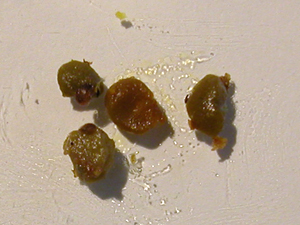
willow pollen packsThis olive drab stuff is willow pollen, apparently a far less desirable product, according to beekeepers. The bees seem to think it's OK. The Twain colony had a lot of maple on the bottom board, while Wilde had almost all of the willow. This may only mean that the Wilde girls filled up the cells with willow before working on maple, or it might mean nothing at all.
The pollen-bearing field bees actually fly into the hive, back into a cell, and scrape the stuff off themselves. They pack only one kind of pollen in a cell, apparently, just like they collect only one kind of plant material on any single flight. The pollen packs that fall down are probably the result of misses, miscalculations, or overfilling. This whole business is a lot different from the way they handle nectar. When delivering flower juice, field bees find a house bee, give the nectar to her, and then fly away again.

I've been messing with the bees too much lately, but it's a bit of a conundrum. There's a risk of swarming, which means I should be checking or intervening, but I've been fiddling too much, which may endanger the colony. So I am sitting tight, watching pollen, and planning a cursory visit tomorrow.

There may be other visitors this week, however! My north side neighbor told me that her roof will be replaced one day this week, and she would call when she knows which day – purportedly because the dogs might be barky as a result. From the way she introduced the topic, I suspect that she knows! But she is a good person, and it makes me sad not to share this with her. Nonetheless, this is a great time of year for such a project, because the bees are in a good mood and it is not impossible or terrible to block them in their hives for a day, especially if it's a bit cooler than today. If anything, I want to meet the contractor who can guarantee a complete roof replacement in one day!

Friday, March 10, 2006

Beespotting

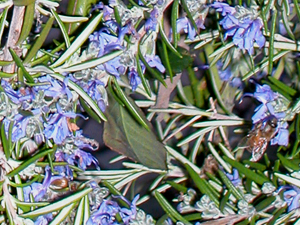
honeybee in rosemaryIf the bees were ready to swarm, they would have done it today, so I kept an eye on them. Instead of waving goodbye to a cloud of departing residents, however, I got to supervise a glorious working day for many hundreds of busy honeybees.
I sat on the roof near the hives, trying to see what they were bringing in. They have been thronging the birdbath and the planters, so some of the more wobbly arriving flights were probably packing H2O. Others had their panniers packed with bright yellow pollen: most likely maple, since you can now see buds on the trees, even from the ground.

Then it hit me, last year it had seemed a shame that I had no picture, or real idea where to take pictures, of where the bees were working each day. Therefore, I focused as best I could on incoming and outgoing bees, trying to see where they were headed or coming from. This is not easy! The bees tend to fly out of the front of the hive, spiral around higher and higher, almost beyond sight, and then take off like a shot in their desired direction. It almost seems as if they blink out of existence.

But some were headed right past me and down, past the bird bath, to something else nearby. I grabbed the camera, headed down the twisty staircase, and out in the alley behind the house, pursuing a generally bee-ish course.

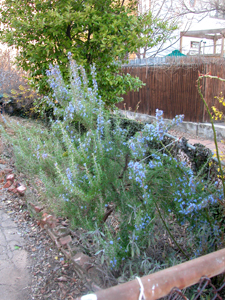
rosemary bushAnd it turns out that the bees had found this rosemary bush, gloriously in bloom, in the yard of a neighbor who does not like me much. Honeybees on the job are notoriously difficult to photograph, and I was afraid to go in this yard, so I leaned on the fence, propped up the camera, and crossed the fingers that weren't pressing the shutter. Within a set of some 20 nearly random shots, the first picture above and the last one below managed to show happy honeybees in their first Spring blooms.
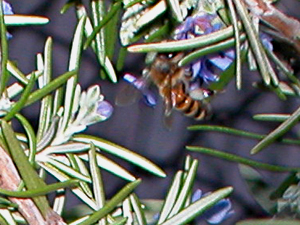
honeybee in rosemaryThis officially marks the beginning of the season where my poor dogs will have to wait as I poke my head into every bush during their walks, looking for the girls. It's time to root for even temperatures and nighttime rains, for abundant nectar and gentle winds. It's time to realize that it's way too soon for these things, but to feel them tantalizingly just ahead.
Wednesday, March 08, 2006

Bad Beekeeping 'R' Us

queen eleanor of the twain colonyIf you have been looking here for beekeeping advice, please let this post be your version of the surgeon general's warning. I am a moron beekeeper. At left is the only worthwhile result of this morning's endeavors: a fuzzy picture of a slightly marked queen.
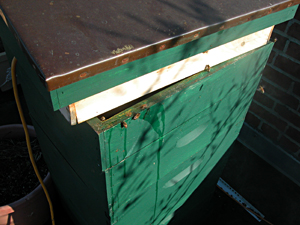
This morning, when the temperatures were too low for the bees to fly, I reviewed George Imiries' instructions for splitting a colony and sort of modified them a bit. I brought all the tools necessary to do the deed, lit my smoker, and waited until bees started flying. At 11:30 it was time to go.

I started taking Twain apart frame by frame, which annoyed them alot after going through a similar treatment yesterday. But I had to find the queen, move her and mark her. I counted honey frames as I went: I have just short of 8 deep frames of honey, as well 10 medium frames. That is a ton of honey.

Pulling frames, scraping burr comb, inspecting carefully: I was at it for over an hour when I came to the frame with the queen cell...and I broke it by mistake.

Holy cow, as stupid a thing as a person could do! If those bees swarmed NOW, one half of them would have no queen at all!

But wait a second! It was empty. Suddenly, it makes sense! Why only one cell, why in a screwy place, why so much honey still uneaten? My crazy comb building Twainians just waxed it over for the heck of it (like they attach everything else). It's not time to split, and this whole exercise has been a total waste of time, bee patience, and some bee lives.

So I'm in the middle of a colony of unhappy bees, and might as well make the best of it. Decision: keep looking for and mark Queen Ellie.

So I rummage down down through 2 more boxes. I'm in the bottom, still no queen. So I look to the left of my foot, on a frame that's sitting in an empty box, and there she is. To me, she looks like a Cadillac bee, but WHAT THE HECK IS SHE DOING THERE? I simultaneously reach for the nail polish (to mark her back) and the camera (to grab a close up) and she flies! I AM AN IDIOT.

Where the heck did she go NOW? I spot her on a random piece of wooden ware to my right, lift it, and try to shake her into the hive. She does not let go. I'm terrified she'll fly again. I jiggle it one more time directly over the cluster, and then I can't see her anymore. Did she go in?

I look all over, feet frozen in place. She's not to the left. Not to the right. Not in the box with frames. Not crawling around the outside of the hive bodies. Decision: CLOSE THIS MESS UP.

So tired but so careful, I place the top brood box, then the medium honey super, then the freaking-stooooopid incredibly-heavy chest-height deep with 60 confirmed pounds of honey in it, then the feeder, then the hive cover. I shuffled away, humiliated, with all the extra boxes, stands, covers, shards of beeswax, mashed bees and instructions for making a split lying just where they were.

I'll clean up tonight when I won't do as much damage.

Tuesday, March 07, 2006

It's Splitting Time!

cracking the topA few weeks ago it became clear that I had to watch the Wilde colony for signs of swarming: Carniolans are known for it, and my bees were crowded. Since the weather is supposed to be quite warm by the end of the week, I popped the top (the picture here today) to check, and found no signs of honeybees with plans to run away from home.
For the heck of it, I looked over at Twain, and saw my first drone of the season. Hmmm. Colonies produce drones at about the same time that they think queens ought to be out and about!

So I popped the top, and got a BIG surprise. A capped queen cell on the bottom of the bottom box! (Unfortunately, the camera died right before: I'll get you a shot tomorrow). The last time we took the colony apart, February 28th, there weren't even any queen cups (the first stage), so the girls got right to work just after we went rooting around in there. We had removed an empty bottom box, though, which probably accounts for the strange location. Once again, the bees got busy just where the books said they wouldn't.

This means that tomorrow, before the Twain crew gets a chance, I'll be making my first split, becoming a mother of three (colonies, that is). There is some possibility that I will have FIVE colonies by the end of this year, if Wilde splits too. That's because there's a nuclear colony coming my way, intended for a new "out apiary" site that has not been blogged about yet.

One last note: in prying the Twain boxes apart, I also found that they had built burr comb with drone cells between the boxes (not sure why they did that, since the bee space is supposed to be correct), and several of those drone larvae had living Varroa mites scurrying about on them. Another battle not yet – perhaps not ever – over. The new microscope my husband bought is supposed to take movies, so I'm going to give my first ever horror flick a try tomorrow, and show you that, too!

Saturday, March 04, 2006

The Colonizers Become the Colonized

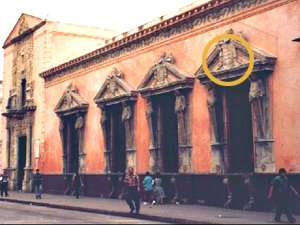
casa montejo bee coloniesYou may wonder why this bee blog is showing you a picture of a building. Well, it's like this: We just took a midwinter break, a quick run down to Merida, Mexico – a city in the Yucatan, and I look for bees everywhere. I thought the most exciting bee-attraction in Merida would be it's large open market (the biggest on the whole peninsula), a place I'd *surely* find interesting honey and bee products. However, as we were walking along the zocalo (the central square and park for the city), I noticed bees flying behind and around giant crests on an impressive old building.
The facade was stone, which means that no one in their right mind is ever going to try to cut those bees out (standard operating procedure for bees nesting in most houses). But what is MORE interesting is that the building was the home of the conquistador who first took Merida from the Mayans, a guy named Francisco de Montejo (not to be confused with his cousin, also Francisco de Montejo... but we shouldn't pick on the unusually close family ties of the Spanish nobility, should we?)

So the colonizers are now the colonized! But let me share one more thing with you.

The Mayans kept stingless native bees before the Spanish arrived, but these have gradually been replaced by European races of honeybees (which I understand to be somewhat more honey-producing than the stingless ones – there are projects to try to save them). But most, meaning perhaps 100%, of the Apis mellifera bees in the Yucatan are now Africanized: the killer bees we have been taught to fear by mindless moviemakers.

In case you wanna know, not 10 feet above the heads of the people passing through the busiest square of the largest city in the Yucatan are 4 colonies of Africanized honeybees, buzzing in and out with much better things to do than to bother anybody else.

Monday, February 20, 2006

Dirty Bees

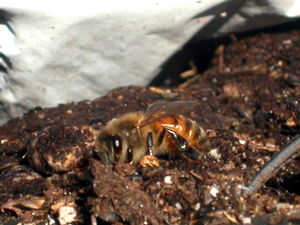
bee sucking dirtWant to know a dirty little beekeeper secret? Bees prefer mucky water. Yup, they gather nectar, pollen, tree sap, and H2O to bring back to the hive, but they take the latter from the yuckiest place they can find. MaryEllen told me that an expert once claimed that the bees were trying to gather protein with the water, but I have my doubts.
Since this is the city, my garden is mostly containers, and many of those are "Earthboxes", biggish boxes with black plastic covers that keep water in and weeds out. The tomatoes that once grew there are long gone, but the honeybees have converted the openings in the covers into places of pilgrimage. On almost any above-40 degree day, I can pull back the cover and see some girls sucking dirt.

bee with tongue in dirtCan you see the little red tongue of the bee at right? It took 20 shots to get that for you (fuzzy as it is). Gotta get my viewfinder fixed. My bees are clearly somewhat soiled, in a couple of ways.

It is extremely comforting to see the bees, in this case almost certainly the cold-weather-loving Carniolans, around and about the yard, not just because they anticipate Spring. At a state beekeeper meeting last Saturday, there was a lot of advanced info around that once again put a scare into me. This blog has more crises than a bad soap opera, and I am afraid that the meeting will only induce more of the same. Like someone who sees a medical show on TV and becomes convinced that she has a terminal illness, the talk of mites and viruses has me shaken up about the girls. Again.

My mite counts are very, very high. The treatment I used is not proven — while it was the best available alternative and one clearly used by a bunch of us (gathered in a group like giggling high school girls, "Did you use it, too?! Tee hee!"). Add the concern that it might be too little too late! One presenter talked about a truly scary relationship between high mite counts and terminal loads of deadly viruses that go on and on even if the mites don't.

The wing deformation that I showed you earlier is not a result of just plain old mite vampires, but of a virus they deliver to the poor developing bees. Apparently almost every bee has some of it (and every part of the hive except the wax can harbor it), but the mites appear to do a one-two punch:
  1. weakening the bees by parasitizing them; then
  2. delivering enormous quantities of virus to the enfeebled host.
The deformed wings don't come from varroa mites, they come from the "Deformed Wing Virus (DWV)," and you don't see it unless the infection rate is very high.

It seems to work like human epidemiology. Name your bad infection (SARS, Spanish influenza, the plague, anything): all were present in the environment, perhaps for centuries, before becoming epidemic killers, or even getting a name. If the numbers of ambient infective agents get high enough, some diseases can make the jump from rare disease (or benign chronic bother) to rampant pestilence. It take billions of virii or bacteria, and hundreds or thousands of potential hosts, and they all need to be closely associated. At some point, a saturation point is reached or a mutation takes place, and the disease explodes.

Varroa mites operate in a large and crowded place full of life, a hive, an easy place to get into the disease delivery business. If you keep the numbers of the varroa low, the amount of virus they pass around never hits the critical mark. Once you have enough virii in place, though, you don't need the varroa around anymore to support the epidemic. The DWV virus can jump the rest of the way up a hyberbolic curve all by itself, and there is no cure. You lose the bees and all the hive products — anything that can't survive a fumigation —because all the bee accessories are now full of virus, too.

I completed a 4-day mite drop count this afternoon. Twain dropped 97 a day, and Wilde is back up to dropping 237. I have a lot of mites, still. During the last warm day (February 16), I saw many dozens, maybe hundreds, of girls with deformed wings creeping around the roof. The speaker at the meeting told us that the deformed bees only live 2 days, so (counting back 21 days plus or minus 48 hours) I know that they hatched on either February 15th or 16th, and the Queens laid the eggs from which they were hatched around January 25-27. These bee larvae should have been exposed to the first oxalic acid treatment (January 27): their honeycomb cells were still open. But they say that the oxalic takes up to a week to kill the mites once it is in contact with them, so it might just have been too late for this generation. The mites could have delivered the virus THEN died.

From the information that the speaker gave, and the many observations of creeping bees and medical mysteries that you can see in this blog, a kind of story line about the health history of Twain and Wilde is emerging.

Last year's weather was great for mites, and stimulated brood rearing until quite late, and the temperatures were too high to use my chosen treatment. I helped this along, by trying everything in my power to raise the number of bees in the Wilde colony before winter. So a really wonderful and prolonged breeding ground for mites was provided.

It was hot right until the temperatures began their drop in late September. The rapid change hard up against the start of winter weather meant the hives were exposed to the mite treatment for only a minimal time. Also, let's not forget the beginner errors that I almost certainly made. So the mite treatment took place under sub-optimal conditions.

Winter usually puts a temporary stop to brood rearing, and knocks down mites. A mild winter here, however, caused it to start up again almost immediately.

With a large initial population, few checks, and a return to pro-mite conditions, the varroa population exploded. The creeping bees I saw in November and again in latter weeks are the effects of the virus ramping up behind the mites. The first wave of DWV girls came when the inital varroa population crested in October, the second when they swung into action in January.

This is the story so far. The ending has not yet been written.

Two weeks ago I still had a lot of vibrant bees. The only question now is whether the oxalic acid nailed the mites, and whether it did so soon enough to stop a viral implosion.

I think there is hope. Some of the dirty bees in today's pictures were very young, newly hatched, and decked with perfect wings.

Tuesday, February 14, 2006

A Gift of Bees

Heifer International Gift Card Today my honey gave me a gift of bees, though they are a bunch of buzzers that I will never actually see, and I love it! Click the pic for details...

Heifer International gives families throughout the developing world animals and know-how for sustaining themselves, their communities, and the environment. It is extremely cool: you can donate a hive of bees, or a trio of bunnies, or a quackful of ducks, and the world is a bit better off. Everyone who receives such a gift is required to pass it on to another family.

Therefore, this is a perfect Valentine's gift! I have received the gift of honeybees and love in my own life, and hopefully that sunshine has already reached somebody else.

Sunday, February 12, 2006

Snow bees

roof beehives in the snowThis picture captures the vision of winter beekeeping that danced in my head as the cold weather came...then went, then came again.
That pink-sky feeling of beehives at the end of the world is just how it looked at 10:30 this AM, when the snow finally stopped, and my boots were found, and I remembered to go back for the camera.

A couple of minutes later, imagine the snow stomped all around, a result of making sure that the entrances to the hives were clear and no puddles of melt water were undercutting the girls' efforts to stay warm.

From a bee's point of view, snow beats wind any time, and this is finally a snug winter's nap.

Saturday, February 11, 2006

The Spaghetti Method

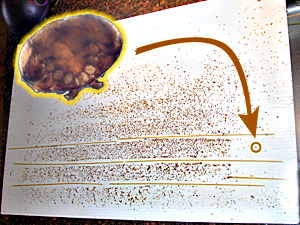
sticky board with miteAnd on the fifth day (which would have been Friday), she counted. And what did she count? Nasty little pin-head sized mites, my dears. By the hundreds.
There is only one way to find out if a treatment for varroa mites is working (or isn't working, or whether you should be working on putting together a treatment): you count mites. In my case, I count the mites that fall down from the hive onto a greased up bottom board below it.

I felt sorry for myself three weeks ago (before it was clear that there was a problem): the bottom boards came out, and there were about 150 mites to count on the worst one. It's a very nit picky business (to mix buggy metaphors), because the mites are so tiny and the bees tend to drop a bunch of other stuff, too, like pollen grains, wax flakes, ex-bee body parts, and unidentified beekeeping objects.

To my earlier self, I now say "Hah!" If you have a good treatment going, you will get hundreds to fall every day, at least at the beginning. After four days exposure, the board from Wilde pictured above contained 814 dead varroa mites (by my count). The board from Twain, surprise surprise, totalled 1514! This is a lot of mites by anyone's calculus, and kinda hard on a poor aging beekeeper's eyes.

The boards are about 2 feet by 18 inches, and I kept getting lost ("Have I counted this mite before? Where did I stop last time?"), and needed a way to mark out territory. Therefore, I have developed the Spaghetti Method (TM) for counting Dropped Varroa Mites. You, however, are hereby licensed to use this technology for your own apiary endeavors if you think nice things about my bees while you use it.

It works like this: the stuff on the bottom boards tends to fall in a way that shadows the frames of bees hanging in the boxes above. Basically, there are rows of assorted crud that overlap a bit. Grab some dry spaghetti (use the straightest ones you can find) and use it to mark off the spaces between rows, pushing the odd mite to one side or the other if you need to. Make sure you count any mites that end up stuck to the spaghetti (there is absolutely not a single cooperative feature of a varroa mite, I assure you). Take a little broken bit of pasta to use as a pointer, and begin working your way along each row, poking around in little blobs that might conceal a mite. Write down your count for each row, then total all the rows when you finish.

By the way, I could go all legal on you and tell you not to eat the pasta afterward, but it's probably safe if you did not use some kinda funky oil on your bottom board. Buon appetito.

The folks on the Beesource bulletin boards seem to think my daily mite counts were in line with an ongoing treatment (203 and 379 for Wilde and Twain respectively), but some thought perhaps a fourth application would be in order. I just completed the third, and possibly final, treatment today, and kind of want to know if this is "too much of a good thing" territory. Therefore, you can guess what's coming next week: another mite count.

So Tuesday, otherwise known as Valentine's Day, I'll be up on the roof, placing clean sticky boards. It's just as well that I lurk up there, because that Animal Planet show for which we (the girls and I) were interviewed is airing that day.

Wednesday, February 08, 2006

Battling the Midwinter Mite Menace, Part 2

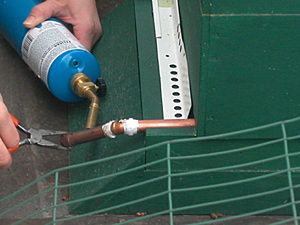
applying evaporated oxalic acid to Twain colonyOn Sunday, my husband helped me apply the second round of oxalic acid treatments to my varroa-mite infested colonies of honeybees. We were actually a couple of days overdue, because the whole idea is to time at least 3 different treatments to catch every cell in the bees' brood nest at least once while it is open. This is an actual real-life picture of me with my genuine propane torch doing the deed. You can see a movie which demonstrates the low flame and positioning in either Quicktime (.MOV, 5.5 MB) or generic (.AVI, 2.7 MB) formats.
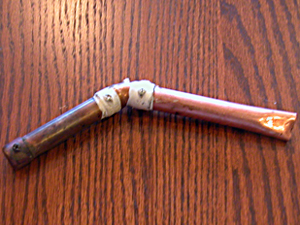
homemade oxalic evaporatorIn case you are wondering what the copper thingum in my hand really looks like, this is the version I whipped up from bwrangler's specs. It has been used a few times, and I am a little bent out of shape about fumes, so I put extra teflon on the outside of the joints. This was whipped up from less than $5 worth of pipe scraps and caps from the hardware store, and $5.88 for a pound of oxalic acid, more than I will need in a life time.
Why repeat all this treatment stuff?


Whipping up a batch of baby bees usually takes about 21 days, and the whole first part of the beekeeping short course seemed to be all about these stages. Unfortunately, I sat there hearing "blah blah blah," thinking the important stuff was coming later. Um, this was the important stuff though.

You see, I can only treat bees that are either already hatched, or in the first phase of being hatched, when the bee egg's comb cell is still open. The order of operations is that the queen comes around, drops in an egg, the nurses feed it lots for a while, and after about 8 days they come by and seal up the cell for the "cocoon and pupa" stage. And varroa LOVE it in there. None of the medications for varroa can get through the beeswax capping, though.

So, to ensure that the whole colony gets treated, you end up doing a bit of bee biology math. We know that it takes about 3 weeks to bake the average bee. We know that each bee only spends about a week developing in the open. Therefore, each bee spends about 2/3 of the hatching cycle, or two weeks, unavailable to me. So on any given day, only 1/3 of the cells receive my ministrations. So the calculator says, if you are giving a treatment, you need to repeat it 3 times at one week intervals to even hope to cover all the bees.

After treating the bees this time, I slid in clean sticky boards at the bottom of the hives, and will count three days' worth of dropped mites tonight. I'm not sure what to expect, because there might be lots of dead mites because of the treatments, but there might be fewer because many have already been sent to the great pestilential arachnid playground in the sky. Probably, the best approach is to take a count after each treatment, and then a little later. If there is one thing that beekeeping teaches, it's to try to get a longer term, more integrated view of the goings on, rather than trying to read the truth from adrenalin-producing snap shots.

Thursday, February 02, 2006

Let's Not Split Quite Yet

beeswax versus propolis with Italians versus CarniolansMaryEllen came over yesterday to help me find out if the Carniolan bees of my Wilde colony were on the verge of swarming (due to crowded conditions and, perhaps, overbearing mothering), and we went through all the boxes of both colonies, all the way down to the bottom board in the case of the Twain honeybees. She came bearing gifts of extra brood comb and hive covers and stands and bottom boards...she came riding to the rescue like those knights in shining armor of which little girls dream.
But a lot like little girls who dream of heroes, however, it seems we did not need much rescuing after all — though a helping hand (and a knowing eye) still makes the day.

We opened up Wilde first, working our way down to see if they had built queen cells beneath the top brood box (the second box from the bottom) and MaryEllen spotted only two empty queen cups, no source of alarm at all!

We also saw bees, frame after frame after box after box of bees! Carniolan bees form a winter cluster (to keep warm) which is smaller than any other, often only a bit larger than a softball, according to the experts. I'm thinking we were seeing something more like a small beach ball in there. I slipped a semi-empty frame of comb into the middle of the deep box above the brood nest, so Queen Elizabeth could have a place to move up and lay some more eggs if she wanted to.

We also saw honey, loads of it. MaryEllen says I should stop feeding the bees, at least for now. It appears that I overfeed my bees just like I do my dogs and husband: a preferred vector for nurturing.

So we turned to the Italian honeybees of the Twain colony. They were slightly more cranky, because they prefer slightly higher temperatures. Once again, lots of honey, lots of bees. When we reached the bottom of the colony, there was brood (bees-to-be) in the second and third boxes from the bottom, but none in the last: the queen had moved up, as they tend to do.

I had the option of taking out the box and having a a whole medium super of my very own drawn comb to use later for a "split" (to start a new colony split off from one of the first ones) or perhaps placing it on top of the brood nest as a place the queen could move into. MaryEllen cautioned against that, saying that until the weather got better I should not put any kind of separation between the bees and their honey stores, and she was right.

So now I have a box of comb stored in the basement, ready for later adventures — and MaryEllen did not have to lend me any of her precious reserves (though she is always terribly generous that way). She told me I should be singing from the rooftops, with two strong and stable colonies more than halfway through the winter, with new bees on the way and a promising new year ahead.

I'm still a little nervous about the future, because it appears that I will soon need to make those splits, and become the mother of 2 more colonies in addition to the one which will be part of a project MaryEllen and I will be doing at a park outside the city. Did I tell you about that? Well, maybe next time.

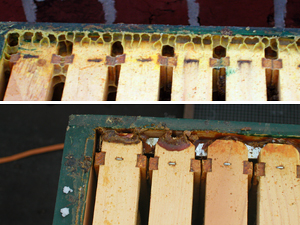
Finally, today's picture is a comparison of differences between bees. The top picture shows the front top edge of one of Twain's boxes, on the side facing the wall. The girls have made lovely lacy comb out of beeswax in order to weld those frames in place. The bottom half of the picture is similar work, as done by the workers of Wilde. They cement the front edges of the frames in place with lavish slavers of propolis (the stuff in the picture has already been pried up). Just like two different smart people, they tackle the same problem using preferred tools and practices. And no book can tell you how your particular bees are going to be(e).

Monday, January 30, 2006

Buckets of Bees

brood from Wilde colonyPlease, do not make fun of me. I know we were just at DEFCON 1. We may still be at DEFCON...perhaps a different number, or a mixture of several. Maybe I should use that crazy national security rainbow scale. But please, no mocking. Not where I can hear.
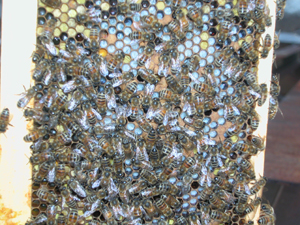
You see, the colonies of honeybees that seemed to be miserably afflicted and likely to be dwindling away to nothing are actually jam-packed-full of a humongous number of bees. Enough, in fact, that MaryEllen is telling me to check for swarm cells in January and I have to get right back out there to do it. Maybe I had a lot of mites because there were a lot of bees. Maybe there is still a killer crowd of mites in there capable of taking my masterful girls out.

They are getting a little crowded in there. The picture actually shows that Queen Elizabeth has laid eggs in every cell avvailable to her, and her babies are all mixed up with pollen and bee bread and maybe even propolis storage. Those Carniolan bees seem to love that propolis.

You can take a tour of the Wilde colony, and see how the sense of the situation changed as the frames from deeper and deeper inside the colony came to light.

I also have pictures from Twain, which seemed its usual healthy active self. It got late, though, and I got tired, so I decided to hold off the true physical until another day.

Judging from the swarm danger, however, that day is gonna be pretty darned soon. Geez, if it's not one thing, it's another. Now I have to go face my husband, who was rebuked for his assurances that all would be well. I think perhaps I will grab a glass of wine first...

Friday, January 27, 2006

The Good, the Bad, and the Oxalic

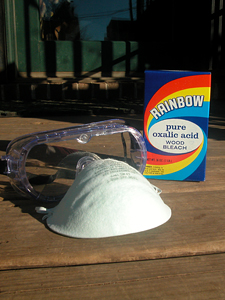
oxalic acidIf the bees are good, and the mites are bad, it's safe to assume that the treatment decision I just made may be a bit ugly. But pretty is off the table.
In a move that seems at the same moral level as shoplifting or kissing in church, I have (ahem) changed my mind and decided to try fumigating my diseased bees with oxalic acid. The deal seems to have been sealed when I found a web page that advocated getting more of the stuff in your diet (Editor's note: don't), another selling it as a deck cleaning product that would not hurt the asphalt on roofs, and (finally) my neighborhood hardware store sells the stuff in a definite non-hazmat manner. I wanted to try the argument that oxalic acid is also a naturally occuring substance, but so is arsenic.

Basically, my girls are dying up there, and this stuff seems like it is relatively harmless, except perhaps to me and the mites. The treatments are short and effective, and nothing else gives me much hope at all.

So:
I built two evaporator tools (one will be given to MaryEllen), and you can see better instructions and pictures than I can offer on Bwrangler's page at http://bwrangler.atspace.com/bee/goxa.htm. But I am now the proud owner, for the first time, of a blow torch!

As of this precise moment, I have tried to use the evaporators twice, and failed to successfully melt the oxalic acid powder, because wiser souls advised not to "boil" the substance, and I am no torch jock. The plus side of this is that the Carniolans of the Wilde colony poured onto the the entrance board when I placed the evaporator at around 11 AM, reassuring me of their continued liveliness and giving me the most unlikely of trophies: a January bee sting. I was actually in a "You go girls!" place with that.

I tried to fumigate the Italian bees in the Twain colony at 2:00 PM, but I was too much of a torch wuss. When I checked the evaporator after it cooled, almost all the oxalic was still in there. The Carnies were flying like crazy this afternoon, so I am going to wait until later to try them again.

Weather.com says the temperature will drop around 5 today, sending the Wilde girls home soon. So this evening, it will be another episode of "A Woman And Her Torch," playing for the third time today live on my roof.

Thursday, January 26, 2006

The Mites are Back

If they ever left.

Yesterday completed three days of sticky board exposure, so it was time to take a Varroa mite count. For Twain, it seems 15 mites a day are dropping, high if no new bees are being reared, kinda middling if they are. Wilde is sorely afflicted: it dropped somewhere from 30-43 mites a day (I counted everything that looked like a mite, and could have overcounted a little).

It's not good if you post your mite count to a beekeeping bulletin board, and one of the experts answers, "Yikes!'

Both colonies need to be treated, but it is midwinter, and you are not supposed to mess with bees in midwinter. The following options are open:
  1. Try to sprinkle powdered sugar all over the bees. Pros: only non-toxic approach still open to me, no potential damage to the roof. Cons: unlikely to be able to completely coat the bees and eradicate mites, will kill at least some of the brood in open cells;

  2. Expose colonies to oxalic acid vapor. Pros: really quick, really effective. Cons: an extremely toxic substance (for people, not bees), not sure whether this use is legal, could damage roof (need to research latter);

  3. Place CheckMite strips. Pros: won't kill bees, won't disrupt brood rearing, effective if mites are not resistant, won't hurt roof. Cons: Another toxic organophosphate, will take a few days to get here, mites might be resistant.

I already ordered some CheckMite strips, but they will probably not arrive until Monday of next week. I am planning to take some powdered sugar and a flour sifter up to the roof tomorrow, when the temperature is supposed to be above fatal and the wind should be gone, and powder what bees I can (anything to hold the line).

Master beekeeper Brenda Kiessling told me, in June, two things:
  • There's really nothing to be gained from babying a weak colony through the winter; and
  • This is a lesson that every beekeeper seems to need to learn for herself.

Expert advice is not always comforting.

Sunday, January 22, 2006

The Dangers of PMS

Yesterday, my husband said, "So now you know everything is going to be OK with the bees over the winter, right?" To which I answered, "Well..." and he responded, with a sigh, "Of course."

It's always something, eh? The current anxiety is "PMS," or "Parasitic Mite Syndrome," a disease caused by Varroa mites. The mites get into the cell where the honeybee is developing, pierce the larvae to suck its blood, and introduce viruses that cause deformation of wings and abdomens. I saw PMS bees when I fed the other day, and began to wonder whether there was a big problem brewing.

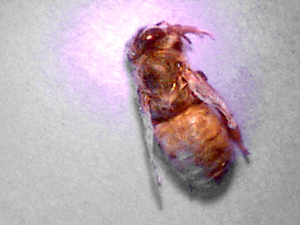
bee with parasitic mite syndromeThis (dead) honeybee has the classic signs of PMS, little shrivelled wing slivers that are very different from the tattered wings you might find on old bees. This honeybee never had a chance: without wings, she could never fly or forage, and she was probably cast out by her sisters as a result. Yesterday, I found a PMS bee very far from the hives, too far for her to creep. One of her sisters had picked her up, flown her off, and dropped her — hygienic behavior that is good for the hive but bad for the sentimental heart.
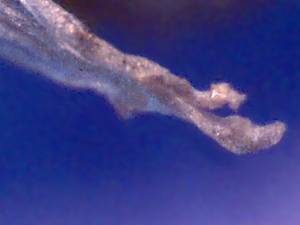
wing deformed by parasitic mite syndromeJust to belabor the point a bit, here is a picture of a wing taken at 60x magnification by my husband. Those two frozen stubs are wings that never were. The name of the order to which bees belong, Hymenoptera, refers to their two pairs of twinned, gauzy wings. This just seems like a particularly mean spirited flavor of destruction to me.
The most important thing to know now is whether I have a problem (if I do, how to handle it is a completely different mystery, since I thought I took action already). In any case, I asked for advice both from the BeeSource.com bulletin boards and my local beekeeper club. Both groups said the same thing: get a mite count. These could be old bees left over from before you treated for varroa in the Fall, they could be newer bees emerging after an ineffective treatment: with beekeepers if you ask two folks you get 6 opinions (this is not a joke). The old bee scenario means "no problem," the new bee scenario means "condition red." If I have a high mite count, it means the latter.

So I have embarked on counting mites, you can see how I have started by looking at the "Making a Sticky Board" page in the links at the right. Your advice is very welcome, and any comments will be read right away.

Friday, January 20, 2006

When Friday is Sun Day

sun beeAccording to the National Weather Service, the coldest days of the year here are usually from January 9 to January 23. Today, it is a sunny 60 degrees F out there, and the girls are flying their hearts out (though bees don't have hearts...but they do have blood). It's the fourth warmest January on record, with no cold snap scheduled for the immediate future.
Now, for the beekeeper, warm weather has its pluses and minuses. On the plus side, your bees are not freezing to death, and you have fewer of those "Poor Bees!" thoughts while hustling about outside. On the minus side, warm bees are more active bees, and they therefore eat more of their honey stores at a time when there is no nectar anywhere for them to collect.

So this means, tah-dah, I get to pay them a visit! In the winter, we feed the bees a heavier sugar syrup, one that is 2-1 sugar to water by weight, and we hope they eat it. Today I got to go up with the second dose of sugar in two weeks, and to be with my girls in the sun. Take a look at that picture and tell me that it's not at least a little like living with Tinkerbell.

Well, the hives were rocking and rolling with honeybee comings and goings, but the girls were very gentle. I did not smoke them, and should not have bothered wearing gloves (since I decided not to use smoke, it seemed smart to wear gloves. To heck with that!) I had a big soup pot with 10 pounds of sugar in 8ish cups of water, and that is what you see me pouring into the hive top feeder on Twain. Wilde once again got more than half, since I suspect that the Carnies are already raising brood.

A subject of more concern: there were bees with shrivelled wings creeping around the roof. Only a few, but this is evidence of Varroa mite damage. When the mites grab onto larvae in the honeycomb, they suck their blood. The stress and loss of nutrients causes the honeybee's wings to form poorly, and the bites can even introduce illnesses to the developing bee. I have posted a question on a beekeeping bulletin board about "How Much Is Too Much?" when spotting mite damage, and will let you know.

One last observation: I gave the hives each one cup of fake pollen during my last visit, and Wilde did not eat theirs, though Twain did. So Twain got some more, even though it's not really time for that (I am supposed to wait until February). We should start having ample local pollen soon, so maybe I should stop monkeying around. I just love to work with them, and to give them what I can.

Tuesday, January 10, 2006

Winter Bees and Quiet Blogs

view from stairsAs you probably know by now, the bees don't fly much in the winter: they huddle together in a cluster inside the hive, and make warmth by flexing their little bee muscles. Mostly, beekeepers take one of two courses of (non)action during this season. The first is to philosophically accept that they have already done what they can for the bees, and that nature holds the rest of the cards. The second is to hover around, and wonder what superfluous actions (wrapping hives, providing extra food stores, sweeping nearby puddles off the roof...) might help the bees' chances.
You get only one guess concerning which camp issued my membership card.

The bees are almost always on my mind. Anytime you head upstairs, you can look at the Twain colony through the skylight above. And every time (sigh), I look for bees on the wing, or hope for a bit of sunshine on the side of the hives. Mostly in December there was nothing but a pale grey sky.

But things have, counterintuitively, brightened up in January. We are in an unseasonable warm spate (temps bumping up against 60 degrees F) and yesterday the activity outside the hive entrances seemed greater than in September! Even better, it seemed that the Wilde colony's Carniolans were running the bigger party!

The Carniolans have clearly been more active at lower temperatures throughout this season, and I am kind of wondering whether I should switch my chief anxiety from "Are there enough of them to survive?" to "Are they starting to raise brood too soon?" Therefore, after a spectacular failure at making bee candy (see link at right) on my own, I turned 10 pounds of sugar into about 3 gallons of 2:1 sugar syrup and hauled it up to the roof today. It is also supposed to be warm and rainy tomorrow, so I figured it would give the girls something to do while they were incarcerated.

As an afterthought, I grabbed a baggy of fake pollen (yes, you can buy fake pollen) and brought some of that up to the roof, too. If they are raising brood, they might like some protein. It also might be a bad idea, since giving them protein might cause them to start brood, but I am willing to take the chance.

When I popped the top on the Carniolans, they were already rocking and rolling inside. There were a couple of half hearted attempts by guard bees to demonstrate displeasure, but that all stopped when I poured the syrup. Many hundreds of bees stuck out their tongues and said "Yum!" I gave more than half of the syrup to the Wilde girls, because they had lower honey stores to start with. In checking a few days ago, they had 6 full frames in the top medium super still to go, and probably some more below, but I am not taking chances.

The Italian bees in Twain were their usual warmth-loving selves: not really into making an active response to me popping the lid. They got maybe a gallon, which those bees present took to right away. A few days ago, they had 8 full deep frames of honey above the cluster, so they are less likely to starve. I will be back in a few days to see how they are taking things, nonetheless.

For the first time, it really feels like they are going to make it. It might be a good idea not to get too excited about this, but it does my heart good: that and having bees buzzing around me again after such a long time.

Monday, December 19, 2005

The Benefits of Rolling With It

candles, we make candlesBeekeeper meetings (like bee blogs) get short on material in the winter, so our last formal agenda focused on "how to roll beeswax candles."

Initially, I thought this would be lame. Why? Because the purist in me knew that none of us individually produce the groovy honeycombed beeswax with which we would work. It is, in fact, the same stuff we buy in order to make frames for the the insides of our beehives. I was, however, mollified (and drawn in) by learning that beekeepers actually contribute their melted wax cappings and so on to "wax accounts" at the supply houses. Therefore, while the wax at hand was unlikely to contain any one beeyard's product, it was a wonderful amalgam of pure bee handiwork from all over.

And the scent is terrific, too. As my friend Alexandra said when she got her candles, "they smell good enough to eat or roll in." They smell like the inside of a hive, actually, and you should take any possible opportunity to sniff them out sometime.

The basics of beeswax candlemaking are as follows:
  1. Order some beeswax from any number of bee gear purveyors – some won't ship to you in cold weather, though, because the stuff can break. I guarantee that your local craft store does not have any;
  2. Get honest-to-goodness candle wicking, and this is probably available locally;
  3. Cut the wicking to about 24 inches, enough for two tapers plus some extra;
  4. Take one sheet of the beeswax, and find the middle of the long side. Cut across the wax at a slant that starts about 1/4 inch short of the center line on one side, and ends 1/4 inch over the center on the other. You should end up with two pieces of the same size and shape, mostly square but with one slanted side;
  5. With the longest side closest to you (the side that comes to the sharpest point), place one end of the wicking along the long edge, with the pointy side on your left and the square on your right, making sure that the wick is roughly even with the square side;
  6. Begin to fold the edge of the wax over the wick, maybe 1/8 to 1/4 inch wide. It will look pretty uneven at first, but don't worry. Work along the whole edge;
  7. Once you have the length of the wicking enclosed, begin to turn that edge over and over on itself, gently but firmly. Make sure that the square end of the sheet stays even with itself. The pointy end should begin to form a pointy candle end.
  8. When you run out of wax, you have made your first candle! Press gently but firmly along the seam at the end, with warm fingers you should be able to work it down mostly smoothe.
  9. If you want to put a tag on your candle, now is the time. Thread it on the wicking which is sticking out;
  10. Now, starting from the other end of the wick, make the other candle, pointy end facing the pointy end of the candle you just made.
  11. When you finish the second candle, you can pick them both us by the wick, and tie a little ribbon around the middle to make a nice presentation.

Remember to trim any wick to 1/2 inch before lighting. Your candles may get a little white haze on them if they sit around a while. If you expose them to warmth, this will disappear.

There are lots of other candle designs around (I used a Christmas tree pattern and some straight pins with pretty heads for mine), but this is the simplest.

But a beeswax candle, like life, does tend to change as it gets older. It gets that homely crust, it don't smell as good as it used to, and it can crack and crumble at the edges. You should go ahead and use your candles, especially during the colder, darker times of the year when the bees aren't around to amaze us.

Friday, December 16, 2005

One short day in the sun

bee pooFor the first time this month, temperatures on the roof rose to about 50 degrees F, and the girls took flight. It was a day of much work for them, I think, as well as a bit of a release and relief.

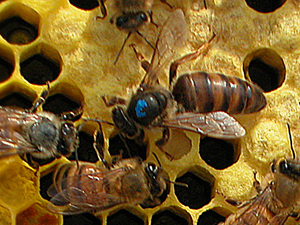
First the more cold-tolerant Carniolans of the Wilde colony appeared, and then (a few degrees later) the Italian bees of Twain made their December debut. They cleared their doorsteps of many dead sisters, and then took to the air.

Bees (unless they are sick) do not relieve themselves inside the hive, so they retain waste until they can get outside. During these cold days, it can be weeks between "cleansing flights." One of the medications that they got this Fall (Fumagilin-B) was meant to help them with the stress of all this: it chews on bacteria that like to live in a honeybee's gut. The picture above shows dots of bee poo on one of our skylights. A master beekeeper once assured me that the stuff stinks like crazy if you get it on you.

It seems that they also come out thirsty. There were bees parked at the edge of the puddles on the roof (we had unbelievably cold, nasty rain just yesterday), sucking up water. There was one swimmer – a worker who may have been swept into the water by an sudden breeze – so I got to sit in the sun with a drying bee for a while.

It's colder than when I did bee-resuscitation during the summer, and the honeybee cranked up a bit like a cold engine. They usually run their front legs over their antennae alot and stick out their tongues while they dry off, but instead of a methodical and furious wringing and patting, this bee engaged in a kind of ssssllllooowww m-ohhhhhh-tion groooom that suddenly sped up when the sun hit her. It seemed really mechanical, but it was just the reality of being a cold blooded life form. Her eyes went from dull to active, and she took off without so much as a backward glance, as bees are wont to do. I hope I see her come Spring.

Wednesday, December 07, 2005

Desperate Winter Pursuits of the Bee-Brained

frappr map of world beekeepersIn the absence of the six-legged set, perhaps we bee-o-centric newbies can turn to each other, to share tales of bees past and stake out the territories our industrious girls have so thoroughly explored. In short, it's a hoot to go to the Frappr Map of world beekeepers (just click on the pic), put down a marker that announces your presence, and shout out to others in your predicament. You can even submit snapshots of your loved ones and look at other beekeepers' efforts.

I, for one, wish that beekeeper Linda Houlihan of Albany, NY had posted her email address, because her beautiful, crisp, and enormous photo of a frame of brood has me wanting to purchase every bit of her photo gear (and reshoot this whole blog).

One interesting thing about the Frappr map: there are lots of us new-bees out there. Maybe this beekeeping thing DOES have legs (please forgive me). It's also possible that well-established, experienced beekeepers don't spend as much time online, trawling around for information and free advice. There is definitely a straw hat and farmhouse set out there that needs me less than I need them. By the way, I envy them BOTH the house and the hat.

Tuesday, December 06, 2005

New Bees, Old Bees, and Queen Bees

After writing so much about the cold, I got some major nostalgia for the warm days just past. When visiting the hives, lots of pictures are taken that never make it here, so I pored over a bunch of them. I miss the bees.

But maybe I have something to show you, even now when there is not a (living) antenna to be seen. A few days ago MaryEllen shared with me a bit of wisdom that I can show you now, with a bit extra besides.

Queen ElizabethThe bee at top is Elizabeth, the Queen of the Wilde colony. That sporty blue mark came from the beekeeper who bred her. If you look at her, she resembles the bees' cousin the wasp more than her workers do. Notice that her broad shoulders have no fuzz, and that her butt is way long and tapered. I think she is pretty. This picture was taken in late May.
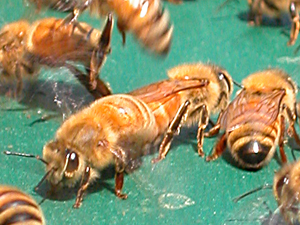
house beeNow, here at the front left is a young worker bee, currently a house bee. After they emerge, bees spend about the first three weeks of their life doing tasks inside the hive. In this picture, it's a really hot day and the girls are fanning up a storm to try to cool the hot insides of the hive boxes. Take a look at her shoulders, where the wings attach. She is all golden and fuzzy! Most of the bees I see when opening the hives are like this: young and occupied with tasks like nursing young, drawing out honeycomb, and putting away honey stores. The girls were fanning so hard because it is still late May, and the BeeCool hive ventilators have not arrived. I think she looks like she is saying "Hurry up already with the AC!"
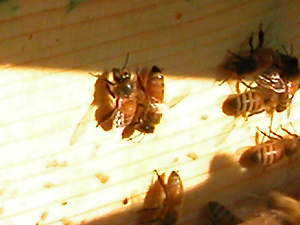
field bee in hive top feederIt's not easy to get a picture of an old bee: they tend to be out in the field during the day when I make my visits, and they try to die outside of the hive so no other bee has the extra work of pushing them out the front door when they pass. The bee furthest to the left has probably lived most of her life by now. Look at her shoulders: the fur has been worn off of her back, probably scraped away little by little by all of her trips in and out of the narrow hive entrance.
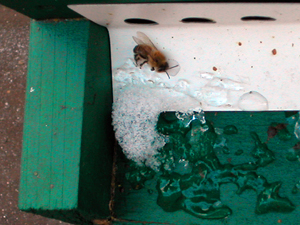
Recently on one of the BeeSource bulletin boards, some expert beekeepers mentioned that the reason honeybees "wear out" after six weeks is that they lose the ability to make replacement parts once they are full grown. Adult bees eat no protein, just the nectar of plants and honey, after they take flight. The pollen they collect — a particularly pure vegetable protein — is just for the young. The Queen lives up to 5 years, maybe because she is made of more durable stuff and does not do the hard work of outside foraging.

Now they are all hunkered down in a big ball o'bees inside those boxes. I wonder if the work of keeping warm is harder or easier than the other tasks they set themselves. I look forward to seeing them again when the sun shines.

The Cold Arrives

young frozen beeWinter is well and truly here: our first snow came last night, leaving a couple of inches and some ice. I went up to peer at the bees, not wanting to disturb them enough to cause a guard bee to detach from the inside cluster. Giving me a piece of her mind could cost her the rest of her life when the temperature is low!

Each colony's entrance now features a handful of frozen bees and frost. The population will dwindle with the temperature, but I don't know what a normal amount of ex-bees would be. The girls brought to ground numbered less than a hundred, maybe not even dozens. But so sad and cold.

To me, the bees are the incarnation of sunlight: lively, golden, queens of the air. Many people I know suffer the darkness of winter, and their spirits tilt downward. I miss the lightness of the bees, I truly do, especially when the only brightness seems to be caught in the crunchy melted-and-refrozen snow.

Turning to the plus side, there were no mouse tracks or signs of rodent incursion. Mice and (ahem) others sometimes get into bee colonies in the cold months to enjoy the comparative shelter and the free food. This seems like a pretty likely threat in the city, but we have beat it so far.