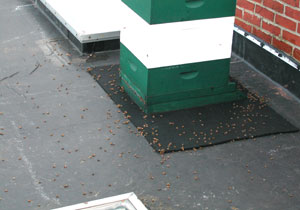
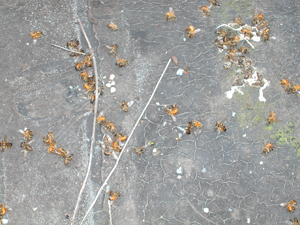
Soon after the new roof was installed, I noticed bee bodies piling up, mostly around Twain. It was hard to avoid the question: "Is the new roof killing the bees?" It was even harder to figure what the solution would be if I have an apicidal roof.
This is going to be one of those posts with lots of questions and muttering and head scratching, just so you are warned.
Initially, the first issue that hit me was that mostly Twain was affected. There were some dead bees around Wilde, but only in numbers that I associate with end-of-the-season dwindling. If the roof were killing bees, wouldn't both hives be affected similarly?
I remembered that Twain, being heavier, took a few extra shots while being moved for the construction, and also that with its larger population, that colony would show dwindling more obviously. However, this was very out of proportion. Was it robbing? David, the pumpkin-farming beekeeper for whom I am doing a web site, says it is always his strongest, largest hives that have the hardest transition to winter, often getting robbed in the process. Whenever I see robbers, I always wonder whether old Queen Eleanor and the girls are still around nearby, somehow surviving wild.
Finally, I remembered that at this time last year came the Time of the Creeping, when hundreds of sick, mite-bitten bees came crawling out of Twain. I "saved" them then by knocking down the mites, but the virus that caused the illness is still in there, mixed in the wax and the propolis and the bees' bodies themselves. With their increased cold weather confinement, was there an epidemic of Paralytic Mite Syndrome (PMS)?
To come up with any answer at all, it was necessary to get more data. The first thing was to sweep away all the existing bee bodies, and determine whether the die-off was continuing. This turned out to be hard to manage, because just enough rain fell at just the wrong time to make it hard for me to sweep around the hives. I needed to sweep in the twilight because waving big sticks around beehives is considered QUITE the provocation during business hours, and any later I would be unable to see a thing. I needed the roof to be dry, or I would just sweep wide swathes of mashed bee around the place – very disconcerting and sad.
My chance came about a week ago, and I swept the dead girls off to the other side. When dealing with dead bees, I try to toss their bodies up into the air, toward the sun, a kind of last flight and a thank you for all their hard work in their short lives. Sweeping them into a dust pan was a heartsore thing.
As of now, it appears that the bee death has stopped. If the roof was off-gassing, either temperature or time has caused that to diminish. If PMS was killing the bees, this month's oxalic acid application has perhaps curtailed its spread. There is still a daunting mite drop. If the dead are actually robbers, the thieving colony has either clustered now or lost too many bees to continue. Our weather has been awfully warm, too, with sudden cool-downs, and it is possible that the bees got caught outside at the wrong time. We had one afternoon when the temperature dropped 40 degrees F in two hours.
I keep wishing that it was more clear what a "normal" year would look like: to have an expectation of when dwindling would occur and what it would look like, to understand how heavy with stores the hives should be, and how much activity I should be seeing. But there is no such thing as a normal year, and urban rooftops are not often factored into your "normal" beekeeping expectations. These weird warm days are actually horrid for the bees in a light honey year like this, too, because they keep flying (and, potentially, trying to rear young) when there is almost nothing for them to forage.
But it must be said that the news is good, though answers are scarce. Whatever killed bees seems to have stopped, and there are still enough girls to make the winter. I will have a job of knocking down mites and topping off stores, but I like having something to do for them.


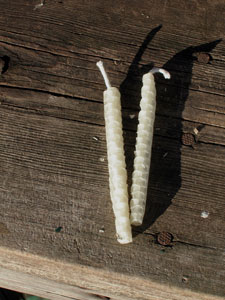 Surprise, surprise: the bees are the lens through which I see the midwinter festivities now, and our celebrations are brightened (even literally) by the bees' presence and presents.
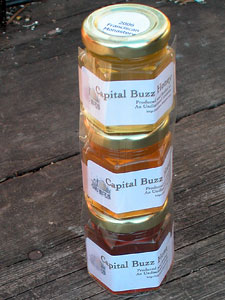 But we have an equal opportunity attitude to holidays around here, so I was also noodling around with bee-based gift baskets, and figured out an interesting way to present the three different colors of honey produced by the roof, monastery, and mill apiaries this year. MaryEllen gave me some special pastry plastic, and I taped together "flights" of honey: the lightest from the monastery, the medium from the roof, and the darkest from the mill. I also labeled some single-source jars for people whom might just like to have a usable amount of a single honey (rather than three somewhat impractical samples).
  With apologies for the blown-out quality of these pictures, here's our final result. The menorah looked homey and glorious with the beeswax candles, though they did not burn as long as expected. The gift baskets included honey, candles, soaps, and a bag of Honey Pecan "Crackerjack," a first-time thing for me that seems to have come out OK. The recipe is below (with instructions about embellishments in parentheses).
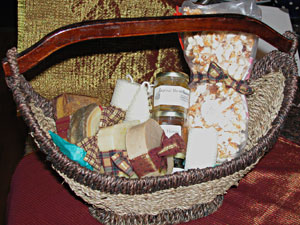 All this craftiness was intended to simplify and refocus this special time, though it must be said that gift baskets are way more time consuming and kitchen-destroying than a trip to the mall. It's hard not to hope rather TOO hard that people will particularly like the effort, and perhaps to get too personally wrapped up in it all. After all, even when the goodies come from the girls, it is not about the stuff.
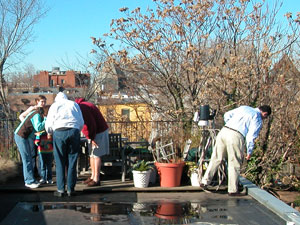
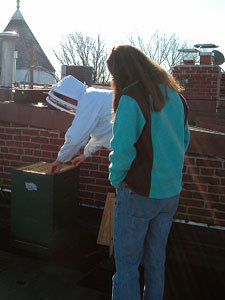 Both of my cousins, Maria (shown here) and Anna (taking the picture) are teachers, and they immediately expressed interest in the bees as a learning tool for kids (I guess it's genetic for us to immediately decide "the kids gotta hear about this!") As I went back to put away the honey frame, Maria came along to take a peek. Note the lack of veil, fear, gloves, etc. She even leaned over and took a good long sniff of wonderful bee essence. One of my favorite things, and something missed in winter, is the warm sweet cloud of scent that wafts up whenever you open a beehive. Now she knows what I mean, too.
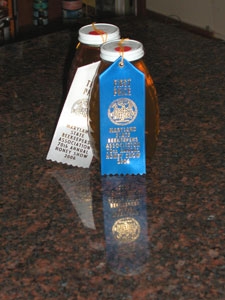 Blue comes in a coupla forms, actually. First, something I meant to mention this weekend: on Saturday, we had the state beekeeping association meeting, complete with a mini honey show. After scoping out whether there were any ants present, the judges gave the monastery honey a first in the beginner category for light color. The rooftop honey got a third for medium color in the same category. It is beginning to granulate, actually (more reason to eat it right away). This makes my collection of ribbons include a second (in a class of two), two fourths (in a class of four and of five), a third, and a first – a complete set, the last two actually meaning something. Interestingly, the wife of the judge who gave me the fourths said that
 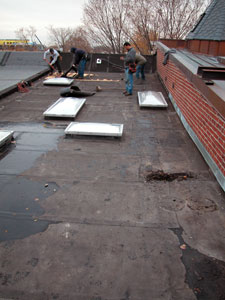 In August of last year, roofers next door outed the bees to our south-side neighbors, resulting in just 4 months of undetected beekeeping. Luckily, those neighbors are a little paranoid, too; they also thought the bees were cool, and decided to keep the matter to themselves. Then, this Spring, the north side neighbor got a new roof, and I became really worried, because Kathy is a normal, well-adjusted person with children and her reactions would therefore be alien to me. But it turns out that her roofers never told her, and as a result I outed myself last month (sort of) and she was kind of happy about the whole thing.
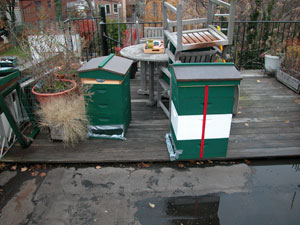 But you might be asking, what about the bees today? Well, they had to be moved onto the deck (which is not being messed with) and they had to be sealed in, because otherwise they would get lost.
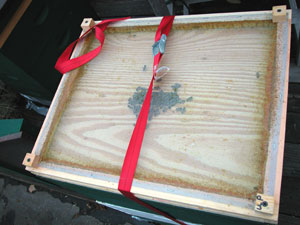 So last night, after sunset (when all the field bees should be back home) I went up and blocked the entrances with plastic window screen material and duct tape, and covered the top with a screen that is usually used for added summer ventilation. Then you run a
 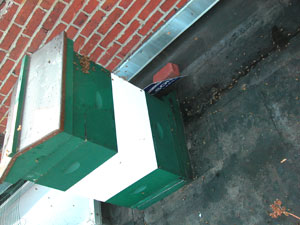 Yesterday was another feeding day, and Twain was the lucky colony... well, sort of. Remember how there seems to be a lot of bees robbing bees this year? Maybe I know why.
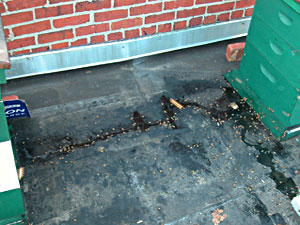 Robbing bees make a different noise than your usual buzzing, and they tend to land all over you, checking to see if perhaps YOU might be a sticky pool of undeserved sugar forming directly in front of them. It's hard to move around without crushing bees, and besides the sadness of that, crushed bee smell is a motivator to get upset: just what you don't want in the middle of a cloud of over-stimulated felon bees.
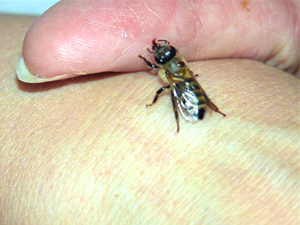
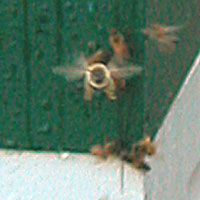 On the up side, while I was wading around the clingy bees, trying to develop a plan, I got a picture of this bee flying at me straight on. I was not trying for her picture: the camera tends to choose its own focal point, and she apparently was it. It's not great, but you can see her antenna on the left if you squint real hard.
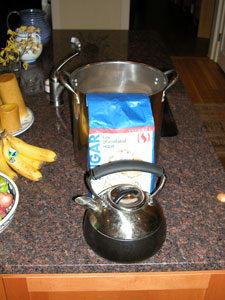 One pot, one kettle, and one ten pound bag of sugar equals a late autumn meal for one hive of bees. As the year winds down, beekeepers who want to ensure that the honeybees have enough stores for the winter mix 2 parts granulated cane sugar to one part hot water in order to make a heavy, honey-like syrup for the bees to sock away in the dwindling days left. The heavier syrup is supposed to signal to the queen that she should stop laying (if she hasn't already: some beekeepers around here say that in our climate she always lays a little through the winter) and the girls should get ready to cluster up and stay warm. By now, the drones are all gone, and things have become serious.
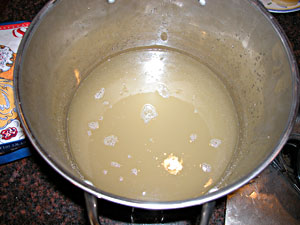 When at loose ends, I make food for the girls. This photo shows what 10 pounds of sugar looks like in about 5 pints of water, just out of the kettle. It's cloudly, and must be stirred for a while. The water must be hot to make such a super-saturated solution, and I boil it before pouring. You must never heat the sugar directly on the burner, however, because the bees cannot digest carmelized sugar and can get potentially deadly dysentery in that manner.
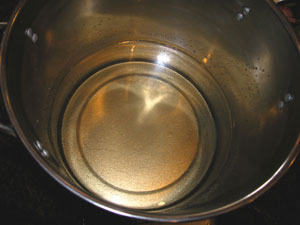 In just ten minutes or so, the mixture becomes crystal clear. It has to cool before you use it, and once it does you sometimes get little floes of sugar ice floating on the top. It helps that my counters are stone and this pot is a thin, cheap one, because I can move it around on the countertop to make it cool faster.
 Even though it has been quiet, I look in on the roof bees everyday — hanging around near the entrance, checking on activity levels, looking to see if any deformed bees are around. You see, this time last year the roof was mysteriously covered with bees creeping aimlessly around, and it turned out that the colonies had a raving Varroa infestation.
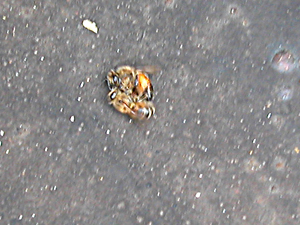 Once bees start to rob, they fight each other like the Dickens at every hive entrance. You can see them rolling around your feet like violent little honey-colored Yin/Yang symbols. They tend to persist, often because the robbing resulted from there being almost nothing else to do!
 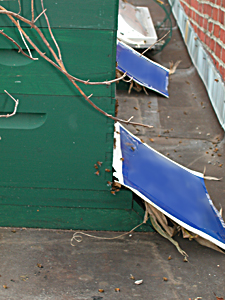 I have only one robbing screen, and two colonies, and it seemed important to balance my response so one colony would not get the advantage over the other. So I went downstairs to seek further guidance from the maarec.cas.psu.edu website, a place of great wisdom. One pamphlet there suggested throwing grass or other plant material over the reduced entrances, making them easier to defend, and/or placing a long board lengthwise across the entrance area, requiring a longer, more complicated, and (once again) more defensible approach path.
 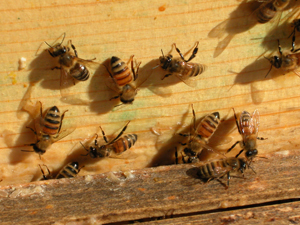 It has been a while since you got to look at a bee picture, so here you go. The year is definitely coming to a close, and my job mostly is to feed sugar syrup and take mite counts.
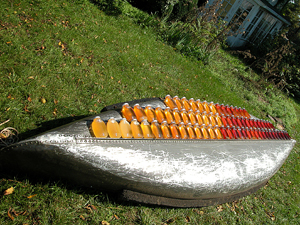 Larry from the beekeeping association ended up putting me in contact with a guy who farms more than 30 kinds of pumpkins, squash, melons, and ... bees! He needed a website for his seasonal business, so with one thing and another I ended up helping him set up satellite broadband and a wireless LAN, as well as a site. I need his permission before I can send you there, though.
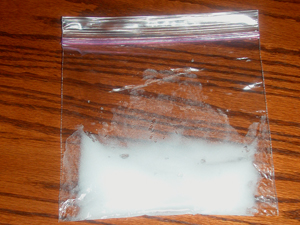 First of all, I want to tell you that the State Bee Inspector came by the historic mill on Tuesday, and he gave us the all-clear on American Foul Brood. In other words, we don't have it, or at least don't have it yet. He pointed out the big mite infestation in my hive there, though, and made various suggestions, including the use of Food Grade Mineral Oil (FGMO) to make those mites go slip-sliding away. I'll probably give it a whirl (there's no harm in it) but I have already completed two oxalic acid fumigations, and will make the third one on Monday. I think I am going to study up on how to double up on mite treatments, without unintentionally poisoning the girls with too much of a good thing.
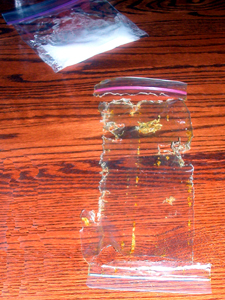 This picture shows such a bag two weeks later, The girls have cleaned it off, and actually started chewing the bag. The yellow stuff is propolis (no Carniolan party is ever complete without propolis). As of today, they got a chance to start over on a second and final dose.
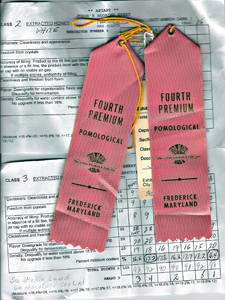 It appears that a foolish consistency sort of inhabits this beekeeper's brain, because both the Monastery and the Rooftop honey have won the same ranking, fourth place, at a nearby county fair. And yes, one of them was fourth place in a field of four! Now, if I had managed to keep the ANT out of my rooftop entry, there was a chance I could have tied for first or earned second...
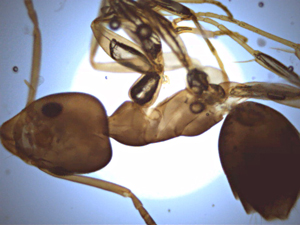 Here she is, the interloper. Like a true friend, MaryEllen maintains that the ant must have crawled in during the judging, but I know that honey extracting brought me a temporary scourge of the critters... I also, shortly thereafter, admitted to needing reading glasses. So, put 2 and 2 together, and you get...fourth.
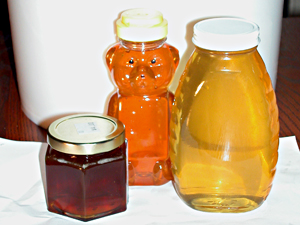 This post actually started seven days ago, when I finally extracted my first true harvest of rooftop honey. On Thursday, September 7, I finally went upstairs to see what was what, thinking that I could have anything from 80 to 200 pounds of honey up there. This was a daunting prospect, because it meant removing bees from seven or more supers, and hauling each (weighing anything from 30 to 85 pounds, depending) down a spiral staircase, across the second floor of the house, down the stairs to the first floor, then back across the house to the kitchen. And no MaryEllen around to make things easy this time!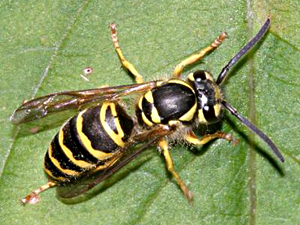

 While working here today, the rain gauge on the roof informed me that today, September first, we have just received twice as much rain as we did during the entire month of August. Far from using this as an (admittedly tempting) opportunity to kvetch about the weather, I'd like to thank you intrepid urban gardeners out there...the ones who planted salvia, chives, lavender, Russian sage, crepe myrtle, augustache, Japanese Pagoda trees, and those few other late-summer bloomers that offer up nectar and life to the bees. And even more, who water them more per acre than any farmer could.
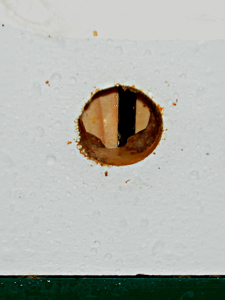
 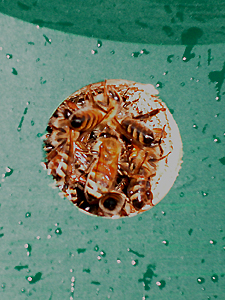 The wind has been whipping fiercely, too (over 30 MPH around 3 PM), so I went up to look at the girls, and this is where today's pictures come from. You may remember that I drilled extra entrance/exit and ventilation holes in many of my hive boxes to spare the girls extra work in coming, going, and cooling the hive. When I went up to peer into the holes on the windward side today, I saw no bees, and could not even arouse a guard bee's interest by sticking in a finger. This was worrying. Checking the wall-ward side of the hive, there were the girls, mighty crowded, too. The wind was affecting them badly, and they were trying to get far from it.
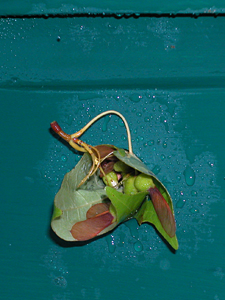
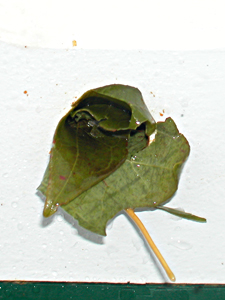 So I searched around the roof to find something with which to temporarily block the holes, and found wind-blown maple and sycamore leaves. The first couple of attempts, using somewhat limp leaves, resulted in near immediate removal. Then some crisper specimens arrived with a blast of rain, and the deed was done. The last picture is the leaf protecting the box with the brood nest.
 One of my major beekeeping shortcomings is taking counts of varroa mites on a regular basis. The reason for this is not laziness (or so I think). There are two main ways to count mites, one is a mite drop onto a board slid beneath a screen bottom board, and the other is a "sugar shake," where you trap a coupla hundred bees in a mason jar with a screened lid, put in a quarter cup or so of confectioners sugar, and shake it out over a bowl of water. The sugar knocks mites off of the bees, and the water makes it easy to count them as they drop. On a board, you just put it in, wait three days, pull it out, count mites, and divide by three.