Sunday, August 27, 2006

Correct Me, I'm Yours!

This might not seem very honeybee-oriented, but in fact it is. The bees have opened up a great wide world of bugs to me, since I spend so much time now poking around in flowers, looking for bees. Sometimes you run into critters you don't know, sometimes the plants you leave for bees cause others to come visit you.

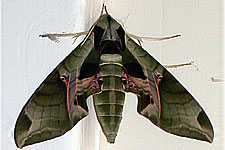
Paonias excaecata I thinkLast year, I posted this picture of a scary-big moth that flew into my house from the garden, and incorrectly called it a "Sphinx Moth," demonstrating my ongoing enthusiasm for, but lack of insight into, our arthropod friends. Well, last month, David M. emailed me with better information, and I thought you might want it, too (though he did not seem to want to receive credit by name).

[A]s to your bee keeping blog page that shows and mentions a visitor to your grape vine,
http://citybees.blogspot.com/2005_07_01_citybees_archive.html

That's not a (Macroglossini) Paonias excaecata, but rather I think is the Pandorus Sphinx, Macroglossini Eumorpha achemon.
http://bugguide.net/node/view/66501/bgpage (You may also find http://bugguide.net/node/view/3936/bgpage of interest.)

Your moth looks very similar to the Macroglossini moth that occurs from England through Hong Kong
and even at times into the Philippines and Australia, Daphnis neri.
http://www.ccs-hk.org/DM/butterfly/Sphingid/Daphnis-nerii.html


Now, of course we talked a bit more, to which he added:

"And, let the vine grow! It's a great food plant for quite a number of moth caterpillars, so you may see some other types munching away. Don't worry though, as you no doubt realize, they can't munch fast enough to damage the vine. 8-)

If you want to get into the swing of things, when you find some caterpillars on the vine, or on other plants you have, you can remove them to a large container with some leaves and observe their development and eventual adult form. Just keep the container clean; i.e. dump the caterpillar's "fras" out every couple of days. If the caterpillar has a small "horn" on the tail end, you might need to put a tissue in the container when it is getting ready to form a pupa, in order to substitute for soil. Some of the Sphinx moth types like to burrow underground before forming their pupa.

Meanwhile, if you find any other interesting bugs, you may look here
http://whatsthatbug.com/sphinx_moth_2.html for identification
or here: http://www.silkmoths.bizland.com/danjansphinx.htm
or here http://rusinsects.com/top/index.php?" for help figuring out what it is.

Have fun! Enjoy some honey!

David


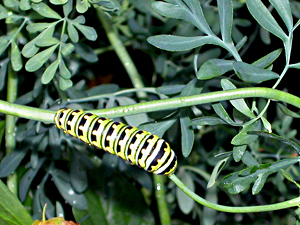
black swallowtail caterpillarNow it's really cool that he mentioned all those identification resources, because only a month or so before, I had met this critter on a rue plant in the front yard. It turns out to be (probably...I am willing to hear other thoughts!) a Black Swallowtail Butterfly caterpillar. As I write to you today, the butterflies are here in force, making their way to winter pastures. There are many monarchs visiting rose of sharon blossoms, and yes, some Black Swallowtails in the front yard. I'm kind of hoping they did some growing up there.

Saturday, August 12, 2006

Nature Loves a Hexagon

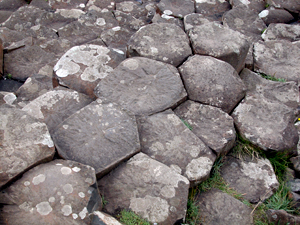
basalt tiles at giants causewayThis grey Saturday morning, Sam and I were advised to get out of Londonderry ahead of the Ulstermen's march, so we went off to the Giant's Causeway, in North Antrim. It's just a short boat ride from Scotland, they say, and the location where some of the retreating Spanish Armada met the rocks. Please witness one of the first things you see when you walk down to the water: a vast expanse of hexagons, almost as regular as honeycomb.

Some say that there is a special place in Hell where people are forced to look at other peoples' vacation photos, but you should not suffer too much because our camera ran out of battery strength early.

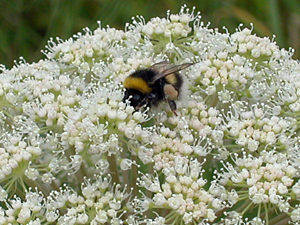
bumblebee on what might be scots lovageThe environment thereabouts is rocky and almost alpine, but there were still several kinds of flowers in bloom, and bees working them. The temperature was only around 16 Celsius, or 60 Fahrenheit, with a steady wind, but the native bees at least were on the job. The bee in this picture is working what might be Scot's Lovage, though I am somewhat unconvinced of this plant identification. This bee is displaying a fine set of cream-colored pollen packs on her back legs, just below the wings.

One interesting thing about bees in cool weather is that, as cold blooded beings, they are slower and less prone to extra activity than they are in hot temps. It's much easier to get a photo on a cold day. Also, in a situation like this, you can actually reach out and pet the bees. I doubt they enjoy it, but they are quite fuzzy and no harm is done by a gentle (and brief) stroke from a finger.

Tuesday, August 08, 2006

Uniting and Departing

In the dizzy rush to depart, the were no pictures today, just news to tell you.

Today, as soon as the girls started to fly, I went upstairs to remove the window screen I placed between the returning Queen Abigail's colony and the workers that were left behind with her daughter queen during the swarm attempt.

Since I really needed these girls to unite firmly before I left — for two weeks there will be no one to intervene if there is a problem! — I tried using plastic window screening to let the scent flow freely between the returning and the remaining hive boxes. The bees will fight each other if you just plop them down together, though some beekeepers do that. Instead, with a temporary barrier present they will get small-but-increasing contact over the hours as they attempt to get at each other, during which time the beekeeper hopes they will decide on acceptance. Because the bees can't chew the screen (like they do with newspaper), however, I could not tell if the two halves of the colony-to-be had contacted each other much over the past 3 days.

You try to get the two brood nests as close together as possible when you unite colonies, in part because that's where most of the bees are and the larvae are really what makes a hive a home. The main clusters in both halves had been somewhat separated because this is absolutely a huge (and disorganized) colony, with brood and honey spread over an astonishing couple of deeps and mediums. They are Carniolans, so they like to form a narrow, tall column of brood nest.

Anyway, the deed is done. I like the tidiness of using the screen, but I will learn (potentially the hard way) whether the bees like it, too, by seeing what is left when I return.

As a final gesture, a beseeching and needy sort of futile effort to appease the bee-ish currents in the world, we went over to the Monastery and gave Joe (the president of the garden guild there) my veil, a hive tool, and some sugar so he could feed the girls over there. They really do look fine, but I will sleep better knowing that someone who cares is watching over them.

Sunday, August 06, 2006

Sucrocide, Then Split... Sort Of

sucrocided beesBack on June 28, we found a bee with a mite on it at the historic mill apiary, which raised an alarm about whether those colonies were seriously afflicted with the vicious varroa mites you have heard so much about here.

The poor mite-bearing worker bee told us, in effect, that we have to treat sooner rather than later. Usually, I'd be waiting until the temperatures began to fall in September, and I would use a treatment that diffused a concentrated essential oil or formic acid (none of which are organophosphate pesticides, or leave toxic residues). However, it's far too hot for that, and we can't afford to wait. It's bad enough that we all could not find a suitable date to work together before this!

Why do I say "we?" MaryEllen has bees there, too, and it's safest to assume that what is living in one hive has also reached out to the neighbors. MaryEllen's presence in this post is important for another reason, too. She and her husband, Doug, used a treatment called "sucrocide" to treat some of their colonies last year, and those colonies registered not one single mite when tested. Not one! So we decided to try sucrocide at the Mill. It's a bit tricky unless you have done it before, so I wanted their help.

The sucrocide treatment meets our standard for keeping poisons out of the hives. It is made up of a tobacco leaf extract and sugar, and it works by drowning the mites, and then disappearing from our lives. It really stuns the bees at first, too, but they are larger and shake it off as they dry. The mites are much smaller, and evaporation comes too late for them. Another bonus: it's really unlikely that the mites will ever develop resistance to this treatment, unless they can evolve beyond a need for oxygen.

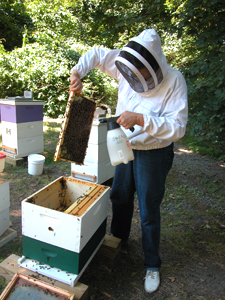
sucrociding beesThe picture up top shows bees recovering from what I am doing in this picture: spraying sucrocide from a pump sprayer onto each side of every single frame in the hive, as well as the sides. We try not to spray Queen Maud or any open brood. By the way, this exercse has to be repeated 3 times, at one week (or so) intervals. Hard work.

The bees cling to my hands in a sort of drunken, but insistent, way. They really hang on, holding my skin with the hooks on the end of their legs that they also use when hanging together to drawn honeycomb. You cannot shake them off easily. It kind of feels like the "pins and needles" effect when you cut off circulation to a foot or hand. I like holding the clingy bees, but it freaks out MaryEllen and Doug. I just thought about how they were very wet and sort of cold, and how my hands were warm and in the sun.

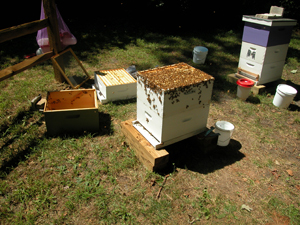
hive of sucrocided beesWhen applying the sucrocide, though, we found ourselves disassembling hives full of bees in hot weather, and reassembling them into hives of sodden bees who just wanted to climb up out of the box to catch some rays and dry off. Kind of a bee-cano, since my colony out there is just brimming with bees, easily a peak sort of population for a hive around here. This picture is actually MaryEllen's colony, though. Those boxes get heavy at midsummer, and they are very heavy to settle down gently, one on top of the other, while trying to gently convince wet bees to move along. Thank goodness we did this together!

Though actually, I will be away for the final treatment. MaryEllen, Doug and I did the first treatment together on July 30, a week ago. MaryEllen and I did it today, and Doug has agreed to complete the process next week, when I go off to a wedding in Ireland (can you believe it?)

I am getting seriously bent out of shape about having to leave on Tuesday. This has been a trend in recent years: I like to travel, but hate to leave home. Adding the bees to my life has not made this easier, but not, perhaps, for the reason you would think. Sure, there is extra preparation before leaving, but I think the real issue is how connected I feel to the pile of dogs, cat, fish, bees, bird feeders, friends, neighbors, plants, and even squirrels about the place. Departing my eco-system for someone else's is good for the mind and for the soul, but it can be kind of hard on the heart.

Thursday, August 03, 2006

A Hot Day and a Low Point

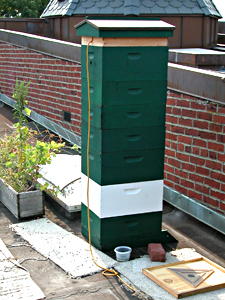
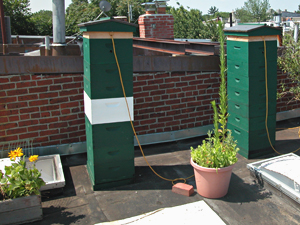
twain is 7 boxes tallThis picture is not, well, picturesque, but it's here to show you what I am up against. Twain spawned a new queen last month, and she is in there somewhere. Abigail, her mother, needs to return from her temporary placement at the Monastery apiary, and one or the other queen has to go.

I just asked Larry, the beekeeping guru who helped me reinforce this colony, if he could use a daughter queen to the one he gave me, and he said yes, so I no longer have to dispatch either queen. They are both young, and should have at least another Spring in them: it would be a pity to kill either one, and unfair, since the only reason this happened at all was that they breed strong, populous families.

I mentioned "having" to dispatch a queen, because today was really, really hard. In the picture, you can see that Twain is 6 boxes deep, with a feeder box on top. You probably can't tell that it is 96+ degrees F out, and that I have absolutely no choice about doing this work today.

Why? I am leaving for two weeks of vacation on Tuesday, and I need to remove the queen in here and let the colony go queenless for at least a day before I bring Abigail back. The gap day allows the young queen's pheromones to dissipate, and makes the bees hungry for another mother's hormonal comforts. Even so, I need to protect the returning queen from the workers on my roof for at least three additional days while Abigail's personal mojo works its wonders.

So I am pulling the new queen on Thursday, letting the hive go queenless on Friday, bringing Abigail back on Saturday, and removing the protective barrier on Tuesday...then I am the one who flies away.

Oh my goodness, it was so very hot up there! By now, my weather station tells me that it got to 107 this afternoon. And the work was so heavy: the top boxes are full of honey, an extracting job for another day (a day, perhaps, in September). In the picture, you can see a little plastic container that I rigged up as a queen cage. It has a piece of comb and some honey in the bottom, and I cut out most of the lid, replacing it with plastic window screen material. This is not a typical queen cage, but it got The New Queen and some attendants safely to Larry's house.

The piece of unfinished woodenware you can see in the picture is a bee escape. I have never used it for its appointed function (someone told me drones can get stuck and die in there), but it is serving here as a stand on which I can balance hive boxes without squashing (many) bees. All of my proper hive stands and telescoping covers are in use! Incredible.

This next part of the story is just hot and whiny. I took that hive apart, box by box, and did not find the queen. It took 45 minutes: sweat was in my eyes, heat stroke was on my mind, and an unattractive Darwinian temptation was getting my attention. Part of me — the part that thinks I am a stupid rank sentimentalist about all this, and that my emotional frothiness does the bees little good — was whispering, "Just put the colonies together, and let nature sort this out."

That would mean letting the bees fight it out, queen against queen, worker against worker... many bees dead in a colony that could actually survive that loss and even more. It would mean that something I thought might happen, a gulf of emotional distance between myself and these beings who add so much to my life, had finally developed (as feared). It would be a sliver of cold in an overheated heart.

So... I went back through the boxes. Spent another twenty minutes. And found her. I also found that she is a good layer, at least for the past week or so, and that Larry might get a pretty decent queen out of this. I tucked her and about 8 workers into the plastic container, reassembled the Twain colony (now pissed off as hell, let me tell you), and got the heck out of there.

After rehydrating, I drove out to Larry's, and he showed me how he gets a queen into a queen cage (clever dude: uses a folded square of nylon window sheers with a hole in the corner: the queen crawls right in!) He also placed the daughter queen in a colony that really needed her, while I was watching. This was extremely comforting, reassurance that I am happiest as a sentimental moron.

He also showed me how his honey harvest was going, and gave me about TWO POUNDS of pure capping wax to turn into soap (as well as two dead ripe tomatoes). This is just wonderful. He wanted to pay me for the queen, but I laughed at him. Instead, I bought a case of plastic honey bears, a few one pound jars, and another deep hive body (unassembled), then gave him a hug.

Sunday, July 30, 2006

The Weather On Top of Our World

davis vantage pro pictureSome of you may not be tickled by my ticker (a little javascript running near the top of this page, featuring the latest weather data from right up on the roof), but for me it is a glorified place where science meets romance. My husband asked me what I wanted for my birthday, and I said, "Either a WeatherStation or for Google Earth to become real time." In both cases, the additional data streams were intended to let me watch over the girls in their rooftop hives, and to pump that data both onto this blog and into an archive.

The weather station totally rocks: It's a Davis Vantage Pro 2 with anemometer (wind), barometer (air pressure), rain collector, thermometer, humidity gauge, and RF wireless transmitter. It is solar powered, with a backup battery for cloudy days. If you live within 1000 feet of me, you can pick up my data, too. Hey, what's confidential about the weather??

There's more to this weather data thing than obsession with what the bees are dealing with today (though there certainly is that). You all know that this seems like a swarm-y year, and that the queens seem to have been superceded more than I thought they would. Earlier this year, I had a theory that early Spring resembled late August, and maybe the girls were being tricked into wrongful behavior by untimely drought and temperature triggers. Well, every theory needs a little data, and that means collecting temperature and precipitation and daylight and all that groovy information.

Please relax: I will not put you through discussions like "Barometric Pressure, Then and Now." But I will, over time, and if my hard drive does not crash, understand just how hot or cold it gets up there, and how rooftop life compares to that of my ground-bound colonies. I'm still kind of hoping to get a comparison of honey yields between the city and suburban sites, but this is not a fair year to do it — some colonies were split, others were just started, and one got mammoth reinforcements.

It will be interesting to see if there ever is a year (or a bee yard) that can be compared fairly to another, or whether I am going to have to learn to see more nuanced patterns.

One thing I can tell you is that this July has been HOT HOT HOT, the third hottest on the weather service records, but the only one from which I have any data at all. If you want to look at a bigger feed than the ticker, take a look at www.tonitoni.org/weather/Current_Vantage_Pro.htm. I have not had time to make it pretty yet. I'll post a monthly archive page when we have been up a whole month!

Friday, July 28, 2006

When Honeybees Go Camp-y

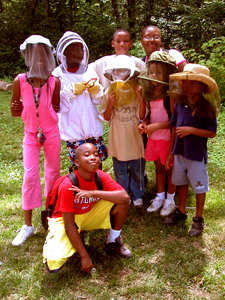
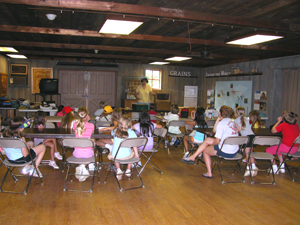
youth garden kids!When MaryEllen and I asked to put bees out at the historic mill site, we were asked (in exchange!) if we would talk about bees to the summer campers and for some general information sessions during the rest of the year. Snickering to ourselves a bit, we said, "Sure!" It's not like public speaking is our favorite task, it's just that every time we do, the people who attend the sessions give us as much as we give them. It has probably been said here before, but the curiousity, enthusiasm, and thoughtfulness which the bees seem to elicit from people really calms some of my worries about the human race.

That being said, this week is a challenge and a half!

The picture above is of the kids who absolutely won my heart today at the US National Arboretum Youth Garden program. The older kids aren't in the picture, but the group ranges in age from about 6 to 16 years. Yikes! The program teaches kids about food and nature by having them help run a vegetable and butterfly garden not far from here. I expected city kids to be especially afraid of bees, because in the absence of farms, most of the hymenopterae around here are yellowjackets, and even I give them a wide berth.

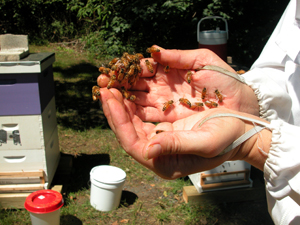
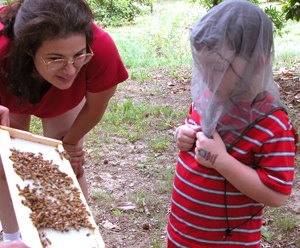
The best thing I did today was to catch a few bees that got out of the observation colony, and hold them in my hands. The bees are really lovely, and the ones that got out were very small young bees, still all fuzzy and not too good at flying. You can state, until you are blue in the face, that the bees are gentle, but there is nothing like sitting there for a half hour with a little girl exploring your fingers to calm and enchant everyone present.

Before long, kids that declared themselves enemies of bees had their faces pressed against the glass, and asked all sorts of questions about how bee families work and how people work with bees. They sniffed beeswax, ate some comb honey, tried on some bee gear and hefted some tools. We took some pictures, and made friends.
The bees in the observation colony came from Abby's crew up at the Monastery. I tried to catch Abigail, but could not find her in the short time I had. I also failed to grab any drones at all! Drat!

When returning the bees, however, I found Queen Abby, marked her (badly), and vowed to try harder tomorrow...because I am doing it all again for a family group then!
camp at the millAll of which follows our best-yet session at the Mill on Wednesday. MaryEllen took this picture of me waving my hands around with my eyes closed. I seriously thought of taking all 4 shots she got of me, and putting them in a little slide show, so you could see me with mouth open, hands all over the place, and eyes half shut! What a charmer!

Even so, the kids were truly with us this time. They were not jumping up and down with questions as before, but they paid attention, ate a bunch of honey, and had fun trying on bee hats before we took them up the hill to see the open hives. There was a group of girls of exactly the same age to sort of stick together, and watch each other for clues (rather than the bees), which made me a little sad. Even so, it's just a matter of time, I think, before their interest and energy gets the better of peer pressure and they come around to the world of wonder again.

As it stands, one of the non-clique-y girls asked me the best "gotcha" question of the day! She said "If honeybees can sting only once, how can an emerging queen sting her competitors and still survive herself?" I was so proud of that kid. (In case you want to know the answer, the Queen's stinger is not barbed like a worker's, and she can sting more than once. She is only stimulated to sting, however, by the presence — probably by the pheromone emissions — of another queen).

Sounds like she was paying attention alright! Those smart kids make my day: there was one little boy at the Arboretum who asked really good questions about the smoker. Count at least two more friends of bees.

Friday, July 21, 2006

A Swarm in July Isn't Worth a Fly

Queen Abogail of ReeceThis past weekend, we went off to a first-ever family reunion. Before leaving, however, there was yet another family to keep united: Twain was on it's way to swarming — again! (This is a picture of Twain's Queen, Abigail, with a bad smear of white paint and her entourage taking care of her!)

Swarm swarm swarm, that's all I've been talking about lately. The frantic goings-on you have heard about here all fall under the category of "swarm control." GOOD beekeepers suffer less panic, and spend less energy on swarm prevention. The difference sounds fiddly to the uninitiated (which, I suppose, includes me, considering all the fun this year). "Swarm prevention" means keeping the girls from ever wanting to leave: give them lots of space, move the boxes around so that the box that just hatched is above the queen (she likes to work up, and likes to find empty honeycomb above her), maybe even make splits to create more colonies if the time of year is right.

But the time is year is no longer right. All beekeeping is local: one reason to learn about it from a local club is that the times when you can get away with various decisions vary based on the onset of winter, and the length of bloom. Here, the old rhyme is definitely on the money:

A swarm in May — is worth a load of hay.
A swarm in June — is worth a silver spoon.
A swarm in July — isn't worth a fly.


You might remember that the Twain colony is the one that swarmed (Bye-bye, Eleanor! Hope you are still out there!) even after it was split this Spring. That swarm basically gutted the hive, requiring me to get reinforcements. Well, reinforcements worked: when re-organizing the hive to make it easier for the girls AND for me (I'm almost 6 feet tall, but the hive rose above chest level!) I found all sorts of swarm cells! Uh oh!

Therefore, last Thursday I grabbed the Nuc box that MaryEllen and Doug gave me, and went up to the roof to seek out Queen Abigail. The idea was to shut off the swarm impulse by removing the old queen (Abby) and some brood and workers, move the latter to the monastery apiary for a brief vacation, and let the Twain bees raise up a new queen. Twain's workers won't swarm once they realize mom is gone, and we should end up with a new queen to give to another beekeeper who needs to re-queen this fall (like most people in our club do).

Did I mention that I was sorting through a 5-plus-foot rooftop hive containing 50,000 bees to look for an unmarked queen on a 95-degree-F day in mid July? And that I was supposed to be packing and paying bills and going to TWO appointments and all those things you find yourself doing to get ready to leave town for an anxiety-inducing first-ever family conclave? Did I mention that??

The first time through the boxes, I found even more queen cells, but no queen. Got stung (and deserved it) a coupla times. I began to panic. Twain was clearly going to take off while I was gone and I was running out of time and I could not find the queen. As I reassembled the brood boxes, I went much more slowly. The lowest box was only capped brood. She would not be there. The next box had some uncapped babies, but everything was several days old. I put a capped frame and a few day old frame in the nuc, and replaced those frames with some drawn comb. Put the uncapped box on the bottom and the capped on top (because they were starting to hatch and would soon offer empty comb).

And so on, until I got to the first honey super. It had just a little bit of drone comb stuck on the bottom bar (meaning that the queen HAD been laying up there, where she is NOT supposed to be), so I looked closer. Hmm. Three day old eggs but no queen. I popped that frame into the nuc. Room for two more frames, one better have a queen on it!

Every frame got a look, every one, but ... No queen in the box! No queen! I set the box aside, and quickly looked through the other honey supers. Nothing. Then something said, look one more time, on a frame near that one with babies. And there she was, covered by her daughters, on the wrong side of a honey frame with some brood comb I had not noticed. At the very last minute, in the nick of time. In she went — nuc filled and ready to go to the monastery!

I swear, my hand felt guided to that frame like it was on rails. If I had not gone back, if I had not looked PRECISELY there, it was all gonna be over. Maybe those girls are finally getting through to me.

But wait, there's MORE!

The first hour of the first morning that we got back (Tuesday), I went back to the monastery (with a metal detector, in part to look for an earring, but that's another story). All weekend, I worried that maybe I had not found the queen, that it was just a big-butted worker. Since the girls needed to be fed sugar water anyway, I decided to check.

So I go through the nuc, and DO NOT FIND THE QUEEN. There are only about 5 thousand bees in there, it should be easy! No queen. There's some annoying bee — not easy to see through a sweaty veil — checking out my foot, but they do that alot. I close up, refill the feeder, and consider what to do.

Meanwhile, that annoying foot bee is on the grass next to my foot. It is acting funny, sort of leaping up, flapping like hell, and not achieving flight. That's weird. Is she hurt? I lean down to investigate. No, she is not hurt. She is the queen!

Queens in the throes of fertility can't fly. Queens about to swarm can (their mean old daughters put them on a crash diet to ensure this). This means that Abby is back to normal, except for the fact that she is about to be squashed by a clueless beekeeper. The first few times I try to catch her, she gets away. She is terrified. Eventually, I run around to the other side of the hive (so so carefully, keeping my eye on her!) and she crawls up on my hand. I lift the hive cover, place her near the passage down, and watch to see if she is welcome. One of her daughters gives her some tongue, Abby lifts her butt and scents like crazy, and down she goes. Phew.


What seems to be happening here, over and over, is that I am building enormous bee populations faster than they are spinning honeycomb to live in. The bees are telling me something about the environment here, and I need to listen. There is lots of pollen out there, and they feel compelled to save it, using up precious comb on the bee equivalent of the junk that clogs your basement. There is enough nectar for the bees to eat, building big families, in part because I feed them. But for some reason, there never seem to be enough young bees (the ones who can best generate wax) and enough nectar (it takes 40 pounds of nectar to make one pound of beeswax) to generate comb quickly.

Also those Carniolan girls aren't the biggest construction workers, anyway. They like to build these narrow, chimney-shaped colonies inside the box, and they don't like to spread out to use the space I give them. They come from a cold place, so they probably like to keep their families in a compact area that is easier to warm.

Next year, when we restart this process with all this year's honeycomb available, maybe it will be easier to stay ahead of the girls. I hope so.

Sunday, July 09, 2006

"No Honey, Please!" ...But Why?

anti-honey sloganFor those of you who seek out local honey, it might be interesting to learn that midsummer is the time when beekeepers look at the colonies they tend, determine how much excess honey is available, and bottle up the liquid gold that flows to teacups and tables around our region. It's a sticky, meticulous job, taking place when the temperatures are highest in part to ensure that the honey flows free-er, and in part to give the bees time to put away additional stores in case the winter ahead is particularly hard.

We are careful with what we take from the bees, and concerned not to take too much. Beekeepers around here like to leave from 50 to 75 pounds of honey on their hives. Last year, I left 100 pounds (I'm a worrier), and ended up with boxes of unused and unwanted (and now crystallized) golden syrup. Well, it's better than starving 100,000 treasured neighbors!

As this year's honey harvest approaches, I've come across some t-shirts being sold by an animal-rights activist that say "Save the Bees, No Honey Please!" which stopped me in my tracks. The two phrases seem to me to be in complete conflict. My main reason for keeping bees is to help them survive the current onslaught of diseases and pests, and every beekeeper I know has as his or her prime objective the health and expansion of those fascinating insect communities. Harvesting honey is mostly a hard and hot job, and necessary to keep the hives open enough for large bee families (and to show our relatives some rationale for this obsessive, demanding hobby)! Most of us local beekeepers lose money on it. I was literally shocked to realize that someone thought that keeping bees was all about honey, and about hurting the bees, to boot! I am generally an animal-rights kind of gal, so I got to wondering what it could possibly mean.

Perhaps the slogan comes from the sad truth that you cannot keep bees without (at least occasionally) killing a few. When a hive is dwindling, often a new queen must be introduced, and the old one dispatched. Sometimes the beekeeper does this just a week or so ahead of the queen's own daughters. Sometimes the beekeeper gets stung, and honeybees die when they sting. Also, at this time of year, when the bee populations in the hives are at their peak, it's very difficult to move parts around (to check for disease, to offer some extra sugar water, or to add more living room) without squashing someone accidentally. But this is not a goal, or even desirable. And re-queening is a process that no beekeeper enjoys — and one that many of us put it off longer than we should.

Perhaps the anti-honey position is based on the idea that animal life should not be dependent on the whims of humans. That's one worry that gets me every time I make a beekeeing error, and one that has even cost me some sleep. But the honeybees can't make it without people just now, even less competent humans, and the truth is that people can't make it without bees, since between 20 and 30 percent of our vegetable crops depend on honeybee pollination. Even more, considering how many days the beekeepers spend chasing around after the schedule set by the bees themselves — working in bee-approved weather, adding hive space when bees need it, offering extra food when weird weather makes nectar collection hard, preventing swarms, buttoning hives down for winter — we sometimes wonder who is in charge. We pay for our pride when we think it is us!

Perhaps a ban on honey is as simple as making a rule and sticking with it: no animal products. Well, in that case, it is more about the human's need for ethical and dietary clarity than it is about saving the honeybees. Our forests used to be full of wild honeybees: now, anywhere in the world where you can even find a forest, the buzzing is largely silent. Those wings won't keep beating unless someone offers the bees a safe home. Clarity and choices are to be respected — they make us who we are — but they do not change the 25,000 year-old beneficial relationship between people and honeybees. And clarity certainly does not save any bees.

One of the things that the bees have taught me is that we live in a world that surrounds us with wonders, not explanations, and I'll take the former if I have to choose. I will also take some honey, thank you, and share it with my human friends in much the same way that I share my caring, hard work, affection, and gratitude with the bees all year long. And for those who see this honey thing differently, I'm willing to just share the wonder.

Friday, June 30, 2006

Surviving June

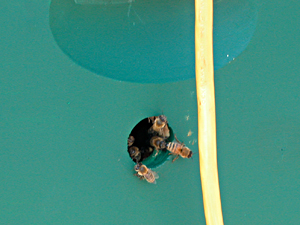
bees in vent holeIf October is the beekeeper's New Year, when everything gets carefully tucked away for the winter respite, June is the month of ultimate hustle and expansion. This picture of the bees busily making their way in and out of the new ventilation holes I am adding to the hive bodies (as time allows!) is pretty much how this month has gone for me, too.

June in this area usually brings the last, big burst of the nectar flow, a yearly orgy of pollen and flower juice. Around here, the big contributors are trees: tulip poplar and black locust are the ones all the beekeepers talk about, but the wide avenues of my fair city are also lined with lindens. The latter are called "basswood" by the old timers, and provide lots of honey that most around here find a bit on the tart side. On the street level, the lavender, Russian sage, and white clover come into their own, providing a follow-on harvest that is supposed to take us into July.

This year, the nectar flow was weird. We had a drought just at bloom time, and that seems to have held down the amount of nectar collected, caused the bees to clog the combs with more pollen than they could use in three years, and (perhaps) triggered a number of supercedures. It looks like the bees blame their queens for their hard times, much like people blame anyone they can, and seek solutions through regicide. Thus I learned that Queen Elizabeth is no more in the Wilde colony. I have not yet gotten around to marking and naming her successor. There's some trouble in this: it really seems like the colony is less active now, and we may have another case of a local girl who could not mate adequately in this low stock of drones.

This month was therefore spent, on the bee front, starting an early program of feeding bees in five hives and three locations. I had a leaky feeder that needed repair, and started taking advantage of a method MaryEllen uses which deploys poultry waterers with sugar syrup inside: no drowned bees at all!

I also spent two separate weeks in New England, helping my cousin disassemble one life and lay the groundwork for a new one. Newfound talent: I'm really good at tossing out stuff, if it belongs to someone else. If you will help me wrangle my bees, I will help you clean your basement. Be warned: I may send you out for beer and chips if you get too sentimental on me! Just close your eyes and think of England, OK?

Appropriately enough, a week of sad necessity was followed by a week of record rain, more than righting the drought deficit of the previous two months. But will it bring more flowers, you know?

too many boxesIf you will take my basement offer, I would be grateful. You see, I really do need some help in rationalizing my roof bees. Do you see these towers here? This is not some banner honey year, with two boxes of bees below and a pile of honey supers above. Oh no. This is the result of mixed woodenware (deeps with honey frames, mediums with brood, ugh!), the addition of a nuc's worth of bees to Twain in mid-June, and the proliferation of pollen-clogged frames in various sizes without always having enough foundation to replace them. At one point this month, I tried to use a hose to blow the pollen clogs out of the drawn comb (in order to re-use the latter — hey, some beekeepers say it works) and NOTHING happened. I have brood spread across four boxes in these hives, honey left here-there-and-everywhere as the bees found space, and pollen generally getting in the way whenever possible.

MaryEllen says she will come over to help me take the hives apart and somehow reduce these colonies to proper size. She says her husband is in the same boat.

There is lots and lots to show you from the month of June, but this post is too long already. Therefore, I'll be cheating a bit and in-filling previous dates with information about all the many goings-on, including the monastery and historical park bees. Every day this month I got up and thought about bees, and then blogs, and as each passed the work to get it all to you seemed more and more monumental. I apologize for those few who have been slogging away with me this long, and hope to make it all worthwhile some how.

Wednesday, June 28, 2006

Summer Camp, Part I

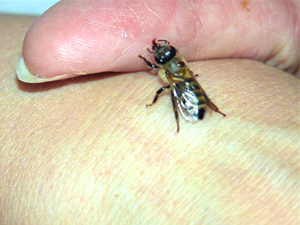
bee with mite taking honeyToday we had our first summer camp presentation, but (in this sad world of ours) pictures of the kids are not allowed. So here is a picture of a bee with a mite that we found today, which means that the time to treat for varroa is already here. This is another item on a growing list. The bee is taking honey from my finger, a picture taken by MaryEllen. I suppose with the clarity of those fingerprints, you could run me through Interpol now.

This has been a busy, busy month, divided across two states and at least 5 states of mind. And every once in a while, a ball gets dropped. This time, MaryEllen and I found out yesterday that our first presentation to a summer camp group of 5-10 year-olds was today!

The folks at the history park participate in a county-wide program of day camps for kids, and when asked about whether we could participate and on what day, we said, "Sure! How would every other Wednesday work?" Little did we know that, ahem, we had just concluded the official scheduling procedure!

One of my main motivations in life, these days, is sharing the joy of bees, and we have been presenting a lot lately, so we thought, "Fine!" There's just one other thing we did not know: because of the torrential rains this week, the swim camp could not swim, so 22 of those kids joined 22 of the history kids for our presentation. That's right, we got 44 5 to 10-year-olds with us in one room for over an hour! Yipes! We were totally out of our league.

First of all, there were lots of questions. It was basically impossible to make a presentation. So I tried to roll with what the kids wanted. At one point, I called on a little boy, maybe 6 years old, and said, "You have had your hand up for a while! Do you have a question?"

To which he answered, "Not so much a question as a comment."

Gulp. Welcome to the well-heeled suburbs of America, where even the kids have media training.

The camp counselors told us that we did OK, though the two barely 20-year-old child herders advised us on how to handle the kids better next time! Others have said that you can't expect kids that age to sit for more than 40 minutes. Ann, who runs the park, says we should have fewer kids next time — in two weeks — and MaryEllen and I may split the group by age and take some out to the hives while some are in getting a presentation in the barn, and then switch places.

We were due to encounter a presentation we could not handle. Thus far, these programs had all gone too-too swimmingly, with us getting a bit too used to winging it. We will be doing three camp presentations in all this summer, plus the odd interpretation if a group is into it. I will be speaking to an urban youth and family gardening group in July, and then there is the county fair in August outside the city.

By the way, the field bee with the mite will continue to live, though probably not as long as she would have. The mite on her back will eventually try to get into a brood cell in order to lay more horror eggs. It's not possible for big clumsy human fingers to pry the mite off her back, and if you look at the photos, you can see that such an operation mite do alot of damage if we even could get a clean grip. Bees don't heal after they become adults (there is no protein in their diets after that) so any wounds are permanent. Pity the poor honeybees, and please root for us as we try to take care of them and help more people who care about bees.

Sunday, June 11, 2006

Budding Bug Fan

trent with beesMake no mistake, I'm as dangerous as a missionary arriving unbidden at your door. I insist that it is in your best interest to like bees, and am willing to speak to you earnestly for hours to win you to my cause. So imagine my delight when my sister offers me her first-born son!

Well, what really happened is this: somewhere, somehow, some day care provider talked about bees. Probably, it was an attempt to get the kids ready for the sting season. But my nephew knew that I had bees, and got a bit curious about visiting them. So we all went over to the monastery to make introductions (kids don't get to go to my rooftop apiary until they are ten years old: at that point, I figure they won't run off the edge. Tune in again in a few years when I change it to 18).

If you click on the picture above, you will get a Quicktime movie of Trent visiting the bees. Note the awesomeness of his mother: I'm wearing a veil, Trent is wearing a veil, but *MOM* is leaning right over the frame with that lovely black hair uncovered, and is happy as can be! Rock on, Alicia! Buzz on, bees!

Thursday, June 08, 2006

Parade of Bees

On Wednesday, MaryEllen and I checked the colonies out at the historical park, and my hive (the one with the incredible brood pattern) had a bunch of swarm cells, including one that was nearly capped. Emergency!

This has been a very swarmy and supercedure-driven year. I lost a swarm from the Twain colony sometime in early May (or so I figure, I was not there when it happened, sigh) and the Wilde colony superceded sometime after.

Therefore, this was a serious business, and one we were utterly unprepared for on Wednesday. When you find a swarm queen cell, it means that the bees have been preparing to split their family in two for at least a week or two. This should be a success story — "A family so successful it can become two families!! — but a swarm gone wild almost certainly won't survive in these parts, and the weakened bees it leaves behind (with a new and unproved queen) faces real challenges, too.

The idea that the bees are preparing to swarm even before they build the swarm cells was new to me. It turns out that they are really mean to the queen, holding back on her food and reducing her egg laying, in order to slim her down and make it possible for her to fly off with them. A working queen is so portly that her wing beats are unequal to the task of lifting her butt. Apparently her daughters also push her and bite her to get her out the door! So you see, there is a large, organized, many-hundreds-of-bees-strong effort underway by the time a beekeeper sees swarm cells, and cutting out the cells is not guaranteed to stop it. In fact, it might result in a swarm taking off with NO new queen left behind. A recipe for colony death!

With no tools and no plan in hand for dealing with this on Wednesday, I did what I usually do: I called my bee guru, Larry. He tsk-tsked a little, and then offered the idea of "a shook swarm." Basically, you get the bees to skip swarming by convincing them that they already did. At the same time, you add space and checkerboard the frames, so the colony is a more spacious place. I also decided (being a glutton for punishment) to drill additional ventilation holes in the hive bodies as I moved frames around. This also seemed like it would materially change the inside landscape, would give me something to do while letting the bees cool their heels (if they have heels) outside, and would provide more entries to relieve congestion.

Larry told me to do this:

1) Find the queen, and put the frame with the queen aside in a safe place;
2) Take any frames with queen cells, and put in a box to raise elsewhere;
3) Place the telescoping hive cover in front of the hive, and provide a ramp back toward the entrance (I used a bottom board insert);
4) Shake (gently) at least half of the bees from the hive onto the hive cover;
5) Carefully carefully carefully shake the queen off her frame onto the cover, too;
6) Let bees mill around a bit;
7) Gently get queen headed up ramp, back to entrance;
8) Watch bee parade as thousands of workers follow her back; and
9) Close up hive, hope for best, check back in a few days.

Now, MaryEllen and I thought we could get this done in the morning, BEFORE a group of AmeriCorps volunteers was scheduled to stop by for a bee presentation. Instead, we were up to our knees in bees when they arrived, and were followed shortly by ladies from the garden guild. Yikes!

But the good thing was, we were so busy doing what we had to do, that there was not time to be nervous. Also, the goings-on were so interesting that there were LOTS of questions, and the volunteers (all young people around 20 years old, I think) got very excited about bees. Maybe we made some beekeepers!

Unfortunately, we were so busy that we got no pictures. Some of the AmeriCorps kids had cameras, and I asked them to send anything they got. I will add it here if any come.

It was a very stately parade up that ramp, you know, and I wish so much that you could see it.

Of course, now I have a (borrowed) nuc box with a frame of queen cells and a couple of other random frames in it. I planned on bringing the queen cell over to a fellow beekeeper in the club, a woman new this year, but when I got to her house, I discovered that her bees had superceded successfully, and she had a brand new laying queen. Therefore I have parked the cute purple nuc on my porch, and am awaiting some kind of plan. Will let you know.

Finally, the folks at the historic park have a newsletter for volunteers, and it was my turn to do the bee update, so what follows is my account of the events!


The Cockrill Colony Gets a Name and Entertains Americorps Volunteers

Both colonies of honeybees at the mill have names! MaryEllen Kirkpatrick's colony is named after the Millards, who once operated the mill. Her queen bee is named Emma, after Mrs. Millard. After a bit of research, Toni Burnham named the other colony "Cockrill," after the former proprietors of the general store. The second colony's queen bee is named "Maud," after Mrs. Cockrill.

Colonies are basically the communities of bees that live in the hive boxes you can see up on the hill. If the beekeeper is good, colonies live on year to year. The queen within the colony changes over time, though, so beekeepers have to keep track of who is who in which community, and give their queens separate names as a result. MaryEllen and Toni had discussed naming queen bees in honor of staff members or volunteers at Colvin Mill, but since queens tend to replace each other (or be replaced) every year, we thought that seemed a bit unfriendly.

In the midst of all this naming, there was a bee adventure on June 8! The beekeepers discovered that the Cockrill colony was preparing to swarm, and had to take action to fool the bees into believing they already had and should just settle down. Swarming is a confusing phenomenon to non-beekeepers: it should be a success story, because one colony grows large enough to spin off another. However, at this time of year and with the state of the pests in our environment, such new colonies won't survive long. So we try to keep them alive through tricks and hard work.

A group of Americorps volunteers stopped by to see MaryEllen and Toni shake out thousands of bees in front of the Cockrill hive in order to convince them that they were on a swarming trip. While the bees were getting their bearings outside, we shuffled up the hive's insides and added space, all just to fool the bees. We took special care to make sure that Queen Maud was sent out, safely, and the Americorps volunteers were treated to a "bee parade" when she began her stately march back up the ramp into the hive, followed by thousands of her daughters.

MaryEllen and Toni are always happy to have visitors when they are working the bees, and bring extra veils so you can come close and see. If you spot us up there, please stop by and say hi!
Monday, June 05, 2006

The New Twain Crew Comes Home

While in New Hampshire, I finally finished reading A Book of Bees, which gave me both inspiration to keep ploughing ahead with this blog and some advice about how to unite the new bees with the existing colony in the Twain hive.
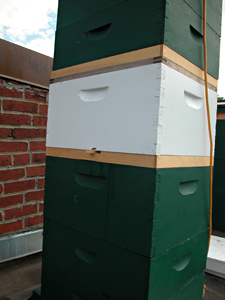
Apparently, book learning is not what it is cracked up to be (yet again), because Larry got really worried when I told him what I intended to do with the bees he entrusted to my care yesterday. I was going to place them at the bottom of Twain, with some newspaper for the girls to chew through to delay contact and get them used to each other before the fact. Larry said it was not a great idea to put new bees below old. He even called me at home to reiterate this point! Therefore, I set the hive up the way you see it at left.
I placed the new nuc colony (the white box) above the old brood area, separated by a double screen board. The latter will allow the new queen's pheromone's to waft down on her new subjects, without allowing them to actually come up and chew on her or her daughters. Larry seemed unhappy with the double screen board idea, but I did not explore this with him.

Putting the new nuc there left me with a bit of a problem: what to do with the two medium boxes full of honey and comb and MORE bees from the old Twain crew? I'm terrified of wax moths (they turned up once already) and have no safe place to store it, even besides the problem with removing the bees. Therefore, I left an upper entrance/exit but placed two reversed bee escapes between the nuc and the supers. If this all seems too complicated, well it is, but it is what I did.

Finally, the part I have been avoiding. Before all this rearranging and stacking and screening and so on, I had to go through Twain to find Abigail. Her reign was so short, but I had to end it. I found her near the bottom, after looking through 20 frames (of course): she was a completely black queen, it's hard to believe her mother was Italian! It took me three tries to grab her, and when I finally had her in my fingers, I could not bear to squish her. My other hand was occupied with holding a frame, so I set her down in a nearby planter, intending to get back to the sad task. But a few seconds later I could no longer find her!

She had scurried off into a crack or under a leaf or maybe even (shudder) somehow back into a hive box! So much for a "known quantity!" And also so much for kindness: in the best scenario here (for the majority of the bees, that is, not Abigail herself), she will starve or die of thirst, unable to care for herself in a strange place. I did not live up to my responsibility with my over-nice ideas of how to dispatch a failed queen.

I've looked for her three times in the past 24 hours, feeling like an angel of death and a would-be ender of pain. No luck, not for either of us.

But each visit has also meant seeing Twain gain activity, energy and life. I think Larry and David gave me extra bees, folks! I am not kidding: I think I have almost enough to winter over in that box. It kind of explains why Larry kept encouraging me to get going on uniting the box, and was so specific on how to do it. There probably is not much room in there.

I plan on letting the girls share pheromones until Thursday, then let them get together.

Wednesday, May 31, 2006

Bringing In Reinforcements

I'm in New Hampshire, helping my cousin to pack up one life and start another (the skillset required: I'm ruthless at filling dumpsters with other people's stuff). Because I am far from the bees, I do not have a picture for you, but I do have news!

It is far easier to advise others to toss away the parts of their lives in which they have invested than it is to take that advice yourself. Therefore, when MaryEllen emailed me yesterday to say that the master beekeepers who let me work with them a couple of weeks ago had bees for sale... well, I just decided to bring in reinforcements for Twain.

I've been telling myself that sometimes nature requires you to take a loss, and that you can pile damage on damage by trying to hold back the truth. But these guys breed awesome bees, and if I let Twain go, I could lose all the drawn comb and honey that the girls had managed to set aside so far. So I asked MaryEllen if she could help me, even though I am several hundred miles away.

Over the phone, I have been coaching my husband on which frames and boxes and covers and bottom boards and so on he needs to bring to work, where MaryEllen will pick them up, and bring them to the beeyard out where Larry and David are. This coaching involved him running around on a nighttime roof with a cell phone, describing various bits of woodenware in the dim light.

During another phone call seeking advice and setting up the purchase, Larry said that he will give me five deep frames of Carniolans and five deep frames of drawn comb. He'll put it all in my deep, watch it for a few days, and I can come get it this weekend, when I return.

After talking on the phone with Larry a bit, he and I decided on getting a new queen, too. Twain's home grown Queen, who I kind of don't want to call Abigail anymore, just does not seem able to perform. There aren't many drones in my neighborhood, so she might not have had a chance to mate properly...or it might be congestion in the hive, or it might be a temporary fluke of hive geography, or it might be something else. I need a known quantity, however, in order to understand what the girls need, so I just signed up to kill yet another queen. Ugh.

So let's say a word in honor and in sadness over the renewal of life, what it costs and how we somehow face the risks of making changes and going for greater vitality and a brighter future. It's wrong to think you can do it without cost, or that "going for the glory" is always the thing to do.

Monday, May 29, 2006

Monastery Check Up

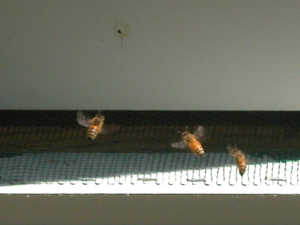
bees flying homeToday was a monastery bees checkup day. The colonies there have been displaying what seems to be a law of beekeeping: where one colony flourishes, another must hang back. I was wondering whether the MaryEllen and Doug colonies needed more room to expand —another medium deep, or whether there might be a problem with Doug. When I called to say I would be coming by today, I found out that additional members of the Monastery Garden Guild really wanted to participate in bee management. The picture above shows bees heading home to MaryEllen.
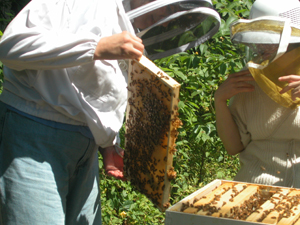
I need to confess to you: having bees in three locations is very different from having all of the girls just up one flight of stairs, where I can hover and dote. It has changed the score alot, and it worries me a bit. Somehow I'm less connected to the "outyard" bees. Finally, perhaps, I'm being nudged toward a less personal and a more "herd health" attitude toward the girls, and I don't like it one bit. But each of these other colonies is more accessible to other people, and they get me in direct contact with folks who might actually decide to foster bees themselves.

Alexandra assistsBut bee-ing in these other places has gotten many more people involved, and several have become true friends of bees. Alexandra here is an officer of the Garden Guild, and she spent the better part of an hour with me today, head down in a beehive or two. Here we are checking the brood situation in MaryEllen. It is good! The Doug colony also has brood, though not quite so much, and they take less sugar syrup. The population is just building faster in MaryEllen, so they got another box today.
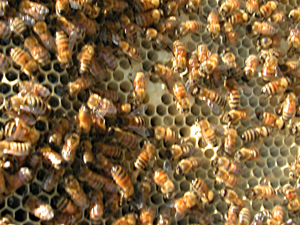
This difference in energy level has been true since the start: MaryEllen's workers released their queen faster than Doug's; they have added bees and taken sugar syrup more quickly, too. The starter bees in that colony came from Wilde. The bees in Doug came from Twain, which has seemed to have endless trouble ever since.

The original bees in both these colonies are long gone, so the tendencies they display should come from their respective queens. Yet, this is not true: the trends that were in place at the beginning still prevail now. Yet another place where the bees are recognizing and responding to the world in a way that leaves humans guessing.

Wednesday, May 24, 2006

Abby is Fertile, but Liz is On Fire

a few capped worker brood cellsToday was a big check up day, a time to answer the questions:
1) Is Abigail, the new Queen of Twain, properly mated and able to provide a new generation or worker bees?
2) Are there enough bees in Twain to keep the hive alive, and are any problems caused by weakness beginning to emerge?
3) Should I consider taking brood from Wilde to support Twain through all this?

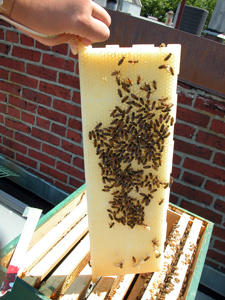
The picture above pretty much captures the state of affairs. The good news is that Abigail is laying fertilized eggs. The few capped cells you see here contain developing female bees, honeybees who will eventually be capable of performing the work that makes a hive go round (actually, that makes a hive go "buzzzz"). Some queens don't mate well, or have some other problem, and lay only male drones. The latter cannot sustain a hive.

a few capped worker brood cellsThe bad news is, after finding just one frame with a few dozen capped brood (and maybe a couple of hundred more larvae besides) there was no evidence of any other brood in the hive. It's just not enough bees. Because there was so little empty comb for Abby to work with, I put some permacomb (the picture here) in, too, but the bees are ignoring it. I was warned about that: apparently, if there is any alternative at all to plastic, they will ignore the artificial stuff.
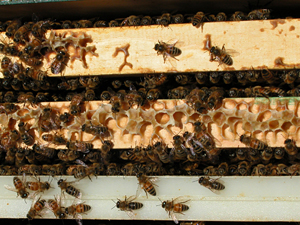
beeswax bridge above brood nestI continued on through the hive, looking for more brood and cleaning up the extra comb on the tops and bottoms of the frames — it seems to be everywhere this year, and it kills bees by pinching them when you move frames around. Therefore you scrape tops and bottoms (and save the beeswax) even if the girls are gonna build it up again. You can see that it's necessary to go slowly and carefully, because the bees basically don't get out of the way. I usually spend a few minutes freeing bees with stuck legs from the beeswax pile at the end of each session.
The next box below contained only honey, so I reversed it. That means that the box with the little bit of brood was switched with the lower honey box, and the latter was moved up and out of the way (it's just an obstacle to the bees at this point — there is no work to do in a capped honey super).

Also weird: I found a capped queen cell in the bottom box, in a supercedure position, but it was really small, and could have been left over from when the newspaper was still blocking the hive. Or the colony let Abigail lay a little, and they plan to supercede here...again. This is very bad. This hive will probably dwindle away to nothing if the bees somehow get the impression that the ongoing weakness is always the current queen's fault.

I wanted to be a smart, super-tough beekeeper and be able to make decisions like "Let Twain go, everyone loses a colony now and then," but I decided instead to gauge the strength of the neighbors, and see if I could let them lend a hand the next time I come by.

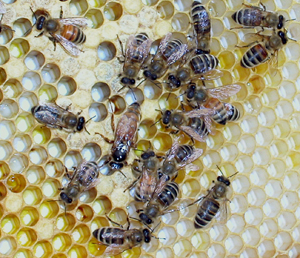
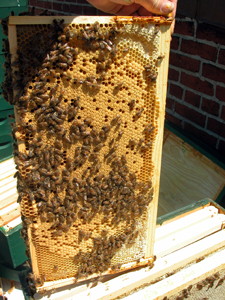
beautiful pattern of capped worker bee broodSo into Wilde, Queen Liz' kingdom, I go, and this, my friends, is what I am talking about! We still don't look like we will have a good honey year (Editor's note: So what?), but this, oh patient ones, is a deep frame full of capped worker honeybees! Do you see all those filled-in cells, with just a few empties interspersed? That, dear hearts, is a beautiful brood pattern from a happening queen. There were two frames in a row just like that, thousands and thousands of bees on the way. Another round of life, coming up!
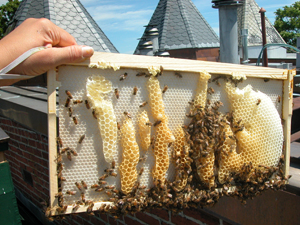
strangely drawn combSince I am in the mood to show you pictures, here is a final one: after several frames of nicely stored honey and capped brood, you encounter this one. It's like touring the Old Masters wing of a stodgy art museum and suddenly encountering Christo. You are supposed to cull this kind of frame, scrape it down, and put it back for proper rebuilding (not at all unlike a Christo installation). I didn't. Not this time. Soon enough, though.
Right now, even though it's the dumb decision, I'm leaning toward moving a couple of frames of brood from Wilde to Twain, a kind of repayment for all the support that went the other way last year. The tough-minded reason for it is that all the drawn comb in Twain may get ruined if a lively colony of bees is not in there. The soft-hearted reason is that Twain suffered from my poor management — probably some swarming, some inept queen management, and the legacy of last winter's mite mayhem. In short, why start making sense now?

Sunday, May 21, 2006

Chewing Through

honeybee chew marksToday was newspaper removal day, time to take a chance on letting Queen Abigail mix freely with her new foster daughters.
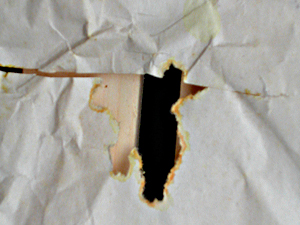
Here's a very reassuring picture: the worker bees had already chewed through to mommy. If you look at the picture, you can see how the slit in the paper looked when I placed it in the hive, and above you can see how the worker girls (in a space between frames) got to work on chewing the paper to make a passage.

Bees' mouths don't have any sharp or bite-like parts. Therefore, it's really dumb to talk about getting bitten by a bee. They do, however, have everything necessary for grabbing an edge and chewing. They need to do the latter all the time in order to shape wax flakes into lovely geometric comb.

The workers had made several holes like this, but this one included some of the original cut, so you could see the extent of their work. I particularly like the little yellow stains around the edges, yellow like pollen, liquid like nectar. Basically, bee spit. Bet it's a lot nicer than ours.

Thursday, May 18, 2006

Abigail is Laying

newsprint dividing hiveThis past week has not been a good one. I have felt out of sorts and worried, all because this does not seem like last Spring, where triumphant life exploded out of two screened boxes full of bees. This is a lower energy year, with mite problems and queen problems and an odd nectar flow, and I am still waiting for that burst of exultation that took me so totally by surprise twelve months ago.

It has been six days since the box with young Queen Abigail was placed over the Twain colony, with that sheet of newsprint you see here dividing the new monarch from her foster daughters. For the first three days, nothing happened: looking in quickly, no bees had chewed around the slits I cut in the paper (or even started), and no eggs were present in the Queen's box. The workers were just hanging around, with little flying in or out. Acting queenless.

So I removed two relatively bee-less honey supers off the hive, moved the newspaper sheet down — so the new queen would be directly over the core population of remaining workers — replaced the Queen's box and then the honey supers, and closed the hive up. I was hoping that, by placing her closer, the Eau de Abigail pheromones would be stronger and might get the workers organized. I closed the bottom board, too, to boost concentrations. And I decided to wait three more days before interfering again.

Gets you wondering: exactly which Queen died last week? The imported one or the home-grown princess? If the virgin queen was triumphant, there would be a delay in her laying. And a delay we had. A virgin would have hung around a few days, taken a mating flight, and then started to lay. I have no explanation for why a mated queen would wait. So perhaps Eleanor's genes live on, and the outsider queen died. This does not make me feel better, somehow.

Today was the day to check again (even though I had no plan if I discovered the worst). Inside, there were a few new chew holes in the paper, and new eggs on one frame of comb. Nice laying pattern, too! The bees had filled up most of the rest of the nearby drawn comb with nectar and pollen, so I put a frame of permacomb nearby to give some space for more eggs. Hope that was a good idea!

This means that I need to watch for a few things, and should anticipate a couple of options. First, sometime in about 3-4 days I need to see how those new eggs are capped. If they are all big-domed drone larvae, I have a problem. You see, when you let a virgin queen be raised and mated naturally, she may not mate well or very many times (she may not even survive her flight). She needs to mate anywhere from a couple to a dozen times to get enough sperm to lay her 250,000 lifetime eggs. A queen who has not mated (or mated enough) lays drones.

For the past few days, I have been counting in my head all the known beehives within a three mile radius, and figure where there might be overlaps that promote a Drone Congregating Area (DCA). This is no joke: drone bees hang out together like youths at the gas station/convenience market in a small town. They are sexually mature, have nothing else to do, are anxious to mate, and are hanging out in mobs to identify likely females.

If those eggs turn out to be drone larvae, the Queen is a bust and I get to play executioner again. I would probably wait another week, though, on the off chance that she just got a weird start. If she is a bust, I can either buy another queen, or introduce some really new eggs from the Wilde colony, and let Twain try to raise their own again. Or I can close up shop in that hive for a year, and start over next year. I will probably try to find another queen (and give them some eggs besides).

If those eggs turn out to be worker larvae, however, I'm opening some champagne. I will probably give Twain a frame of Wilde's larvae (to help with the dwindling they have experienced) and feed them like the Dickens all summer long, since they will have missed out on the nectar flow. The colony that was gangbusters last year will be the dependent one this year.

But this story does not have an ending yet, and every time there is an ending some question arises to draw uncertainty and suspense along, like an insect serial drama.

If I do get to pop that cork, my first toast will be to bee years that are good for all one's buzzing communities, and that 2007 will be one of those.

Friday, May 12, 2006

Eleanor is Dead

Queen Eleanor was not laying, and was moving very slowly around her new domain, so I dispatched her today. She was born in Georgia, shipped to one midAtlantic state, lived in another, and died in a third. It was time to stop subjecting her to the whims of humans, and to let her return to nature.

She was buried with a buttercup and the hope that I gave her no more pain.

Today, it no longer seems so sure that her daughter was the queen who died, but it is certain that the Twain colony was reunited today, with a single queen. The nuclear colony was placed on top of the main colony, with a sheet of newsprint paper between (sliced in a few places to allow bees to start chewing through).

Mother's Day weekend here has seen a transition of generations among the bees, with mothers gone by and mothers-to-bee.

Over time, as little as a couple of days, the bees will become bewitched with the aroma of a young new queen wafting through the paper (a perfume for which they have probably been yearning for days) and will forget about the old monarch. But I won't.