City Bees: Urban Honey is Twice as Sweet
By [Me]
When people think of honeybees, they usually summon up images of orchards and farm fields, old farmers in straw hats, and buzzy country afternoons. Would you be surprised to learn that highly prized honey is produced above Manhattan apartment buildings, on the roof of the Paris Opera, by London artists in a flat overlooking Tower Bridge, and right here around town homes and condos inside [deleted]?
Urban honey may seem like a contradiction in terms, but there are many ways in which the diversity and the energy of our densely-packed communities can offer a wonderful home for bees. Bees demand little space, and managing them is a matter of learning relatively simple basics … and then holding on for a lifetime of learning.
Bees in the city have access to more types of plants over a more extended growing season, and having happy honeybees around can add bloom to your cherry or pear tree (and fruit to your harvest basket). The honey produced by urban bees is also highly prized, featuring a wider variety of hard-to-find floral flavors. Honey produced by the London Beekeeper's Association is actually very difficult to get in Britain for this reason!
Much of the honey produced for sale in this country features a single crop name on the label: clover, orange blossom, peach or apple, for example. This is possible because in most farming areas a hive can be placed within acres and acres of a single crop. This is good for the crop, good for the farmer, and not bad for the honey consumer, either. It's also the logical result of the main contribution of honeybees: pollination of the food crops upon which we all depend, crops that are usually produced in large agricultural operations.
A bee in the city does emerge from the hive each morning to find itself surrounded by fields and fields of a single type of flower, however. They have farther to fly. But on the plus side, the urban honeybee is surrounded by gardens, window boxes, parks, and public plantings with a rotating variety of nectar-producing delights. Like the variety of people who live in a thriving community, there are more kinds of green living things crammed into more unusual places, each doing their own individual thing, contributing to the tapestry of life around us.
The bees often get a longer blooming season in the city, and the honey gets a complex pedigree. For simplicity's sake, it's usually labeled "wildflower," and I tell my friends that it means that the beekeeper has no idea where it comes from. This, however, is only partly true.
In our area, beekeepers often mention the slogan, "Take a Bee to Lunch: Plant a Flower," but if you want to feed the whole hive, plant a tree! In [our community] and all over the [metropolitan] area, our lovely tree-lined streets are a million-mile smorgasbord for bees, and when each neighborhood tree flowers, you can see the nectar change within the hive.
For instance, when the holly tree in my neighbor's yard bloomed this Spring, my two rooftop hives were suddenly filled with combs full of crystal clear nectar that smelled like those heavenly (but hard to spot) holly flowers. Come May, however, the Tulip Poplar blooms, and its honey fills the colony with thousands of cells of a darker, delicious gold.
Finally, urban beekeeping has given me a tie back to nature that has changed my world. Walking down the street means a wall to wall survey of what is in bloom, how the weather has been trending, and who is working in each blossom. Looking for honeybees, I've become enamored of native bumblebees and spent my first real time with butterflies in 30 years.
And all this is just the beekeeper's share of the benefit! You may have heard that honeybees are under siege, and this is true. Pests like the varroa mite have killed thousands of colonies of bees since they first arrived 20 or so years ago, and the number of honeybees in the United States has been in steady decline ever since. Many beekeepers have retired, and the large commercial operations that facilitated the mites' spread represent a larger and larger proportion of what remains.
But the good news is that beekeeping is beginning to appeal to a new generation of hobbyists who keep only a few hives, a population that can be closely watched and carefully maintained. The hobbyist beekeeper, spread in small numbers across all kinds of communities, offers a reserve of preservation, pollination, and environmental health that benefits us all. That's news that goes down well with a teaspoon of honey.
If you are interested in becoming a beekeeper, you can contact one of several local beekeeping associations, and take a free "short course" early next Spring. I'm a member of the [Deleted] Beekeepers, www.[deleted]beekeepers.com, but we'd be pleased to direct you to the club nearest you. You can also contact me via my beekeeping blog at citybees.blogspot.com.
Friday, October 28, 2005
Beevangelism Revisited
A local food coop has invited me to contribute a beekeeping article to their newsletter, maybe even a recurring column. So, bee-brained as I am, it seemed impossible to resist. Your comments are also welcome. Here's what I wrote, and I will let you know how it was received:


Tuesday, October 25, 2005
Mighty Mite-y
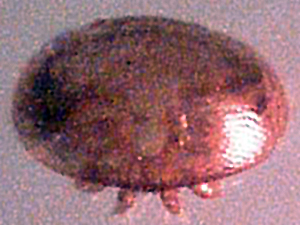 You non-beekeepers out there probably get bored out of your minds by my constant discussions of the ways of mites and men, but perhaps this picture might make the point. The nightmarish bug above, which looks like a hairy-legged lentil at 60 times magnification, is actually a varroa mite — a critter that lives to for two purposes: to suck the life out of developing bees, and then make more of itself. It's not much more than a grasping mouth and reproductive system with a poorly thought out transportation arrangement.
 This is the bug, actually an arachnid, that you heard about on the news, or NPR or the paper. It killed about 60% of the honeybees in California last winter, and is the reason why feral honeybees (ones that don't have beekeepers) basically exist no longer in this country. The current rumor is that it jumped to honeybees from some other host bee by travelling to this country in a bouquet of cut flowers. Folks around here like to blame Florida, saying it's the most probable point of entry (since so many other invasive critters and plants got in that way), but it must be said that there is now almost nowhere in the world without the nasty varroa mite.
This is the reason why many beekeepers gave up the hobby in the past 15-20 years: it is a hard and heartbreaking fight. The medications can be rude, over not-very-much time drug resistance grows, and then you need to use something else. Me, I am using an approach that only just got approved in all the surrounding states, and it is less toxic but much more work. And on Sunday, when weather and the instructions and my conscience dictated I had to go in, round two of the anti-varroa labor took place.
My order of operations, for both colonies, was:
- Attempt to block view from nosy neighbors by deploying deck umbrella on its side (as if I was trying to dry it out);
- Open hive top, check on syrup consumption in feeder;
- Remove feeder and 2-3 supers of honey, cover with cloths to prevent robbing. Give a quick look to see if stores were still adequate;
- Once down to the brood level, pick out and set aside the first packets of ApiLife VAR. Take new packets out of baggy, and set in four corners above brood;
- Reassemble; and
- In an unplanned brain wave, check out the contents of the bottom boards below the hives.
The good thing is that I got lots of pictures this time (and you can see them via the link at right). The bad thing is that my wifty hopes that maybe I did not actually have an infestation got kicked around by the evidence of mite death you can see already. That's how I got the picture above: fishing dead mites from beneath the colonies (in this case, from Wilde).
This is yet another occasion where, being a beginner, I am not totally sure what I am seeing, and it will be hard to look up some kind of reliable reference point for comparison. You usually estimate your mite count by conducting a special test of mite drop over a few days onto a clean surface, or by doing something called a "sugar roll." I used the bottom board test, but knew I would treat anyway because my bees are under stress and I am error prone. It just seemed safer.
Sunday's information would not constitute much of a mite population count. Happening upon dead mites — over an indeterminate amount of time, on a cluttered work surface, after getting partway through a cycle of treatment — won't tell you many specifics...but you will know that they were there.
Therefore I am glad to be going through the bother of putting together meds, taking apart colonies, and fussing over the girls. I checked to see if they had slurped up their 2:1 syrup with the Nosema meds (yes), whether there was an evidence of robbing (no), and what seemed to be occupying them most (bringing in pollen). The bees were not aggressive at all, but I still kept my gloves on because I had to handle meds.
Today, when I went up on the roof (in the 53 degree F rain) the girls were all inside, no bees flying at all. Originally, I'd hoped to do the work today, and to have my friend Kim and her mom stop by to both help and get a look (there is some chance that I'd get a beevangelical convert out of this, I thought). Looking at the weather, next Monday would be my best timed shot, if the temp is high and the sky is dry.
Saturday, October 15, 2005
Medication Day
There's a bit of hesitation as I write this, mostly because a lot of beekeepers out there would just throw up their hands, saying it is too late for me to be trying to do some of these end of season tasks...but I think I disagree. I also think I must play the hand that nature has dealt, so here we are.
 Beekeepers often refer to September 1st as the "Beekeeper New Year," a time to start putting the bees to bed for this year, and to make preparations for next. These tasks include checking to see whether the hives seem to have stored adequate honey for the winter – around here that means at least 60, and as much as 90 pounds – placing menthol to drive away tracheal mites, deciding upon and executing a treatment for varroa mites (those are the ones you might have heard about on the news), and pouring in sugar syrup that contains a medication for Nosema, a digestive tract disease that sort of gnaws away at the health and productivity of a colony.
The Nosema medication is an antibiotic, Fumidil-B. I am somewhat unhappy about this, not much wanting to get involved in chemicals and so on whether in the garden, the dog, or the husband. The disease that requires the med itself is an outgrowth of the stress that bees endure in the winter: they do not defecate at temps below 50 degrees, and the stress of holding waste can promote digestive disease. Fumidil targets a microbe (I think) that loves being in a crowded bee gut. It's a powder that you mix with a couple of gallons of 2 parts sugar to one part water (a heavy mixture). I planned on finishing each hive visit with a feeder fill-up with this stuff.
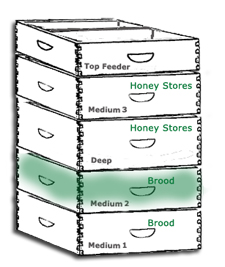
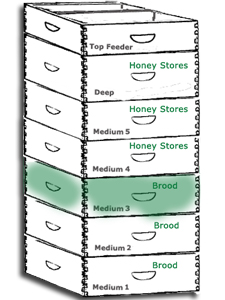 The menthol all went in in mid-September, just before I found out that it was potentially OK to skip it. I chose ApiLifeVAR as my varroa treatment, mostly because it is not an antibiotic per se but a concentration of essential oils (thyme, eucalyptus, menthol). It's organic and non-polluting. The varroa treatment comes in wafers that must not touch bare skin, and which needed to be enclosed in little screen envelopes to keep the bees out of direct contact, too. So I had a bit of homework to do before placing it. And putting it in the hives would be a chore in itself: you can see from the green areas in the illustrations where the wafres need to go, directly above the brood nest. The first, and smaller, colony is Wilde, my girls who have struggled along this year. The second illustration is much-larger Twain, rampantly healthy and tending to rapacious behavior.
I went into Wilde first, thinking to start with the lesser weight and work, and move up to the bigger boxes on Twain. I was happily surprised to find an entire capped deep of honey on Wilde: this means I do not need to transfer resources from the other colony over! Hurrah! It also means I could have extracted honey for real this year, but what the hell.
The work in Wilde took less than 20 minutes, I think. The girls were quite pacific, and that technique (learned from MaryEllen) of throwing a cloth over each box as it was moved off the hive really seems to help. I burrowed down to the brood nest, placed the little screened packets, and reassembled. When I put the feeder back on top, bees crowded around my hands and the bucket, tongues stuck out, no mean buzzing. (There are different tones and behaviors of buzzing, and these girls were as mellow as all get out). My gloved hands (had to use the latter, when dealing with meds) were covered with happy bees licking off the drops of sugar syrup. Yum.
Twain was rowdier, probably because the smoke did not reach the inside boxes as well. Got stung once, but it might have been me mashing the bee against my leg as I worked. All told, they were WAY less upset at this hive manipulation than anything I have done in months. They seemed really hungry, too. though the boxes were full of honey. Twain took me more like forty minutes...those boxes are so heavy, and it is so easy to squash tons of bees as I grapple for a handhold and turn about. There were some truly mad mad mad bees at Twain, but they dropped pursuit long before I got back to the deck table where I put away my tools and wash my hands, etc.
Mostly they seem to be settling down for the season, and I plan on bringing them some more syrup when I come back in a week or so to replenish the ApiLife Var wafers. Now I need a shower, and I have a husbandly offer of lunch. I, too, can use a bit of autumn nourishment.
Beekeepers often refer to September 1st as the "Beekeeper New Year," a time to start putting the bees to bed for this year, and to make preparations for next. These tasks include checking to see whether the hives seem to have stored adequate honey for the winter – around here that means at least 60, and as much as 90 pounds – placing menthol to drive away tracheal mites, deciding upon and executing a treatment for varroa mites (those are the ones you might have heard about on the news), and pouring in sugar syrup that contains a medication for Nosema, a digestive tract disease that sort of gnaws away at the health and productivity of a colony. The Nosema medication is an antibiotic, Fumidil-B. I am somewhat unhappy about this, not much wanting to get involved in chemicals and so on whether in the garden, the dog, or the husband. The disease that requires the med itself is an outgrowth of the stress that bees endure in the winter: they do not defecate at temps below 50 degrees, and the stress of holding waste can promote digestive disease. Fumidil targets a microbe (I think) that loves being in a crowded bee gut. It's a powder that you mix with a couple of gallons of 2 parts sugar to one part water (a heavy mixture). I planned on finishing each hive visit with a feeder fill-up with this stuff.
The menthol all went in in mid-September, just before I found out that it was potentially OK to skip it. I chose ApiLifeVAR as my varroa treatment, mostly because it is not an antibiotic per se but a concentration of essential oils (thyme, eucalyptus, menthol). It's organic and non-polluting. The varroa treatment comes in wafers that must not touch bare skin, and which needed to be enclosed in little screen envelopes to keep the bees out of direct contact, too. So I had a bit of homework to do before placing it. And putting it in the hives would be a chore in itself: you can see from the green areas in the illustrations where the wafres need to go, directly above the brood nest. The first, and smaller, colony is Wilde, my girls who have struggled along this year. The second illustration is much-larger Twain, rampantly healthy and tending to rapacious behavior.I went into Wilde first, thinking to start with the lesser weight and work, and move up to the bigger boxes on Twain. I was happily surprised to find an entire capped deep of honey on Wilde: this means I do not need to transfer resources from the other colony over! Hurrah! It also means I could have extracted honey for real this year, but what the hell.
The work in Wilde took less than 20 minutes, I think. The girls were quite pacific, and that technique (learned from MaryEllen) of throwing a cloth over each box as it was moved off the hive really seems to help. I burrowed down to the brood nest, placed the little screened packets, and reassembled. When I put the feeder back on top, bees crowded around my hands and the bucket, tongues stuck out, no mean buzzing. (There are different tones and behaviors of buzzing, and these girls were as mellow as all get out). My gloved hands (had to use the latter, when dealing with meds) were covered with happy bees licking off the drops of sugar syrup. Yum.
Twain was rowdier, probably because the smoke did not reach the inside boxes as well. Got stung once, but it might have been me mashing the bee against my leg as I worked. All told, they were WAY less upset at this hive manipulation than anything I have done in months. They seemed really hungry, too. though the boxes were full of honey. Twain took me more like forty minutes...those boxes are so heavy, and it is so easy to squash tons of bees as I grapple for a handhold and turn about. There were some truly mad mad mad bees at Twain, but they dropped pursuit long before I got back to the deck table where I put away my tools and wash my hands, etc.
Mostly they seem to be settling down for the season, and I plan on bringing them some more syrup when I come back in a week or so to replenish the ApiLife Var wafers. Now I need a shower, and I have a husbandly offer of lunch. I, too, can use a bit of autumn nourishment.
Tuesday, October 11, 2005
Bathroom Bees
 This blog has gone post-less this weekend, in part because the beekeeper has been a bit listless, and in part because – right after Rocky's departure – it proceeded to rain, and rain, and rain.
From a beekeeping standpoint, this is mostly OK. We had 60 days of total drought, and the rain gives us our last chance for any natural nectar flow that might be out there before the temperatures finally fall into the 50s. The bees get a bit frazzled after a couple of days, though. Some of the more anxious ones seem to be the eldest, the workers who have almost no hormones left for in-the-hive work. If a break comes in the rain, it seems like a few try to fly out, and are often surprised before they can get back in. We learned this because some storm-tossed bees shelter under the edges of the skylights on the roof, and discovered how to crawl inside through little cracks of which we were unaware.
We end up with bathroom bees, as well as a caulking and sealing chore on the to-do list for when those temps do fall.
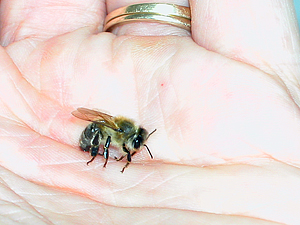
The bee above appeared in our bathtub this morning. I tried to feed her a little water and honey, but it appears to be no-go. Four other bees turned up, mostly livelier, some hungrier, all released out of the back door. Bathroom bees are, perhaps wrong headedly, kind of an up moment in my day. After all the aggression in late summer, it makes me feel better to hold a bee and a q-tip with water on one end, a drop of honey on another, and offer up a snack. I only use my own honey, that little bit that got entered in the fair. Good hygiene, doncha know. It's a nice quiet moment, and I keep them around until I know the temperature is not bee-fatal and the break in the rain is real.
There is a down side to all the rain, of course. The bees are getting an early start eating their winter stores at a time when they are less likely to be able to replenish them, and I need to get into the hives to place the last medications of the season: stuff for Nosema and those cursed Varroa mites. The temperature trend printed in the paper says I still have a little time, but they also said we would have some rain in September.
But rainy days are, in the end, days of peace and replenishment, and a time to think. And the bees have affected how I think about the lives of individual buzzing and breathing and barking things. Sometimes those drops of rain are excellent cover for how I feel about the whole thing, and sometimes they just seem to make things a deeper, richer green.
Tuesday, October 04, 2005
Life and Death Outside the Hive
 Romantic notions about life and death would be, I thought, the first things to fall under siege with this beekeeping thing. I was not conceding the outcome of this hard-edged enlightenment, but admitting the obvious: I live in the city. I live in a world where most of the creatures are either imperilled wild things or treasured pets. Being a beekeeper is like playing god, not like playing parent to a pet. I have to choose who dies sometimes. I hate this. I do it. It's not routine, and I don't feel good about it. But it's not keeping me up at night, and I feel like there is a lesson in it. The upshot is not about being hard-hearted, it's about the unconceivably numerous ocean of life, the sheer numbers of living things coursing around us, and how impossible it is for any one living thing to see the whole and understand what it happening to it. In one case, an early death, in another, an extended life. No reason given.
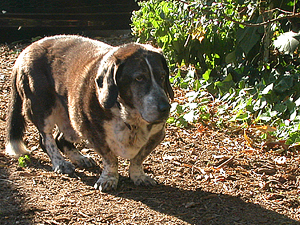
Tonight my husband and I will have trouble sleeping. We chose death for Rocky today, and it needs to be said in that bald-faced way because he died when we said he should, via euthanasia. One could say we killed him, though that does not fit right, either. We cut the death that was coming off at the pass, at an hour short of sunset.
What keeps a girl awake here are memories of all the times we were not good parents, where we lost our patience or jerked the leash or dealt out discipline that now makes me cringe. Rocky was a thieving, lusty, greedy, smart, passionate, loving, and sometimes violent dog. His aging looks like, with great pain right now, a process of his losing one great love and then another. First, no longer able to jump on the bed and jockey for position, later not able to climb upstairs to the bedroom, followed by an inability to compete effectively for table scraps, and finally stuck at home when the park (and his adoring fan base) was just too far away. At the end, barely able to creep out to the backyard, swaying on failing legs.
We told our friends this tonight: as we prepared to leave for the veterinarian's office this afternoon, he slept in my arms a while. As he slept, he dreamt of running, clearly at full tilt. I could not remember the last time he ran: the vet later told me his arthritis was diagnosed in 2001.
I don't believe that when I crush a bee, or blow out the candle of Rocky's life, that those sparks of vitality are automatically lit again in some other place. I have been thinking more about the way light shimmers on a lake at sunset, one glint shining and blinking out, replaced by another. Some people talk about a sea of life of which we are a part, and to which we are returned. I still hope, whatever follows this, that there is some way I will feel that Rocky spirit again. Is there a way to be in *that* light again?
Wednesday, September 28, 2005
Before and After, Part 2: After
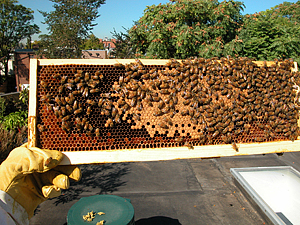 Both hives have brood, bees to be. I am so grateful, relieved, and embarrassed to find myself in such a weirdly opposite place to my last post. I also need a shower.
The bees actually seemed quieter when I got up to the roof, ominously so it appeared. "Maybe so many have died?" I wondered... To work with them, I hauled smoker, lighter, fuel, tools, bee brush, an empty hive body, an extra set of baggy PJ bottoms to wear over my jeans, gloves, sheets of old fabric to cover open colonies and prevent robbing...
Oh I just hauled up everything I could think of, to put off what seemed like the inevitable.
I loaded up my smoker for bear, using sisal twine and some well-washed cotton scraps to get things started this time: I figured I might be working for a while, and I needed a reliable source. I smoked the bees a bit, and then postponed a bit more by gathering up the dirty roof coverings for cleaning, sweeping up debris, moving plant pots.
Then I went in. The feeder in Twain was stuck to the frames in the deep hive body below, requiring all sorts of prying. The worker bees stayed remarkably calm through all this. I removed the feeder, and then carefully took off every honey super, a total of three mediums and a deep, all of which weighed a ton. Then I arrived at the two medium boxes at the bottom, where the brood should bee.
The first frame I pulled out was full of honey on one side, pollen on the other. Not good but not really meaningful. The next was honey with empty brood cells. Gulp.
But the next was the lovely frame with capped brood that is featured above! Hurray! I did not see eggs or larvae on this frame, but I opted to close and assume the best for the bottom box, since squashing queens and otherwise committing beekeeper errors is such a high probability and source of nightmares (complete with sound track). Also bees at my feet began to fight, and I wanted that to Stop Right Now.
I carefully put the colony back together, taking a bit of time to scrape off the bits of beeswax that were sticking frames to feeder: the bees really hated that, but I would be extremely unlikely to be able to remove it later if I let them continue. I set the beeswax aside, and then turned to look at Wilde.
I did not want to go in.
There could be a handful of reasons, all of which would be excuses:
- I was tired and clumsy and sweaty;
- The Italian bees in Twain had a history of robbing the Carniolans in Wilde, and the former were already fighting and riled up:
- Twain for sure had an active queen, guaranteeing (for now) that there would be bees to winter over regardless; and
- I already suspected that I would lose Wilde, and it would hurt to see it as a fact.
But Twain had settled down so completely, no bees going after me only a few minutes after closing, and the smoker was still going and all the tools were out and it is supposed to rain tomorrow and on and on and on...
So I went in.
Wilde came apart quicker: the feeder was not as stuck, and the hive bodies were a bit lighter. I took time between removing each body to throw some fabric over the top before returning to the colony to pull off another piece. This seems like a very helpful thing for keeping the peace: fewer bees able to get to the beekeeper, as well as fewer robbers able to get at the lawful residents.
Wilde's brood nest is in a medium and a deep, slightly larger woodenware than Twain. The last time I checked, there was almost no brood in the deep.
But not today! I found capped brood on the third frame in, meaning perhaps as much as 6 frames in the deep, plus whatever is in the bottom. This is MORE than ever before. Once again, I did not continue all the way down: I will be back soon enough to place ApiLife VAR and the Fumagilin-B I have yet to buy. (This endeavor is still more full of chemicals than I like.) Wilde could also use a bit more sugar, in retrospect, but maybe I will do the candy/paste thing rather than sugar from now on.
Both colonies have queens, both have bees in the making, and Wilde is even marginally better than before. I am so grateful, so pleased. And there is more to come. Wonder what the theme song will be while I sleep tonight?
Before and After, Part 1: Before
When I get stressed, tunes get stuck in my brain, whether I like it or not. Because of the persistent questions about whether the bees are making it, and a maddeningly apparent subconscious addiction to puns, last night my dreams were full of Ben Folds Five's "Smoke", a song with the refrain, "there will never be(e) another one." Consider it a beekeeper joke: we are the among the few people who discuss smoking as a tool or management choice, rather than a health problem.
Today, this entry is being added before I go upstairs to see whether there are any eggs or brood in the two colonies on the roof. This is a serious question. If I killed the queen(s) or if the bees killed each others' queen(s) during the robbing episode last month, my colonies will dwindle and die soon. Both of them.
Why would I even ask this question?
The bees have continued to be temperamental, and the twice weekly feedings (then menthol placement) seemed like they might be making the situation worse. When the menthol went in, I realized that there was an absolute ton of stored honey in each hive, so it also seemed like feeding them sugar syrup had been pretty much a bad idea. This blog has been post-less for over a week because I hoped that the tide would turn toward happier bees if they were disturbed less often.
So I left them bee, not entirely meant as a pun. A phone conversation with a more experienced beekeeper also made the menthol seem less necessary than I thought – apparently scientists are studying whether or not the tracheal mite this chemical is meant to kill is still a problem in our area! – and I am getting quite tired and discouraged.
I went to a different beekeeper's association meeting last night, and more than one experienced beekeeper there said that my bees seemed meaner than they should be, and asked if there was brood. I did not see brood when I placed the menthol, kids, though I was so tired and hot when I got to the bottom of the coloinies (where the brood nest is) that I did not check as thoroughly as I should have.
So today, with dread and absolutely no energy for the task, I am going to take apart both colonies to see if there are any queens active in there at all. Queen Lizzie, in Wilde, is marked so I have a chance of seeing her. Queen Eleanor, in Twain, is not, and I may just have to look for eggs or supercedure cells (structures the bees build when they know they are in Queen trouble), to decide what to do.
If there are eggs and brood in both colonies, there are healthy queens in place and I can stop worrying.
If there are no eggs and brood in one or the other of the colonies, a queen has died and I will have to unify them and hope for the best. If that happens, I will be calling MaryEllen to ask for her help and to borrow some equipment I would need to do it.
If there are no eggs, no brood, and no queens, I guess I am done. Perhaps I could scare up a queen somewhere, but it is probably a bit late for that.
Then the question might be whether I keep doing this at all.
Today, this entry is being added before I go upstairs to see whether there are any eggs or brood in the two colonies on the roof. This is a serious question. If I killed the queen(s) or if the bees killed each others' queen(s) during the robbing episode last month, my colonies will dwindle and die soon. Both of them.
Why would I even ask this question?
The bees have continued to be temperamental, and the twice weekly feedings (then menthol placement) seemed like they might be making the situation worse. When the menthol went in, I realized that there was an absolute ton of stored honey in each hive, so it also seemed like feeding them sugar syrup had been pretty much a bad idea. This blog has been post-less for over a week because I hoped that the tide would turn toward happier bees if they were disturbed less often.
So I left them bee, not entirely meant as a pun. A phone conversation with a more experienced beekeeper also made the menthol seem less necessary than I thought – apparently scientists are studying whether or not the tracheal mite this chemical is meant to kill is still a problem in our area! – and I am getting quite tired and discouraged.
I went to a different beekeeper's association meeting last night, and more than one experienced beekeeper there said that my bees seemed meaner than they should be, and asked if there was brood. I did not see brood when I placed the menthol, kids, though I was so tired and hot when I got to the bottom of the coloinies (where the brood nest is) that I did not check as thoroughly as I should have.
So today, with dread and absolutely no energy for the task, I am going to take apart both colonies to see if there are any queens active in there at all. Queen Lizzie, in Wilde, is marked so I have a chance of seeing her. Queen Eleanor, in Twain, is not, and I may just have to look for eggs or supercedure cells (structures the bees build when they know they are in Queen trouble), to decide what to do.
If there are eggs and brood in both colonies, there are healthy queens in place and I can stop worrying.
If there are no eggs and brood in one or the other of the colonies, a queen has died and I will have to unify them and hope for the best. If that happens, I will be calling MaryEllen to ask for her help and to borrow some equipment I would need to do it.
If there are no eggs, no brood, and no queens, I guess I am done. Perhaps I could scare up a queen somewhere, but it is probably a bit late for that.
Then the question might be whether I keep doing this at all.
Monday, September 19, 2005
Wilde, Now with Menthol
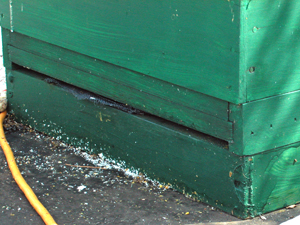 Today, I cheated.
 It's no pleasure to work the bees these days, and they pay and pay for the trouble, too, so I decided not to take Wilde (the weaker colony) apart to put in their menthol, but dodge the bullet by sliding the packet in through the slot below the screened bottom board. I should have checked on honey stores, on brood size, on any number of things, but today there were a couple of hundred dead bees around the last hive I disassembled...and that, my friends, was enough of that.
If you look at the slit near the bottom of the green boxes, you can see a ragged edge of what looks like window screen poking out. It actually *is* window screen, cut into two 6 inch squares and sewn around about a quarter cup of little menthol pellets that look like junior moth balls. The screen keeps the bees from crawling around on the chemical, or chewing it, or otherwise damaging themselves. The white crumbs you see are flakes of menthol that objected to being crammed through a slot. The orange cord is the power for the BeeCool unit, which I opted to leave in place for this hive (let's call it "the experimental method" rather than "fear of carnage," OK?) I left the screen sticking out for ease of retrieval and to limit direct contact between menthol and the materials that make up my roof. You never know.
Beekeepers place menthol in their hives in the autumn in order to (try to) drive tracheal mites out of their colonies. These mites are one of the plagues that has jumped into the honeybee world (along with varroa and American foul brood and so on) and the late summer and beginning of fall is when you must/oughtta/have to take steps to fight them.
You see, the bees are about to enter their winter survival mode, when they all cluster together and the core population of bees that starts the winter season has to survive WAY longer than usual in order to renew the life of the colony in the spring. They live longer, cluster together for warmth, and are therefore more susceptible to spreading and catching diseases and pests and you name it.
For everyone out there who was ever told or believed that sex causes disease, or thought that the latter was the punishment for the former, know this: it's not sex, but closeness, interdependence, and intimacy that makes us vulnerable to each other. And life is not worth living without a bunch of that dangerous stuff. Remember, there are few organisms as blameless as a bee, and few who have faced such a punishing assault on their well being in the past few decades.
And I hate being a punisher. Sometimes I think about how beekeepers play god, and how those worker bees must see me as the Fifth Horseman -- you know, Famine, War, Death, Pestilence, and That Brunette With The Smoker.
So after I slipped in the cheating menthol, and dropped a gallon and a half more syrup into the feeder (while waving at yet another set of roofers across the alley, sigh), I resolved to leave those girls alone until the daily high temps drop into the 60 degree F range (right now they still bounce around in the mid 80s).
And what will I do then, you ask?
Then it is varroa medication time, which will overlap with the nosema treatments, and the measures I will have to take against marauding mice (my husband is not going to like that last part).
And during this time, I will be deciding whether or not to try to build insulating sheaths for the colonies like the Reece brothers do, or to take some other steps to ward off the cold.
And then, perhaps, I will watch to be sure there are enough food stores, and hope for Spring to come soon.
Saturday, September 17, 2005
A Round of Stingers
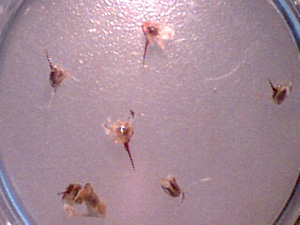 When working the bees, many more of them light on me and yell at me and bang at my veil than actually sting me, and my hope had been that all those girls trying fervently to land one through the veil and the jacket were doomed to fail... and therefore to continue living.
If a honeybee stings, a honeybee dies, so even beside my own enlightened self interest there is plenty of reason to hope they don't get into attack mode during attempts to handle them.
I decided to wash my jacket and its hood/veil thing because of the general atmosphere of mayhem that prevailed by the time I finished yesterday. The bees leave behind pheremone traces of how they felt about you, and you can literally carry your bad karma around from hive to hive if you don't wash up. Sadly, as I took the veil off to launder the rest, I saw all the sad stingers still in place at various locations. So the lesson learned is that sometimes a bee can fail to sting me, yet still get stuck enough to perish in the effort.
Above is a slide with the stingers that were still in the hood by the time I got down to the laundry room. I picked them out to get a better look. My husband has a groovy digital microscope that we bought for the nieces and nephews, but we ended up liking it better.
There are more photos and stinging remarks at the right. I'm going to go up and attempt to telepathically transmit apologetic thoughts at the bees now.
Friday, September 16, 2005
One with Menthol, One Without
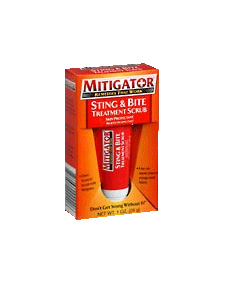 Sometimes working the bees is like playing god, and sometimes it's more like playing the heavy in the Divine Comedy. Today was such a day.
Luckily, a couple of days ago, my husband ordered some stuff from cvs.com that came with a sample packet of "The Mitigator," a salve for bug bites and stings. Talk about intervention from on high: the stuff works, and thank goodness!
Today was menthol placement day, and yesterday I mixed up 4+ gallons of sugar water in hopes of making the medicine go down sweet. Nice try, but..
I started by taking Twain apart, down to the bottom board, for the first time since mid-July. During the intervening weeks I have been either on vacation or dodging stings as I pour sweet stuff into the feeders. So I needed to figure out:
- whether or not their honey stores had been depleted through the past few weeks of drought and dearth;
- whether any brood was still being produced;
- whether bad things like "becoming pollen bound" or similar meant some frames should be manipulated; and
- whether there was any evidence of disease like American Foul Brood, since I knew some people who had it.
It was just brutal, kids. At the club meeting on Wednesday night, I felt a bit reassured because Barry, a really experienced beekeeper, shared with me how his girls were like to "eat him alive," these days, and that there was no way to find a good time to do anything right now. You just have to.
After a relatively calm start, trying the light smoking and calm movement advice again, I still ended up with a boiling mass of furious bees when I reached the bottom. There is very little brood, meaning that not only the field bees but the nurse bees are at loose ends. I need to ask if the absence of any capped brood is a bad thing for this time. I removed the BeeCool unit from the top, closed the screen bottom board, and left a screen packet of menthol on the bottom, then closed her up, at speed. Yes, lots of squashing, but I was sweating terribly, and in the places where I soaked through the veil I got stung: back of neck, tip of right ear, inside of elbow. 6 in all.
So after finishing one colony, I retreated and sighed. I gave Twain a full two gallons for their pains, though it raises more questions: they already have a deep hive body and two mediums full of honey, plus a few frames in the brood area. I think this means they already have 100 pounds stored against the winter, before the 8 pounds of sugar they received today.
I slapped the Mitigator on my wounds, filled the tub, and soaked my sore spots. MaryEllen and I are going to another Bee club's meeting next week, so I can ask all those new victims all my questions about "how much honey is too much?" "should I worry about brood?" and all the other wonderings we have as we face the upcoming winter.
And I get to look forward to Menthol Monday for the Wilde colony!
Tuesday, September 13, 2005
My First Bee Tourist
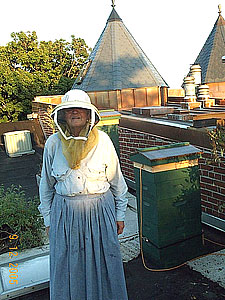 Yesterday, my apiary hosted it's first-ever bee tourist: my friend Elizabeth's cousin Todd from Berkeley.
Cooler heads would have postponed hosting group activities until cooler weather, but we only had Monday or Tuesday to visit, and the invitation was issued. The girls are still surly, but if we just stopped by to take a look, they might not cause a whole lot of trouble. Nonetheless, I asked many questions about bee sting allergy and general freakiness, received proper assurances, and we were off!
Todd. my visitor, has travelled the world and dealt with stuff like poison spider bites in Madagascar (no joke), so my warnings were probably misplaced. She is also a birder and a lot of fun to talk to. I asked her to come back in the Spring, when I could actually give her a frame of friendly bees to hold in her hands. Showing her my spare wooden ware and some busy hive entrances is just not the same.
I only have one spare veil, so Todd got to wear it. Elizabeth, with whom I went to college, hung back in order to be our photographer. She, of course, got stung. It was, as I'd like to believe, one of those near-blameless events: 1) Fly-by bee gets caught in veil-less hair; 2) Reflex to slap complete before conscious brain engaged; 3) Finger receives sting; and 4) Apologetic beekeeper picks buzzing bee remnants from hair.
Not quite ready for bus tours, eh?
We went downstairs and had some water, then chatted for a bit. Todd said that she did not see beekeeping in her future, but appreciated my enthusiasm. I think Elizabeth may be somewhat less positive on the subject at this point, but she's on my list for honey this year. Not that you have to get stung first, I swear!
Sunday, September 11, 2005
Bee Keepers, Havers, and Meddlers
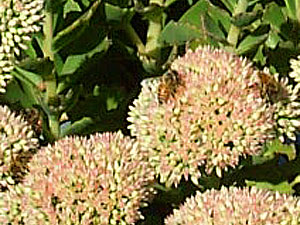 The photo this time shows a pot of stonecrop on my roof, a feasting site for bees of all persuasions over the past week. It's included here for two reasons: finally there is something out there for the girls to eat, and it turns out to be something I can happily plant en masse on a hot city roof. Where coneflowers and buddleia have failed, bring on the succulents!
 Speaking of sources of consternation and hope, beekeepers all over mention the name George Imirie with reverence and wonder. On the BeeSource forums, the experts write, "If George said it, you can take it to the bank." An authority, and a personality. Legend has it that Mr. Imirie once demonstrated the harmlessness of honeybees by wearing only a speedo and playing his clarinet in a screened in cage containing a couple of colonies. Less legendary: he founded the bee club of which I am a member, and only retired from it (and this geographic area) a year ago.
George Imirie wrote much valuable (and very forceful) advice about beekeeping in a series of pamphlets known as "the Pink Pages," and it would be a mistake to ignore them. But he also made a CAPITALIZED distinction between "beeKEEPERS" (i.e. good and responsible citizens of the apiary world) and "beeHAVERS" (dissolute sorts who kill their bees and still dare walk the streets with heads held high).
Having been born an anxious soul, it's perfectly obvious that I would get a complex about this. However, there is more to say on the topic.
As is often the case when a great leader passes the mantle, whispers start in the wings. "Well, George always said 'menthol by Labor Day' but it was just too hot this year..." or "I just don't think the Imirie shim gave me anything but more bridge comb ..."
But beekeepers still very much refer to George Imirie's expertise, even as we continue to teach Newton in the age of Einstein (and we even teach Einsteinian shortcomings now). This week, a fellow member of our beekeeping club called, and of course I pestered him with question after question, and the conversation came round to "What Would George Do?" I told Marc (the other beekeeper) that I figgered myself for a lowly beeHAVER, and he paused before he responded. This summer was a hard one for Marc: he lost several colonies to American Foul Brood, and had to make lots of decisions about how to manage the whole apiary while dealing with the infection. He said he had posed the question, "HAVER versus KEEPER" to the person whose orchard he was pollinating. And she said, "You are more a beeMEDDLER I think."
Perhaps there are other fraternities of bee enthusiasts to which I could pledge my loyalty: the beeFUMBLERS, the beeWORRIERS, the beeDAZZLED (sorry about that last one). Though a lowly sinner, I also claim beeVANGELIST.
Wednesday, September 07, 2005
Bees Without Enough To Do
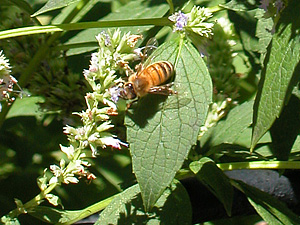 A week out, it appears that the robbing crisis is over, at least unless some other incident – syrup spillage, opening the colonies, spite – triggers another bout. The gentleman who told me about setting up robbing screens said that his bees regained their sweet disposition within a few days of the reinstitution of the rule of law.
Well, mine haven't.
If I hang around the roof more than a few seconds, guard bees come flying at my big dark mop of hair...quite emphatically. It's not clear how well the feeling can be described. The bees fly right up and bounce off your head. In the Spring, they just tend to bounce and go. In this season, they are instead attracted to dark holes: eyes, ears, nose. Since my hair is nearly black, they can land there and get a bit tangled. You can hear them up there quite clearly, too. It quickly evolves into a weird, mixed blessing or "negotiating with Fate" situation: "If I have to get stung, please let it be my scalp!"
So I retreated from the roof with fingers in ears and nose, eyes closed as far as I could, trying not to breathe out too much of that CO2 which annoys them so much. And you need to go slow, because sudden movement is annoying. And you need to go quickly, because one angry bee usually attracts others. As I sit here, every tiny crawl feeling on my head feels like a bee leg.
The guard bees generally give up pursuit when descent of the stair case begins, however, and so I was off. Unstung, but much ruffled.
After I put in the anti-robbing screen (with a feeding), the bees got two more fill-ups of sugar water, an offering intended to boost health and improve mood. Now I wonder if it just made them crankier. My logic was this: if the lack of late season forage makes bees cranky, home delivery of chow should delight. But bees cycle through each day with a program, and the field bees want to do it for themselves. They are like ornery older relatives or toddlers in this respect.
Pouring in the sugar water is kind of cool. The bees are initially teed off when I slide back the roof of the hive: the buzzing actually changes tone (will try to record this somehow). At least a handful of bees immediately proceed to flying at my head and, now especially, face, though I am always wearing a veil. (Many beekeepers on the bulletin boards talk about working without even a veil, but I just don't know how.) I begin by picking up this square one-gallon-plus Rubbermaid container, and carefully start to pour very slowly from one of the corners into the hive top feeder. The feeder has floating balsa wood frames in it, and I try to pour in such a way that any bees underneath have a chance to grab the wood, and the sugar water floats them up and over. If the frames are stuck – meaning that they are not floating, with the potential for trapping bees under there – I reach in with my hooked hive tools and pull it free. I put about half a container of syrup in each side.
In these times, the bees are so hungry that you can see girls run right up to the main flow of my pour, and they stick their little tongues in. Most of the bees who started to bubble up from the colony below are diverted directly to the nearest patch of syrup, and they settle in. Within 2 days, I can count on the feeders being dry.
It has been dry, dry-dry-dry, and we are not scheduled to have rain for another week. The aftermath of Hurricane Katrina missed us last week, and we really needed moisture then. So you see how it is.
No rain means no nectar in the few plants that are flowering now. I found my girls going crazy over a plant in a front yard a few blocks from here, though even it looked kind of dried up. The picture from my phone was lousy, so we'll take another try today, both to post here and to try to ID it for possible roof planting next year.
They are bringing in pollen in spades: saw a native bee just rolling inside a rose of sharon bloom yesterday. I have to open up my colonies, have postponed twice now because of foul moods, but one thing I will have to check for is whether the brood areas are pollen bound.
Tomorrow, I am facing a prolonged encounter with Bees with Attitude. The brood needs to be checked, the hives need to be weighed, menthol needs to be placed, and maybe even the varroa treatment. I need to bring up extra equipment for covering hive bodies as I work to cut off robbing at the pass. And I still need to wear gloves.
Sniff.
Monday, August 29, 2005
Robber Bees
 The bee population in these parts has been acting weird since last week, and the time finally came to determine whether there was really something wrong. However, if I knew how to formulate such a conclusion myself, I would not have needed so much determination. So I posted this on our beekeeping club's online bulletin board for beginners:
From: phang@tonitoni.org
Date: Thu Aug 25, 2005 7:24 pm
Subject: Fighting Bees in Late Summer
Over the past week, there has been an increase in bee-to-bee combat: does anyone know what the cause could be, whether it is significant, and what I should do?
Probably the main questions are:
- Is this a heat-related or seasonal behavior?
- Is this a human management problem (like robbing)?
- Is some intervention advisable?
I noticed a bit of fighting after working the bees last week. I had moved two frames of brood from my strong colony to my weak one, and after found a few dozen dead bees. It seemed possible that I had transferred too many bees with the brood or had not let the frames stand long enough before moving them.
But today, a week later, after cleaning up and feeding more sugar water, another (but smaller) number of dead bees appeared. I saw two fights, though they appeared to be drones getting beat up (the other dead bees were workers). Also, the fighting seemed concentrated around the stronger of the two colonies, not the one that received brood.
After such nice days, lovely cooler weather, and a plentiful sugar water supply, it seemed odd for something that seems stress-related to appear. Your thoughts welcome!
I also posted the query to beesource.com. And got the same answer. Which was:
- I screwed up by allowing any bees at all to transfer with the new capped brood: they might put up with it in Spring, but not in late Summer; and
- My feeding, by being at the wrong time of day (not early AM or evening) and with too many openings in the weak hive, had triggered some robbing.
So like a good little girl, I did a couple of things: on Friday evening I closed the second entrance to Wilde, and I cast baleful looks at Twain. Ta-Dah.
Big whoop.
On Sunday (8/28), I went up around 11 AM (notice how I still had not learned my lesson?) and there was a full scale robbery on: hundreds of bees in a cloud at the entrance to Wilde, a brawl, carnage, awful, and MEAN.
The previous excuse for a response had not been enough. So I quickly put in an entrance reducer on the only remaining opening in the weaker colony, and fed the heck out of Twain (home of the bloody minded bees). AFTER running downstairs in desperation, logging into my computer to get information and advice, I learned that Italian honeybees are well known for this behavior. Apparently everyone knows. I must have been late for class that day...
So today I worked out how to make an anti-robbing screen, another item which – if I had been paying attention – could have prevented the whole apiary cataclysm in the first place. You can see the details in the "Thwarted" photo page at right.
Finally, in order to churn some good out of this, I wrote a little article on this comedy because our club newsletter requested submissions. If there are more misconceptions, I hope they edit them out. The unexpurgated version is pasted below. Sigh.
The Thieves of August
Guilt, blame, and recrimination are such ugly experiences, yet they are the most natural things in the world at the scene of a crime. I'm talking about theft, assault, and murder, all taking place between neighbors and sisters. What is the world coming to? Late summer, my friends.
Yesterday morning my apiary became a bit of a killing field. By 11 AM, it was all abuzz with a full scale robbing attempt by the strong upon the weak. My gangbuster Italian colony was attacking my poor struggling Carniolans, and what was meant to be a peaceful Sunday morning bee feeding in front of curious visiting family members turned into another round of beginner scrambling.
Since hindsight is 20-20, problems in this picture are already becoming clear. Who demonstrates beekeeping in August? Why had my bees been aggressive even after the temperatures cooled? In times of nectar dearth, what was I doing opening hives or feeding in the middle of the day? Why didn't I know that Italian honeybees are notorious robbers?
And it gets worse. There had been other warnings. But here might be the main point: for the beginner, so much of beekeeping is to know what you are seeing. Let us not overlook a more subtle point: you also need to know what you should not be seeing. This is very hard to teach in a short course. This is very hard to teach without benefit of a late summer dearth of nectar. But sad experience is a great instructor. But maybe I can tell you what happened at this particular crime scene, and you can undertake a more successful neighborhood watch.
The perpetrators were first spotted fighting with unidentified bees shortly after the beekeeper messed up the process of moving two frames of brood between colonies in early-mid August. This seemed like a turf war, one gang eliminating some interlopers from their territory (something the beekeeper should have done ahead of time). Except that was only part of it.
There was also suspicious activity for some time at the back entrance of the smaller colony, a group that had never been all that keen on their sugar water before, but had taken to importing suspicious quantities. Law enforcement attempted to identify the suspicious characters frequenting the back door to the establishment, but found she was clueless.
As often happens in crime-ridden neighborhoods, gang members with crummy attitudes starting congregating in additional locations, annoying law-abiding citizens, including neighbors. Perhaps you could tell me what business honeybees had hovering over the floorboards of the back porch, occasionally bumping the sliding door and the exiting dog. A person on the street said, "Why are all these bees suddenly hanging out in my yard?" I got stung watering plants in the yard, and – for the first time – it was one of mine.
Finally, the Mid-August Massacre might have tipped off law enforcement. Dozens of dead bees carpeting the apiary between the colonies, more fights in plain sight. So I called in backup.
In the midst of this sorry saga, let us give thanks for the goodwill of experienced beekeepers, including those who answer queries on the MCBA bulletin boards and the good people at BeeSource. Because they were right that I was beginning to see robbing, but even being told did not help me to go straight.
Closing the back door to the weakened colony was not enough: common sense, not that I had any. That same afternoon, both colonies got more sugar water, since they are being raised from packages. This was the gasoline on the simmering coals of gang war.
I don't know how long the robbing went on, though there were only a couple of days between visits this time. There is an entrance reducer in place now, and I am going to make this groovy anti-robbing screen I found on bee source. I'm thinking I may not have a Carniolan colony anymore, but cluelessness can also mean pigheadedness, so I am still going to try to bring them along.
If any of this contains advice to wise, it would be:
- The bees of August are not the easy going girls of Spring, and you cannot treat them the same;
- Changes in bee behavior mean you are seeing basic shifts in the Bee Operating Protocol, that predictable pattern we need to manage them. Knowing when something is different is your only hope of bringing them back to that safe sameness we count on;
- Those particularities between bee families – like Italian bees rob and Carniolans tend to build population a little late for our area – can suddenly get really important, even to a beginner who did not pay enough attention in class; and
- An autumn Goldenrod flow would really help right now.
Sunday, August 21, 2005
On the Pleasures of Second Place
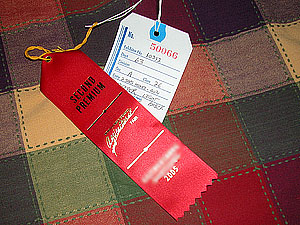 As you may have read here, first year beekeepers (like me) are not supposed to expect or extract a honey harvest. Our worker bees have got their papillae full just rearing new co-workers, building a new colony, and setting aside adequate stores for the winter.
But a single exception is made, or at least it was made when our beekeeping club was encouraging entries into the local county fair: a new beekeeper may extract honey from two frames in order to offer up a sample for the special newbee category. I did this with MaryEllen's help, and got me 2 jars containing maybe 5 pounds of honey. Translating this back into sugar water – you know, the stuff I feed them in order to make their work easier and faster – my entry started life as 3.5 gallons of nectar of one kind or another. That's a lot of work for critters who are maybe 2/3 of an inch long.
The fact that there was a special category really wasn't reason enough, nor was the (apparently universal) desire of a new beekeeper to see the fruits of her girls' labors, but the club itself seemed to need a good showing of interest, and that is what locked it for me.
There is a profound debt of gratitude in my heart: for the free class and the many hours of preparation, demonstration, and counseling that came with it; for organizing the monthly meetings with the guest speakers; for the newsletter and the field trips; and on and on. The club is also in a funny transition time, because the founding generation has retired from leadership and the kind of person who becomes a beekeeper is moving to include both the traditional biology fans and farmers as well as the Birkenstock set (like me). This reminds me strongly of the period when the Internet changed from a technical to a public forum, and all the sturm and drang that came with it. We live in times when folks are at each others' throats for much less: I'd like to sign up for a club that did not implode as soon as I joined it.
More personally, I've participated in the inadvertent extinction of several startups, a major reason why I have given up working just now. It's hard to pour your heart and best efforts into an endless battle for life, over and over. I want to do what I can to contribute to something that might thrive.
So, in summary, I entered because:
- I had permission;
- I had encouragement;
- I had the means;
- I had self-important philosophical stylings; and
- County fairs are fun.
And I won second place, which in this category was also last place. However, my score was just two off the winner, a 92 at that, and I was never one to sniff at A minuses in school. Plus the winner, Jim, is a totally good guy who has helped me with advice and just being good company at the meetings. Don't get me wrong, his favorite topic is his wife and kids. Let's just put it this way: losing to a better, more experienced beekeeper who is also a sterling individual is never bad.
Here's how the judges scored our honey, which was classed as "light amber:"
| Criterion | Winner (Jim) | Me | |
| Containers: Cleanliness and Appearance (out of poss. 10) | 10 | 9 | |
| Freedom from Crystals (out of poss. 10) | 9 | 9 | |
| Accuracy of Filling (out of poss. 10) | 10 | 10 | |
| Cleanliness and Freedom from Foam (out of poss. 30) | 29 | 28 | |
| Flavor: Downgrade only if something is wrong (out of poss. 20) | 20 | 20 | |
| Density: Disqualify for water content above 18.6% (out of poss. 20) | 16 | 16 | |
Percent moisture content | 18.0 | 17.7 | |
| Total points (out of poss. 100) | 94 | 92 |
Jim gave me pointers on how to slay the foam problem, and I can fix up the container question just by going with regulation honey jars (Ball jars, while picturesque, are not The Thing). I'd like to point out that my moisture content is already better than his, though...
Thursday, August 11, 2005
Putting the Gloves On
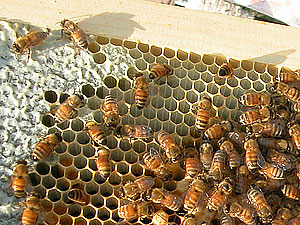 After a couple of weeks away – fourteen days of baking bees – I really wanted to check in, especially on Wilde, to see if the colonies were standing up to the high temps and low nectar flow of late summer in this area. They are clearly in a totally crappy mood. Guard bees are taking shots at me when I am on the other side of the roof, watering plants: there is no chance I can manage them bare handed right now.
Before leaving on vacation, I ordered two new medium deep hive bodies, some menthol for tracheal mite treatment, and a new (non-toxic) varroa mite medicine from Brushy Mountain Bee Farm, and this had arrived precisely as I was leaving (late) for the airport. Well, all of it except for the "Api-Life VAR" varroa treatment, which I will have to reorder. I thought I had ordered pollen patties as well, but this apparently did not take place: pollen supplements might help the bees in Wilde rear more young faster, though I am not sure about this.
I need to paint the hive bodies before I can use them outside, and it is too hot for the menthol, so this check up will use the usual equipment – two hive tools, bee brush, smoker, fuel, lighter, veil jacket, two containers of sugar water, and ankle socks for tucking in my jeans. For the first time in a long while, I brought gloves. When I go up to the roof, I am carrying bags of stuff even when no new equipment is being deployed. I often look a bit spastic, trying hard to conceal the funky screen covering of the veil and the obvious shape of the smoker while going round and round a wrought iron spiral staircase.
I have placed a roof top storage shed on my must-have gift list. For those that are curious, that is. I prefer the one from Rubbermaid.
The photo above captures what seems to be the state of the colonies right now: it is a close up of a brood frame from near the top of the nest area in Twain. You can see nurse bees and brood at the lower right, and a band of empty cells above them to the left. There is still some honey stored in the corners. This means that the bees have been consuming the stores that had been packed in around the nest, and that these have not been replenished as fast as they were used. Adding sugar water today may help with that. I saw cells packed with pollen elsewhere, so maybe those pollen patties I was going to order would not matter. There were cells in the brood area itself that had no larvae or eggs, and Queen Ellie may be slowing her laying in response to these seasonal clues. Colonies often take a population dip in August, and add more in September.
These facts are for more worrisome for Wilde than for Twain. We have a real population deficit there, and it appears that nothing much happened to change that status while I was away. On the up side, nothing much happened while I was away: the girls are still there!
So today I decided to move two more frames from Twain to Wilde next week, something that will be easier to do once I get my new hive bodies painted and have some spare frames to substitute in. I am also hoping the temperature will be a bit lower: moving these hive bodies is pure murder with their heft, the heat, and how irritable the girls are when my motions are shaky or abrupt.
Home is Where Your Honey Is
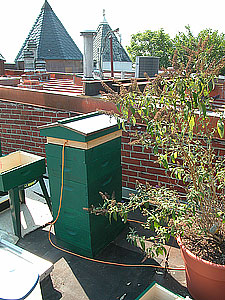 We got home on the oh-god-thirty flight from Boston, and as soon as I could get the (seemingly surprised) housesitter on her way, I mixed up some sugar water, gulped a few times and went to check on the girls.
While we were on vacation, a message came into my voicemail from the next-door neighbor with the amazing roof project: his crew had finally proceeded to the part of the project only 3 feet from the hive entrances, and they were getting stung. "Could you please call immediately and advise? We have a 'breathable' canvas that might work..."
Unfortunately, at that precise moment we were probably over Greenland.
So throughout the trip, when not actively bee-spotting the European cousins of my dear hometown buzzers, I had to actively banish all thoughts of what might have happened, whether the hives had been upset or damaged, whether the roofers had suffered similarly, or whether I was so absolutely, totally and irrevocably busted in my lame attempt at low-profile beekeeping that lawyers would be calling.
But, and you should be proud of me for this, I practiced a short mantra: "What is, is."
So what was up on the roof? By now you have probably checked out the photo with the museum-quality roof and the still-functioning colony before it. (That roof really is a work of art.) As of now, my neighbors have said very little to me about my apiarist obsession, but if memory serves they'll need our yard again later to install the museum-quality downspout. So perhaps we are all willing to pay the price of peace.
Tuesday, August 09, 2005
Note from the Road: A Better Place for Bees?
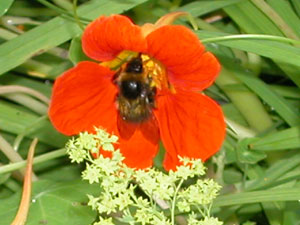 For the past couple of weeks, we have been on vacation in Europe. Highlights have included a visit with a real-life British beekeeper, purchasing honey from bees who live on the roof of the Paris Opera, and driving my family crazy with constant bee-spotting. This bee was working outside a small church in Warminster, Wiltshire.
It is much cooler weather-wise here than on the US East Coast, and I mean just about ANYWHERE on the East Coast. We have had nights in the low 50s (Fahrenheit) and no day has managed to break 80. This after flying away on a day when the temperature topped 100 and I prayed that the bee cool units would keep working for two weeks.
In England, France, and Germany (no, we were not in Belgium on Tuesday) the Hydrangeas are still blooming, and I would like to report the general ubiquity of buddleia. That's "butterfly bush" to those less annoying than me, a vigorous plant that attracts every kind of pollintor imaginable. The bumblebees mostly seem to have pretty white butts here, though there are some dark girls in the bushes, and the yellow jackets seem similar. The Germans told me that our word for bumblebee was better than theirs, and I told them that their weather is better than ours. Score one point for trans-Atlantic harmony.
Coming into Britain, there was a big picture of a honey jar with an X through it at Customs. This worried me no end. I asked everyone except the Customs people about it (why invite trouble?), but I might enquire on the way out, tomorrow.
Our friends, knowing of my obsession, arranged tea with a fellow bee enthusiast. The beekeeper we met in the English West Country had lovely woodenware that was kind of flared, if you can imagine that. I hope my pix come out. It was kind of odd in a way, I am so used to talking about what breeds o'bees that beekeepers are trying in the States, but he appears to have a healthy stock of wild bees around him, and naturally bred Queens that do just fine. It is just easier to be a bee on the Salisbury Plain.
From the railway between Paris and Stuttgart, every German town seems to have an abundance of pocket garden plots, perhaps a memory of those hard postwar days when a few vegetables (or jars of honey) could keep ones' children fed. Like the States, however, our German friends reported that general fear of bees kept apiaries out in orchards or rural hillsides, though I did spot at least one good sized set of colonies (painted blue) somewhere around Baden-Baden.
My luggage is now three jars of honey heavier as we prepare to return, admirable restraint if you ask me. Acacia, wildflower, and Paris City honey in case you are curious. I sure hope U.S. Customs isn`t.
Monday, July 25, 2005
Bees at Midsummer
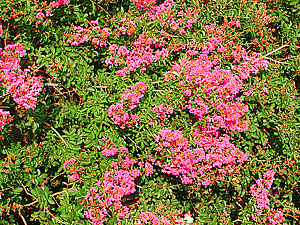 Looking down from my roof on the north side, this is what you see: the top of a crape myrtle in full glorious bloom. Whether or not the bees like it, too, has been the subject of some obsession.
The answer, my friends, is yes! This evening, while sitting in my hammock, watching the field bees come in, I discovered that this was the middle of a bee freeway straight from that tree to the hives. There had been evidence of honeybees (and other bees) in there from time to time, and the pollen packs I had been seeing on the legs of bees at the hive entrances seemed to be of the same over-the-top yellow as the center of those blooms. Bees do not like people to hang out in the flight path, however, and the level of activity in that tree was brought home to me by the degree of displeasure at my presence. No stings, just a lot of that emphatic "What the heck are YOU doing here!" insistent buzzing around my head. I have dark hair, and that is a trigger to bees that hollers "potential predator!" Therefore, guard bees spend a lot of time around my face and head, and I generally cede the field.
Not that this makes me avoid field bees, or anything. When walking around, I tend to poke my head into everything blooming to see if any pollinators are in there. Interestingly, there is hardly ANYONE in white crape myrtles, but the pink ones have a following. And readers, if you want to do the bees a favor, please include coneflowers in your gardening plans. Begonias and impatiens do not seem to cut it. All this flower watching has given me a completely new (but related) blog idea: a daily chronicle, with pictures, of what the bees are eating around here.
But now for business: a catch up for those of you who would like more data on how the colonies are doing.
The short version is that Twain continues strong, but increasingly cranky, and Wilde is showing progress, but the seasonal signals are working against them I think.
Twain "donated" the two frames of honey that got extracted a week ago, and therefore the cursory check I wanted to make revolved around honey stores and whether or not a mistake had been made. The colony was busy capping the full deep that was just nectar last week, so I think they are going to be fine. A book I read said that every frame of a deep is 7 pounds of honey, so that means there is 70 pounds in that box alone. They will need to consume some to get through August, but they probably have over 100 lbs. again. (MaryEllen straightened me out on honey measurements: a pint of honey is way more than a pound, so I was worried for no reason). Today, I noticed something that has probably been true for a while, accounting for some creative comb building in Twain: one of the rear corners of the hive is tilted off the hive stand. I need to fix that, maybe this Tuesday before leaving for vacation, but this is no minor errand. Did I mention three boxes with more than 100 lbs of honey, with three more boxes home to 60,000 bees? *Sigh*
In another book, from MAAREC I think, I read that a colony needs a minimum of 14 deep frames covered with bees to survive the winter. As of Thursday (July 21), Wilde had 14 medium frames, and had eaten up all it's sugar water again. The queen is filling every cell she can get, and she really seemed to like those frames from the capped brood that got transfered over a few weeks ago. Her own kids are not building comb in any regular manner, but I think that is because of the seasonal signals they are receiving. Comb is built during the Spring, with cooler temps and a rampant nectar flow. These girls are getting a bunch of pseudo nectar, but these may be the highest temperatures of the year. The crape myrtle is ready pollen for brood rearing, but I actually ordered some more pollen patties to put on when those flowers are gone. I am hoping to get the population up during that lovely interlude in September. I may move just a bit more brood from Twain, too. I gave the girls in Wilde the last of my empty hive bodies, a deep, because in the top medium box (of three that they had) the workers were storing honey, something that environmental signals are probably screaming for them to do. Imagine all their senses telling them, "Midsummer! Fall's around the corner! Winter after that! What's in the pantry?"
Finally, we are going to be travelling, starting on Tuesday, and I am hoping that the shipment of pollen patties, along with a few more medium boxes and frames, gets here before we leave. It would be more comfortable if Twain had just a bit more elbow room, and if I could feed them just one more time. When we get back, I need to think about testing for varroa and administering menthol for tracheal mites.
If you have any swat with the powers that bee, please ask them for a good Goldenrod flow this year, and right after the crape myrtles, if possible. I want the girls to be busy while I'm gone.
Friday, July 22, 2005
Busted with a Capital Bee
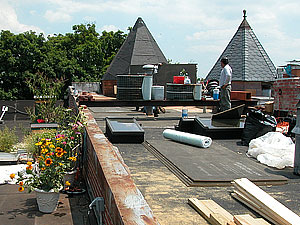 On Monday, I awoke to what seemed to be the Royal Lipizzaner Stallions tap dancing on the ceiling. I was close. It was a group of contractors pulling up the entire surface of the next door neighbors' roof.
 Can one's heart sink and one's nerves race at the same time?
The picture shows the roofers a few days later. My hives can be seen from the little copper roofs cleverly camouflaged by all the butterfly bushes and coneflowers I put there. This technique does not work from 4 feet away, in case you are wondering.
So I pulled myself together with a little pep talk. "They might not be from around here," meaning that they would not know anyone to tell or would not take much personal umbrage. "Just act like you would if the hives were bird feeders," was my final self-counselling: demonstrate an extreme lack of interestingness or anxiety related to the hobby...after all, fear is contagious. What I really believed was, after four years of having the roofline all to myself – and not taking proper advantage of it – not even four months into the pursuit of an odd little private passion, I had company.
Those who would indulge in hanky-panky should consider themselves warned by my example!
A few minutes–and a session with a hairbrush – later, I strolled up the spiral staircase to the roof, ostensibly to water the plants. I was greeted with, "Hey! Are you doing it for the honey?" And a big smile. I introduced myself, explained it was kind of more for the bees and the environment than for the gold stuff, and that I would be happy to work with him if the bees were in the way ("HOW?!" I shouted internally).
He said that the gals were no problem at all, should his crew just not wear certain colors, or something. I said that colors were no issue, that major rumblings or bumpings at the immediate location of the hives would be the only potential source of annoyance, and he said there should not be any.
Of course it is hot, and the bees are in a witchy mood, so I decided to hang around a lot and be sure.
We made it through the week with no stings, and I even had to open Twain a little to put back those frames and add some sugar syrup. I also gave syrup to Wilde and took a little look. But more on bee status in the next post.
The roofers were really interested, and definitely not freaked, even when I had the hives open. I think they think my roof is in danger, and they may be right. But I would like to get their card. They do good work, and maybe they could build me a reinforced pad next year.
Subscribe to:
Posts (Atom)