Showing posts with label bees in winter. Show all posts

Friday, January 15, 2010

The Uneasy Quiet of Winter

hive with no bees flyingDuring mid-January here, you'd have to search a long time to find a smug beekeeper. There has been a good long freeze this year, more than a month since the last time temperatures reached flight-worthy levels (also known as bathroom break levels—more important, though less poetic).
Beekeeping teaches this: nature is an amazing 360-degree extravaganza of millions of living things making their bets and living with the consequences. Last year, in late February, the temperature one Friday night was over 60 degrees F (16 degrees C) and as the sun set and the air chilled all the bees around here made group decisions about where to cluster together for the night ahead. This is about to get a little geeky, but you need to know this: bees cluster together to flex their little wing muscles and keep each other warm. They place themselves over stored food—honeycomb to us humans—about as much as they think they will need.
The colder it gets, however, the closer those bees need to mash together. A ball of bees the size of a basketball can look more like a honeydew melon if the temperature changes enough, and bees can face the choice between warmth and starvation as the honey they cluster over has to nourish more and more bees, and the edge of the stores above recedes a few precious inches away.
By Monday at the beginning of March in 2009, the temperature was 7 degrees F (-14 C) in downtown Washington DC. Every bee colony that bet on an average night in an average winter probably died by Monday morning.
Freaky, worrywart bees, or perhaps profligate "why worry" kinds of bees that were willing to place themselves WAY up above the edge of their stored honey supply were the ones who made it last February. And so bets were made, and whole families lived or died.
Some people tell me that generals are always fighting the last war, and perhaps the beekeeper equivalent is to prepare against the last winter. In January, all of us are facing the choices we made for our bees, as well as the choices they are likely to make for themselves. For millions of years, the genes they received from their ancestors stored up good choice-making tendencies that may be worth a lot less in the turbulent climate changes of today. For just a few years, I have been trying to figure out the challenges my patch of the planet presents to these small creatures, and to learn from beekeepers a whole lot more experienced than I ever will be. The bees place their bets, I place mine, and sometimes I know I am betting against the house.
And January comes, and the truth will out.
The not particularly interesting picture above shows the beehive at the Lederer Youth Garden in Washington DC. This week, for about 72 hours, we have flying (and pooping) weather, and I have visited all 9 hives. A whole bunch of them looked like this: too damn quiet for me. No bees flying, no bees obviously dying, nothing at all. Nine times I steeled myself for the worst, nine times I found warm bees inside.
Let me tell you my beekeeping sins: I treat for mites, though I don't count them enough. I am told to move honey close to clustering bees, but I am far too afraid to mess with the inside of a cold hive. Most of my hives go into the winter twice the recommended size. Some of my bees have viruses and I should let them die, some of my bees have queens more than a year old. Some of my bees get regular visits, some of my bees are on the wrong side of rush hour. But today, they are all alive.
When I think about the vagarities of the choices I make, of the way that Nature spreads her bets across the full spectrum of environmental possibilities, of the not-yet understood changes we all face from the weather, how can I possibly take pride in nine live hives? I can only be very humble, and very glad.

Monday, March 02, 2009

Snow Day, Spring, and City Hives on the Rise

bees in the snow, with deck and neighborsIf October marks the end of one yearly cycle of beekeeping in this city, late February and the beginning of March are when we anxiously watch our hives to see if life will return after the trials and tribulations of winter.
Last week, temperatures hit 70 degrees F (21 degrees Celsius). Today at noon it is 23 degrees F (-5 degrees Celsius). This kind of variation is brutal for the bees.
When it is warmer, they form a rather large, loose cluster over the bottom edge of their honey supply. As it gets colder, that cluster contracts smaller and tighter over a diminishing amount of supplies. They can starve to death if the cold spate lasts a while, because too many bees (who cannot shift) are concentrated too far from where the top edge of the cluster (and the fresh honey supply) used to be. This sort of challenge is what keeps beekeepers biting their nails as our increasingly shifty winters begin to fade.

Local Update

As for my girls, the henbit (Lamium amplexicaule) is out, the willow and maple pollen has started to come in, and the short courses around here will soon be opening their doors, despite all the snow you see above.
To recap, six hives and a nuc (nuclear colony) started the winter, and there are still still six hives today. I tried to winter the nuc as an experiment, one many beekeepers around here are doing, and have found it to be a fine way to provide cold-weather homes to white-footed deer mice.
As a last part of my personal report, I wanted to apologize for the quiet on this blog: I've been out with the bees and the beekeepers, and a little ashamed of some of my mistakes.

Spring Brings Newbees

There's a video (from Meerkat Media) embedded below as a flagrant attempt to reach out to newbees, because interest in beekeeping in my city is growing, with at least 8 hives going up on hotels, offices, roofs and back yards. I'll have new neighbors at the monastery, and new beeks to mentor.
Just for you curious ones who are wondering if it is possible too have bees on the streets where you live, I know beekeepers in Atlanta and Philadelphia and Baltimore and San Francisco and London who are all on their trajectories toward Spring. The video shows happy beekeepers working in Chicago and New York, as well as more traditional places.
Some renegade beekeepers in Manhattan, The Gotham City Beekeepers, have also asked me for a shout-out and you for your support as they attempt to come out of the shadows and contribute in the sunshine (like the bees).

title screen of film

Thursday, December 27, 2007

A Late Season Save?

bees in top box in December!My Romanian beekeeper friend George Tamas (his blog is linked at right, "Happy Apiary") once told me about the benefits of knocking on beehives. Most of you might question the sanity of walking up to a perfectly peaceful hive of honeybees, rapping smartly on the side, and then pressing your cheek tight up against it to hear what you can hear.

Well, the reason is this: during the winter, you don't see much of your bees. And when the temperatures are low, you really should not be smoking them, opening up their home, and poking around. You can very easily kill the creatures about whom you are curious.

One cheap-and-cheerful way to see if they are still alive, whether they are near the end of their seasonal stores, and whether a more intrusive visit is warranted is to knock and to listen. George says he can tell by the type of sound that the queen is OK, and maybe a few other things. Myself, I just listen to hear whether there are a lot of bees, and where they are positioned in the hive.

If I knock, and very clearly hear a big BUZZ, I know there are a lot of bees in there. I can also tell whether my ear is placed somewhere near their winter cluster, where the bees are all keeping each other warm. The position of that cluster tells me where the bees are with respect to their food supply.

bees eating fondant in WildeWhen I put them to bed in the autumn, all my bees were in the bottom box of the stack, and I had placed supers full of honey above them. Because I am the worrying kind, I also put additional food above that. This is a picture of the Wilde bees chewing on some fondant I had put on earlier.

bird poop on the roofThe Wilde hive had been worrying me for a while. There wasn't as much action out the front door as I like, and my knocking seemed to indicate very few bees in any one box, with the majority, perhaps, very high up! I did not see alot of dead bees around, but the presence of some concentrated crow poop meant that the birds may have finally taken to cleaning up departed buzzers, and I could have dying bees without a lot of visual clues.
Don't get me wrong about this: I am very pleased to see this kind of interaction between species. I know you all might expect me to be horrified that anything would eat honeybees, but when you have 50,000 of the girls going into the winter, there are going to be some dead bees around later. If other critters can turn this grim reality into sustenance, this means that the bees have done yet another service to the health of the world.

When knocking on the hives got me to thinking something might be wrong, I decided to do something that no one recommends: opening up a hive just before New Years Eve.

The very first picture above shows you what I found: almost the entire cluster was in the top box. Bees eat their way up all winter: they will not usually go back down for food they overlooked. This means that all those upper-level bees were facing starvation.

Having lost bees in the past, I can tell you that there is some comfort in knowing that you cannot control every force in nature. Disease will sometimes beat you. But I can also tell you this: I will have a hard time sleeping the day that my bees starve on my watch. Disease is tricky, but food is easy.

I don't have many more pictures from inside Wilde that day. It was only 47 degrees F, right at the edge of feasibility, and I needed to get in and out quickly. This is what I found...

The Wilde colony was clustering ABOVE its honey supply. Probably because I had fed so vigorously, they seem to have stored food all throughout the brood area on the warmer days. Bees have a hard time clustering over full cells of stores: it takes extra energy to warm up the diluted fondant, and it creates gaps between the shivering bees. My theory is that on cold days, they moved up over capped or empty cells, and clustered there.

My job was, therefore, to put that top box (and the one directly under it, which also held a bunch of bees) on the bottom of the stack, and move the honey bound boxes back up above. In other words, totally disassemble a winter beehive, reshuffle the boxes, and re-stack them. And a deep full of stores weighs a ton, my friends. Why do I *always* end up stacking an 80 pound full deep box on top of all the mediums? Is Mother Nature that committed to building my upper body strength?

And that really is the whole story. I was paying attention, thank goodness. The weather cooperated a little, as well, and with a little exertion and a few curse words, the bees got another chance.

Wednesday, November 28, 2007

After Long Silence

press clippingHi all, it's me, the "secret" beekeeper who has a problem with actually remaining quiet. Except for the past two months (or more), when I have had a hard time figuring out what to tell you. But there are a few things I can clear up right away, and we can all relax.

First of all, here at the dawn of true winter, all six hives appear to be fine. Everyone in this area is a little light on stores for the cold days ahead, but we've been feeding, feeding, feeding, and don't intend to stop.

Second, as I sit here today I am hoping that the girls have gulped down their last serving of pre-freeze bee medicine. The only "unnatural" medication I apply is Fumidil, an antibiotic that helps the girls deal with Nosema (a digestive ailment that you might get, too, if you had to hold your poop for as long as the outside temp hovers below 50degrees F (10 degrees C)! I might have skipped it this year, but the roof girls are still suffering the after effects of the mighty mite battle of over a year ago (some deformed abdomens) and I want to give them the help I can.

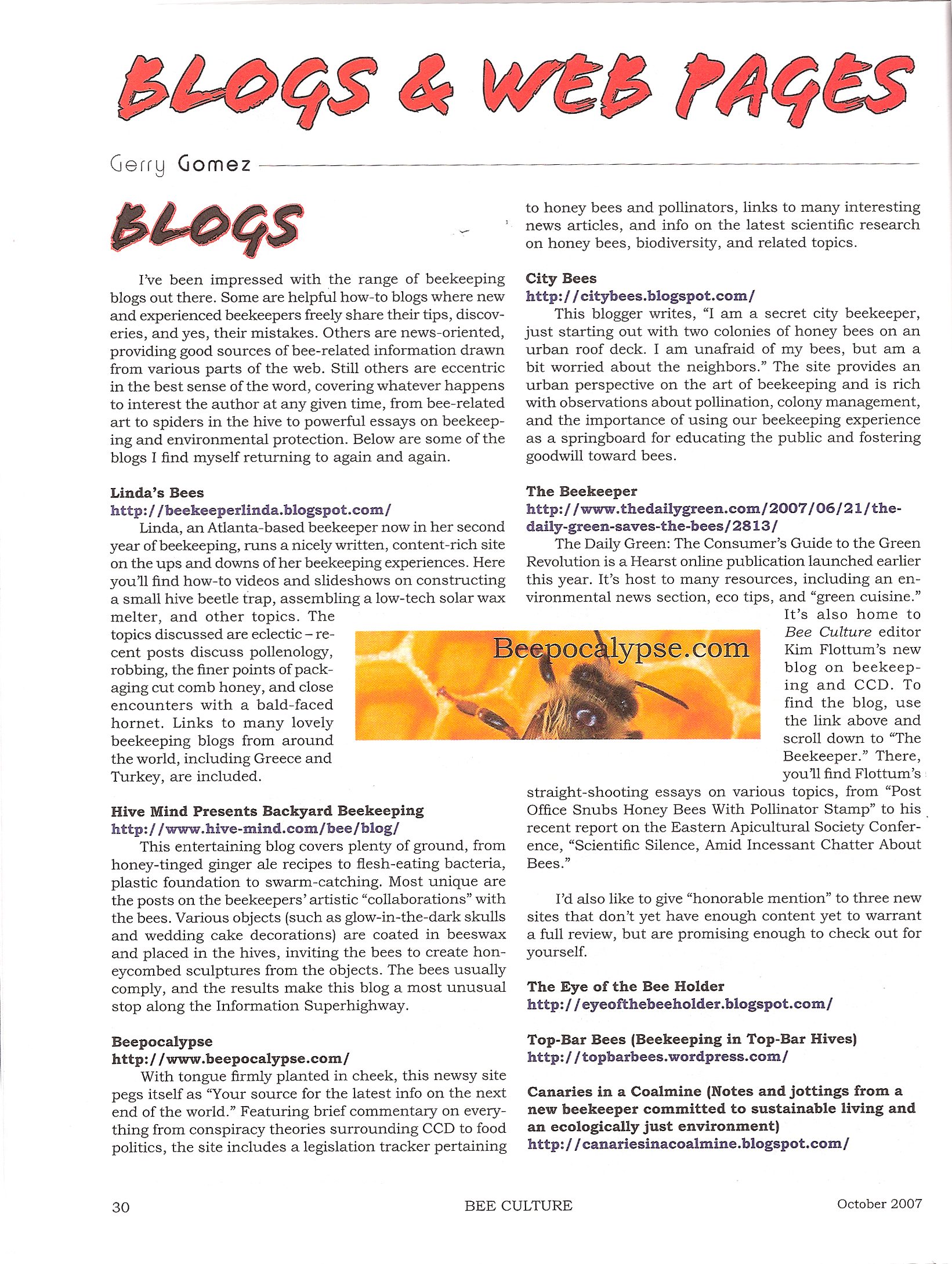
Third, my blog life and my face to face life have become hopelessly muddled, and I am not sure what to do about it (Hi everybody! Yes, I could be referring to you...) The clipping you see above is from the October 2007 issue of Bee Culture, an honor my whole club knows about. I'm one of a distinguished company of bee bloggers, most of them much better beekeepers. And I could be very dramatic about being found out, etc., except I have been telling so many people about my blogly efforts for so long, it's hardly a surprise that SOMEONE would stop by!

But you know, this whole beekeeping thing is deeply personal and concerning, and to stand in front of someone you barely know discussing your deepest worries and failings and foolishness is, well, harder than telling folks on the other side of the world. Also, I cannot gossip effectively...

You know what, it is also very hard to stand in front of people I know *very well* and feel my heart out there on my sleeve, potentially receiving the odd bruise.

Suffice it to say that enough is enough, you have heard enough about my crowing and my cowardice, and that I promise to catch you up on stuff. I'm going to try to fill in a few entries from earlier dates (I have been taking pictures and thinking of you all, you know) and I apologize for any resulting confusion.

To say something final (and it does somehow seem required), I still love the sight, smell, and sound of a humming hive, and I care deeply for the bees. It was easier when it was a more private passion, but perhaps there comes a time to announce one's love out loud.

Wednesday, April 04, 2007

The Bumpy Launch of Spring 2007

twain bees festooning on broodSorry that it has been a while folks, but as a local apiary inspector told me in a (late) email this week, it's the time of year when beekeepers tend to be digging in beehives, not tickling mice!

So, you all might be keeping score already, but let me sum up where we landed in March 2007:
  • five colonies went into the winter: two on the roof, two at the monastery, and one at the historic mill park;

  • one colony, at the historic mill, died. The apiary inspector (mentioned above) has given his opinion — which happened to agree with MaryEllen's and BWrangler's — that they dwindled due to mite-vectored disease, and that the frames and all can be reused;

  • there was evidence of life in all the remaining hives; but;

  • no one had been down inside any living hive since Fall to see the state of the colonies inside.


We returned from travel on March 17 (sometime, perhaps you can ask about the charm of being in Newark Airport during an ice closure, and how you can end up returning from Israel on the train!) By March 25, all four surviving hives had been surveyed (as well as a couple belonging to my friend Jane, who was worried about hers). MaryEllen, Doug and I had installed four new packages each at the mill. To clarify, I am a godmother of 6 honeybee families now: 2 on the roof, two at the monastery, two at the mill.

On March 20, the roof bees were simply marvelous. The year had truly begun, with both queens laying and abundant new brood. The picture above shows nurses covering new brood (no close ups, sorry: the camera ran out of gas). It seems that my constant desire to feed them left them very well stocked for the Spring, too: there was almost a medium super's worth of honey throughout each hive. I saw no bees with deformed wings, and lots of bees flying in and out. * Happiness *

packages before installationOn March 25, we did a simple thing that should not be overrated: we installed 4 packages of bees! Jane (another club member, who worries way too much about how she handles her bees) came along to help and to get more experience. Watch the sidebar for a detailed run-down of how we did it: I messed up a lot less than I did two years ago! My girls went onto drawn comb left by the deceased colony: this should help them get a much quicker start because the queen can begin to lay right away, and there is already honey in the hive for nurses to feed the young. MaryEllen checked a couple of days later, and said it all looked like a living apiary again. I will name one of the hives "Cockrill" again (hey, no superstition here) but am currently stumped for the other hive's name. I'm thinking about perhaps the current miller on the site...

The question at the monastery was more complicated. Both colonies were still there, but something had gone wrong with the queens. Both were laying only drones, which means that the queens had either run out of sperm or that their reproductive organs were not functioning right, and the colonies were going to collapse if a fertile queen were not introduces soon. But there were no queens to be bought, and Larry, the most experienced beekeeper I know, said I would be lucky to find queens by April.

While I was in the MaryEllen hive, I even saw the failed queen: she looked fat and beautiful, but she was not the marked beauty that was there in the Fall. Her daughters may have superceded here due to some hardship during this weird winter. If so, she did not mate. Could this have happened to BOTH hives? Larry said it was truly strange. Could it be an affect of the oxalic treatment in the fall? The roof bees got the same, and came back strong. Oh mysteries, and second guessing, and so little to do about it anyway.

But, as usual, I was saved by MaryEllen. She had ordered (WAY ahead of anyone else) queens for spring requeening of her hives, and she still had two left. And said I could have them, if I replaced them when queens became available.

Like before, I found the queen of the MaryEllen hive right away, and (quite terribly) had to kill her. I hesitated to do it, and set her aside in a box, but when I turned back to her, she was trying pathetically to climb back home. So then I did her in, and buried her near her hive. There is something heartwrenching about this task of killing a helpless being, who bore no fault for her state. Yet a healthy colony would do the same to one of its own. This is little comfort, and maybe comfort should not be had.

I placed the new queen, who came in a plastic cage that was way odd to me, and the girls freed her in three days. I will be visiting this week to see how she is doing. She has a yellow dot, and I am trying to work out a saintly name for her. Suggestions welcome!

The Doug colony was hard, hard, hard by comparison. The first time I went in there (and discovered all the drone brood) I had dropped a frame, and throughout that visit — and the next two! — I failed to find the queen, looking at each side of each frame, going in and going out. I began to freak, since I needed to be sure that there was no queen if those girls would ever accept a new one, but I had no way to make certain of the fact!

MaryEllen rescued me again. She suggested that I make a little nuc in a super with my new queen (still caged) and some bees and frames from one of my strong roof hives. They would free the queen, she would lay down her fertile-mamma mojo, and MaryEllen and I would visit on the next good day to see if we could find a queen below, and if not, to unite the two groups. She is quite the smarty, that one.

Of course, the weather has turned cold again, so I probably cannot get in again until Monday (5 days from now, and 12 since my last visit: much longer than planned) but I have hope for both colonies.

And more news: at least one other beekeeper will be joining me at the monastery, a direct result of the girls' presence there this year. Let us all praise Spring, the renewal of life and friendships, and time in the sun for people and bees!

Sunday, March 04, 2007

Blue Signs of Spring

henbit perhapsWith apologies for the crummy, telephone - photographed image, here's a plant that I think the bees go to, blooming profusely in my neighborhood. No honeybees were here quite yet, but it's a glorious day and, and hope blooms, too. I believe this is "henbit" and that it *is* a bee plant, though I cannot check it just now. My husband and I are on the road again, this time to Israel. I hope to find some Galilee bees, and to see who is flying in the Negev.

In case you were wondering, it seems like the search queries that bring people here now are evenly split between "bee death" and "bee feeding," and I hope you all find what you need here. There are at least two "new" disorders this year, "colony collapse disorder" and a virulent nosema (bee dystentery) but I do not deal with them here, because I have not seen them myself. I can tell you an insight a more conservative beekeeper told me though, a kind of wisdom about this time of year in this type of climate.

The bees truly rely upon numbers, population numbers, to make their worlds work, and rightsizing the number of bees to tne environment they inhabit is a major bee proccupation. What do I mean by this? I mean that it takes a large number of bees to exercise control over the inside of hive -- to make sure everyone gets fed, that the temperature is warm enough, that disease and dirt are eliminated quickly, that new brood is covered, that the queen is tended, and so on. If the bees are in too much space, they may be overwhelmed with work. If they are in too little, they don't have enough resources to support them all or have enough room to get their work done.

But right now, too low a population is the threat. If there is enough family in there, they can stay warm, they can balance their hive tasks among workers, they can avoid frenzy, exhaustion, and disease. There is less stress, there is less disease.

This same beekeeper told me how, a year ago, he found three dwindling colonies in temperatures that were far too cold. He took those colonies, only three or four frames of bees a piece at that point, and popped them (queens and all) into one hive box. Two months later, in much warmer days, he opened up the hive to find all the bees in there, as well as all three queens. To the honeybees, the numbers were everything in the game to survive: joining forces, all the queens laying, god only knows what kind of pheromonal cocktail animating the place. Normally, the queens would hunt and kill each other until only one remains. In this case, perhaps the workers kept them apart. So much for "one hive, one queen" By season's end, it was a normal hive, but not a very strong one. They had all been through too much, and cracked foundations make unsteady buildings.

dead bees near Twain feb 23As the weather warms, some beekeepers make see piles of dead bees like this near the entrance to the hive. This is right after a cold cold time, and the bees have a lot of dead sisters to get out of the hive all of a sudden. They usually carry their sisters farther away, but in this case they have to push 'em out quick. This is frightening to find, but not unusual. I hate to show you this picture, but the numbers of people worried about be death make me think you need to see it. I have been in this hive, and monitored its progress over a few more good days, and the death has not continued at least up to now). They are still in there, taking sugar.

Outside my hive that died, the signs of death went on for quite awhile, and much less dramatically. There were few bees around at all when it life ended there. So please baby your bees, feed them fondant and sugar, and look forward to Spring. I hope we al find the flowers that make us hum.

Wednesday, February 28, 2007

Four Hives of Golden Girls (and Some Fat Drones, Too)

bees eating sugar at the monasteryLet's confess this up front: I did not want to visit my hives today, because it seemed inevitable that the news would not be good. MaryEllen lost a hive yesterday, and she found out that 10 of the 12 hives at the University of Delaware had also perished. This truly bent me out of shape, because I went to a talk by the UDel head apiarist last Fall, and he appeared to be doing everything right as he tucked his bees in for the Winter. I know I did not do as much, so I feared that Twain and MaryEllen-the-Beehive might be dead.

sugar and honey given to Twain hiveBut, my dear friends, I cannot tell you what it does to my heart to see all those thousands of golden girls still buzzing! The bees were clearly in flight this morning, because my yard was full of scouts, looking for blooms. That meant one of the roof colonies was certainly alive, but could I hope for both? Well, the photo on the left shows the top of the cluster still peeking out at the Twain hive, and there were not very many new dead bees around (I have not been showing you the pictures, but since the worst of the cold snap ended, I have removed thousands of bees from in front of Twain, and have taken photos at one day intervals to see if a crash — like the one at the Mill — might be taking place).

The Wilde hive has finally risen up to the top box, and those girls are nibbling sugar, too. I had taken away all the feeders with 2:1 sugar syrup a week ago in order to better monitor bee death around the hive, but the bees found those feeders (at the other end of the roof) and were thronging them today. I set out some sugar water downstairs in the yard, too.

dead bees at MaryEllen entranceAt the Monastery, I had grave fears for the MaryEllen colony. Their hive entrance had been almost stopped up with dead bees when I visited there last week. I cleared it, opened the entrance reducer a bit more, and gave them additional dry cane sugar (they had eaten a bit). Then I officially began to worry. It's hard to know exactly when worrying is warranted, especially since I do so much of it here. I tried to remember that, during the cold snap, the bees could not clean their home: they would have had to leave the cluster of warm bees to do it, and would have died themselves. Therefore a few weeks of deceased bees had piled up. What is too much? Only Spring can tell.

bees landing at MaryEllen entranceBut today, I took the picture (way) above of the bees in the Doug colony, munching sugar for all they are worth, as well as this shot of the MaryEllen bees lining up for landing (like jets following I-95 to Newark...) packing pollen in three colors (one willow-grey, one maple-yellow, and one mystery-neon-orange). The Doug hive is clearly stronger, but I think there is reason to hope they both will make it.

And let us take a moment here to say "All hale the fuzzy male!" Why? Because every few minutes, a fat and furry drone would make his way to the hive entrance, and fly off to cruise queens. Somewhere out there is a Drone Congregating Area (a DCA), literally a great 7-11 in the sky, where willing males with not a whole lot of impulse control seek female joy. I'm going to read up on DCAs, and see if I can find any in the city.

There certainly are a lot of pictures today, but I just want to show you how the Doug hive got more sugar today. You saw above that the bees were thronging, and just pouring sugar on them could bury the poor buzzers. So I sprinkled sugar over them to make them retreat, then I filled in the empty areas with more sugar. The final picture shows you bees eating sugar at the MaryEllen colony. It looks like ice and snow, but it is bee-bitten sugar lace.
bees have eaten lots of sugar
sprinkling sugar to clear bees away

bees have more sugarto eat
bees make sugar lace


We are not in the clear, but now hope seems like a much more plausible, and pleasurable, way to pass the late Winter.

Friday, February 23, 2007

Death by Dwindling

two frozen beesWhen some people arrive at this page via search engines, I can sometimes see the query which brought them here (sorry if that freaks anyone out). Lately, several poor souls have arrived here on the the heels of the search term, "bee death." I am sorry to welcome you, fellow beekeepers, to a woebegone club.

Today we investigated the death of the colony I keep, alongside one of my friend MaryEllen's, at a historic mill site. It's important to do this in order to determine whether a disease was present that could affect others; to learn what mistakes might have been made that could result in the death of other colonies managed in the same way; to decide whether any of the equipment or comb can be used again or rather should it be sanitized or discarded; to secure the site against possible robbing out by healthy bees; and to clean up the dead.

To see a more extensive explanation of what we found, you can look at a bunch of photos and a narrative on the sidebar at right. But here's the short version.

My bees froze to death. They need each other, in the thousands, during this cold, hard time of year in order that each individual flex her tiny muscles and contribute that warmth to the whole. When we popped the top, I expected to see thousands of dead bees, because I am seeing many many many dead bees at two other hives, and fear the worst there. I expected to see those thousands with their heads stuck into the bottoms of empty cells, starving because I failed to feed them enough, or ensure that their stores were close enough by — a mere 2 inches in the coldest weather.

However, what we found was a clean hive, with just a few dozen dead bees on the bottom board, and just a few hundred clustered around each other, not able to hold off the cold.

We looked for signs of disease, and some were there. There was an instance of chalk brood, but that is a disease of weakened colonies, not one that brings them to their knees. There was no AFB, but there were dead larvae in cells with no wings. There were thousands of dead mites on the bottom of the hive, and they were stuck like fleas to dogs on the poor last bees standing.

The picture here is not a good example of what the remnant cluster looks like — you can see better on the sidebar — but it does show the limit of what I could do for them. Those bees are on a frame full of nectar, and the last thing they saw on this Earth was each other.

Varroa mites seek a symbiotic relationship with the bees, but they kill their would-be partners with their vigor. And then they, too, die. It's hard for me not to think of humans and our demands on the planet, as well as the limits on what we can do for other creatures once balance is gone.

When confronting the death of these bees, I approached with too much of a sense of being at the center of responsibility and blame, because I never had that much control and power. Knowing what I do now about the mites, and about the almost sure death of the Mill bees, I think I should have considered other alternatives, including the use of pesticides. But those are blunt tools in clumsy hands, too, and such violently lively mites might best be escorted out of the picture at the cost of one colony of bees. But I will never know, or at least need much more time to learn, before I have the kind of wisdom that will tell what should live or die, and whether I should make it so.

Tuesday, February 20, 2007

One Down

the hives at the monastery in winterBernd Heinrich, a famous naturalist, once spent part of a winter standing in front of beehives, trying to figure out how the honeybees knew that it was safe to fly. In a parallel of the story of Noah (who released doves to see if his particular time of stress was over, until one came back with an olive leaf), it turns out that the bees send out an emissary from time to time, as well. In the case of the bees, though, the adventurous workers fly out in singles and groups, and if the weather is wrong they do not come back. Nature sacrifices a bunch of bees, one or two at a time, in order to find Spring.

Nature also sacrifices entire colonies, which is what has happened at the Mill. Today was check-on-bee-feed day, and MaryEllen helped me out by checking out the bees out in the 'burbs. Hers are not doing well, and mine are dead, or so I learned on the phone. She was terribly sorry to tell me, and is not sure what happened, other than a population crash. She says that the cluster of bees is still there, inside the boxes, and that there is still lots of honey in there, but that they are all dead (oh what a beautiful, fantastic Queen to go so young). I know they were there two weeks ago, before this cold snap, but I also know that there were probably ten thousand mites by now, too. And now all are dead, a result of a would-be symbiotic relationship (between mite and bee) gone terribly wrong. Or so I think. The hive is now sealed, and after a bit more melting, we will go in to learn more.

You cannot be a beekeeper without losing a hive, or so I am told, and have repeated to myself a bunch. The state beekeepers meeting last weekend included a talk by a government apiary inspector, who estimates that 40-60% of the hives around here will die this winter (see, I wasn't just whining all these months!)

Oh man, I feel bad. So bad I am not even working out how much. It's not the money for equipment, the hours spent to-and-from, or even those spent sweating in a bee suit several times in the August heat, spraying sucrocide on 80,000 bees (every box, every frame, both sides, in the sun, three times). Or kneeling at the hive entrance in November, attempting a last-ditch application of oxalic acid. It's how little I can help, how little I know. It is, as well, the part that I do know, which is that Nature places its bets across most possibilities (in cold and hot weather, in rain and drought), but that I made the gamble to put those bees in that apiary at that time, in my care. And they needed me to do it, and I surely wanted to, but it did not work.

The picture above is of the monastery bees, which are still alive, a picture I took while making my own rounds. They look so resolute-yet-vulnerable, there at the edge of the woods. None of the colonies are truly out of the woods, you know, and if you have any pull with the authorities, I hope you will put in a good word for the girls.

Tuesday, January 23, 2007

The Difference Between Up and Down

bees clustered belowAs much as I like to show you bees, on January 23, this is what I like to see.

These are bees on the down-low, clustered Carniolans in the Wilde hive who still have enough food in the hive to remain below the top level. Oh sure, I stop by and refill these feeders as necessary (if they will take sugar syrup, I will surely give it), but the weather has finally turned cold and they are not drinking much. Today it was 39 degrees F (about 4 degrees C) while I was on the roof, and these girls were all cuddled down inside, not a bee in sight. The little marks you see are dirty bits of much-travelled beeswax.

bees clustered at topNow offered for your consideration: honeybees up top. This is the Twain family, big and bustling in the Fall, and perhaps too numerous for its own good now. They have burned through just about all the honey they had stored, but scarily have only taken two quarts of sugar syrup since the last time I came by. It's so cold, they may not be able to access enough of the food to keep from starving.

Interestingly, their behaviour is reminiscent of the dearth days of August: around here, there is almost nothing for the bees to collect during the absolutely-crazy- hottest time of the year, and the bees get ornery. It's certainly not hot now, but some of that risibility is certainly present. I got a January sting last week from these girls (luckily it was on the ankle of the foot where I seem to have tendonitis, and it seems to have helped).

bases filled with dry sugarI decided to refill the two empty feeders in Twain, and to use the two feeder bases left over to hold dry dugar. The bases are stuck with propolis to the frames below, and I do not like knocking frames around when bees are clustered all over them.

The bees kept jumping in while I poured in sugar, so I would stop occasionally to root around with my finger and uncover them. You can see a couple of bee heads emerging in the picture, I think. The trouble with reaching into the hive is that dearth-y bees react more to everything, and some would try to take flight to defend their hive each time I reached in. It was cold enough that they would probably not be able to fly back, so I stopped reaching in, and tried to pick up and put back the bees I could find.

Apparently I had some stowaways on my veil and my tool bag, because I found bees inside, buzzing the windows, after I went back to the house. I opened the door and let them out, confident that a few minutes at room temperature allowed them to warm those wing muscles enough to fly back home.

Saturday, January 13, 2007

Drying Bees for Fun and Profit

wet cold bees on towelFew things in daily life hurt my heart like the cold, wet body of a honeybee victim of winter. There seem to be many more of them these days, in part because all of the beekeepers around here have to work hard now to keep putting sugar syrup out. The bees are running through their stores this winter because it is warm(er), they are more active, but there are no more flowers.

Warm as it is, the nighttime temps usually get pretty low even without a frost, generally 40 degrees F (4 degrees C). I learned from MaryEllen that at 46 degrees F (8 degrees C) bees go into something called a "chill coma." They cannot move, they cannot fly, and they can sit there in the middle of a pool of golden honey and still die. All that sugar syrup gets as cold as the surroundings, and sometimes I think, when a bee drinks up too fast, her temperature falls below coma level, and she is in trouble.

But, the important lesson *I* have learned is this: honeybees are rarely as dead as they look. And my husband now has another of my behaviour quirks to live with.

I've taken to collecting (Careful! They are small and fragile!) and reviving the sodden bees around and in those pools of winter syrup. Here's how you can, too.

Start with a roll of paper towels. The unbleached ones are best, because the dioxin in the white ones seems to poison bees with extended exposure (I cannot always find the brown ones). Expose a couple of full sheets (I like to keep them attached to the roll), and gather as many bees as you can, placing them gently into the middle.

bees waking upPlace the towels carefully over a heating register or other gentle source of heat (a blow dryer would be too rough). I hold down the edges with heavy books.

Get your husband equivalent to turn up the thermostat or crack a door or something to get the heat to kick on. The prepare for a wonderful, up close experience in bee-watching.

As the bees dry and warm, they begin to buzz and walk around. They will spend alot of time running their front legs over their antennae and wings, cleaning and drying. Their butts will go up as they start rubbing their hind legs together. The buzzes come at first in little bursts, as they get back control of their wings and warm those muscles up.

The bees come online gradually, and not all on the same timeline. I use the register nearest my back door, because as each individual achieves critical warmth, she will rise up and fly. I can see the sun through her translucent body. Then I just pop the door open, and off she goes.

At first, the bees come online in one-sies and two-sies. But the rate is like an air popper for popcorn. You get one or two right away, then there is the great crowd, then the last couple of laggards, and then one or two that never fly again.

The good news is that I have done 18 bees at a time, and had them all fly. I've also picked up 6, and found that one or two awakened with damaged wings...I had done them no favors. I might think I am fooling with raising the dead, but my limitations in helping them are humbling. Still, I wonder if bees return to the hive with the equivalent of an old-time prophet's testimony: "And then did the pudgy brunette make the winds blow warm..."

Friday, December 15, 2006

Light in the Winter

beeswax hannukah candlesSurprise, surprise: the bees are the lens through which I see the midwinter festivities now, and our celebrations are brightened (even literally) by the bees' presence and presents.

While rolling dozens of candles (pillars, votives, pagan trees...) to hand out to friends and family, it suddenly hit me that I could make Hannukah candles! We usually miss a night or two, so we had enough left over candles to cover about half of the nights this year. It only took about 20 minutes to roll up another coupla dozen more!

all three honiesBut we have an equal opportunity attitude to holidays around here, so I was also noodling around with bee-based gift baskets, and figured out an interesting way to present the three different colors of honey produced by the roof, monastery, and mill apiaries this year. MaryEllen gave me some special pastry plastic, and I taped together "flights" of honey: the lightest from the monastery, the medium from the roof, and the darkest from the mill. I also labeled some single-source jars for people whom might just like to have a usable amount of a single honey (rather than three somewhat impractical samples).

beeswax candles in menorahWith apologies for the blown-out quality of these pictures, here's our final result. The menorah looked homey and glorious with the beeswax candles, though they did not burn as long as expected. The gift baskets included honey, candles, soaps, and a bag of Honey Pecan "Crackerjack," a first-time thing for me that seems to have come out OK. The recipe is below (with instructions about embellishments in parentheses).

gift basketAll this craftiness was intended to simplify and refocus this special time, though it must be said that gift baskets are way more time consuming and kitchen-destroying than a trip to the mall. It's hard not to hope rather TOO hard that people will particularly like the effort, and perhaps to get too personally wrapped up in it all. After all, even when the goodies come from the girls, it is not about the stuff.

Honey Pecan "Crackerjack"


Ingredients:
  • Stick of butter
  • 1/2 cup of honey (you can almost double this for extra sweetness)
  • batch of air-popped popcorn (about 3 quarts)
  • 1 cup of pecan pieces (or even 1 1/2 cups)
  • two cookie sheets (the ones with raised sides are best)
  • Optional: ziplock bags for packaging

Instructions:

Preheat oven to 350 degrees F

Melt butter in a saucepan with a thick bottom (burning is the enemy here). Stir in honey until blended, and keep it warm but NOT boiling.

Spread the plain popcorn on the cookie sheets (which I lined with silicone baking sheets, a help at clean up time). Sprinkle the pecan pieces over the popcorn.

Using a ladle, dribble the hot butter and honey mixture as evenly as you can over the popcorn and nuts. Use a plastic or wooden spoon to mix the nuts, popcorn, and sauce until everything is coated.

Place cookie sheets in oven for ten to fifteen minutes, depending. You want the mix in long enough to carmelize as much as possible, but not to burn.

Take crackerjack out of oven and pour into a bowl to stop cooking. When cool enough, begin spooning into ziplock bags, squeezing out extra air and sealing. Tie a ribbon around the bag and you are done!

Makes between 20 and 24 ounces of sweet stuff, depending on how free you were with the nuts and honey.

Sunday, October 15, 2006

Gratuitous Bee Picture

bees in the feederIt has been a while since you got to look at a bee picture, so here you go. The year is definitely coming to a close, and my job mostly is to feed sugar syrup and take mite counts.

These bees were hanging out in the Twain feeder, licking their sweet-loving chops because they had eaten all their 2:1 sugar syrup (3 gallons!) and were about to get some more.

The girls over in Wilde are not taking their syrup, though. Ugh. I want them to suck it up because it contains a treatment for Nosema (a disease bees sometimes get in the winter because they cannot poop when temps are below 50 degrees F, and they therefore "hold it"), and also it's really really hard to clean out such a full feeder if they let it get moldy. Imagine a big shallow box full almost to the brim with sticky stinky old sugar water. Ugh again.

The Wilde colony is actually better off for winter stores, and some beekeepers don't even treat for Nosema around here (we have lots of winter days that break 50 degrees F at some point). Finally, the National Weather Service predicts another mild (or at least average) winter, so the main concern is the mess, I guess.

Finally, since we are approaching the cold days, I thought it would be a good idea to catch a glimpse of those golden bees. I'll soon be missing them, and I also like to go back through old photos sometimes, and think about how so many bees have come and gone. The idea that the light bounced off these few and made an longer human impression seems like just another kind of honey.

Sunday, February 12, 2006

Snow bees

roof beehives in the snowThis picture captures the vision of winter beekeeping that danced in my head as the cold weather came...then went, then came again.

That pink-sky feeling of beehives at the end of the world is just how it looked at 10:30 this AM, when the snow finally stopped, and my boots were found, and I remembered to go back for the camera.

A couple of minutes later, imagine the snow stomped all around, a result of making sure that the entrances to the hives were clear and no puddles of melt water were undercutting the girls' efforts to stay warm.

From a bee's point of view, snow beats wind any time, and this is finally a snug winter's nap.

Friday, January 20, 2006

When Friday is Sun Day

sun beeAccording to the National Weather Service, the coldest days of the year here are usually from January 9 to January 23. Today, it is a sunny 60 degrees F out there, and the girls are flying their hearts out (though bees don't have hearts...but they do have blood). It's the fourth warmest January on record, with no cold snap scheduled for the immediate future.

Now, for the beekeeper, warm weather has its pluses and minuses. On the plus side, your bees are not freezing to death, and you have fewer of those "Poor Bees!" thoughts while hustling about outside. On the minus side, warm bees are more active bees, and they therefore eat more of their honey stores at a time when there is no nectar anywhere for them to collect.

So this means, tah-dah, I get to pay them a visit! In the winter, we feed the bees a heavier sugar syrup, one that is 2-1 sugar to water by weight, and we hope they eat it. Today I got to go up with the second dose of sugar in two weeks, and to be with my girls in the sun. Take a look at that picture and tell me that it's not at least a little like living with Tinkerbell.

Well, the hives were rocking and rolling with honeybee comings and goings, but the girls were very gentle. I did not smoke them, and should not have bothered wearing gloves (since I decided not to use smoke, it seemed smart to wear gloves. To heck with that!) I had a big soup pot with 10 pounds of sugar in 8ish cups of water, and that is what you see me pouring into the hive top feeder on Twain. Wilde once again got more than half, since I suspect that the Carnies are already raising brood.

A subject of more concern: there were bees with shrivelled wings creeping around the roof. Only a few, but this is evidence of Varroa mite damage. When the mites grab onto larvae in the honeycomb, they suck their blood. The stress and loss of nutrients causes the honeybee's wings to form poorly, and the bites can even introduce illnesses to the developing bee. I have posted a question on a beekeeping bulletin board about "How Much Is Too Much?" when spotting mite damage, and will let you know.

One last observation: I gave the hives each one cup of fake pollen during my last visit, and Wilde did not eat theirs, though Twain did. So Twain got some more, even though it's not really time for that (I am supposed to wait until February). We should start having ample local pollen soon, so maybe I should stop monkeying around. I just love to work with them, and to give them what I can.

Tuesday, January 10, 2006

Winter Bees and Quiet Blogs

view from stairsAs you probably know by now, the bees don't fly much in the winter: they huddle together in a cluster inside the hive, and make warmth by flexing their little bee muscles. Mostly, beekeepers take one of two courses of (non)action during this season. The first is to philosophically accept that they have already done what they can for the bees, and that nature holds the rest of the cards. The second is to hover around, and wonder what superfluous actions (wrapping hives, providing extra food stores, sweeping nearby puddles off the roof...) might help the bees' chances.

You get only one guess concerning which camp issued my membership card.

The bees are almost always on my mind. Anytime you head upstairs, you can look at the Twain colony through the skylight above. And every time (sigh), I look for bees on the wing, or hope for a bit of sunshine on the side of the hives. Mostly in December there was nothing but a pale grey sky.

But things have, counterintuitively, brightened up in January. We are in an unseasonable warm spate (temps bumping up against 60 degrees F) and yesterday the activity outside the hive entrances seemed greater than in September! Even better, it seemed that the Wilde colony's Carniolans were running the bigger party!

The Carniolans have clearly been more active at lower temperatures throughout this season, and I am kind of wondering whether I should switch my chief anxiety from "Are there enough of them to survive?" to "Are they starting to raise brood too soon?" Therefore, after a spectacular failure at making bee candy (see link at right) on my own, I turned 10 pounds of sugar into about 3 gallons of 2:1 sugar syrup and hauled it up to the roof today. It is also supposed to be warm and rainy tomorrow, so I figured it would give the girls something to do while they were incarcerated.

As an afterthought, I grabbed a baggy of fake pollen (yes, you can buy fake pollen) and brought some of that up to the roof, too. If they are raising brood, they might like some protein. It also might be a bad idea, since giving them protein might cause them to start brood, but I am willing to take the chance.

When I popped the top on the Carniolans, they were already rocking and rolling inside. There were a couple of half hearted attempts by guard bees to demonstrate displeasure, but that all stopped when I poured the syrup. Many hundreds of bees stuck out their tongues and said "Yum!" I gave more than half of the syrup to the Wilde girls, because they had lower honey stores to start with. In checking a few days ago, they had 6 full frames in the top medium super still to go, and probably some more below, but I am not taking chances.

The Italian bees in Twain were their usual warmth-loving selves: not really into making an active response to me popping the lid. They got maybe a gallon, which those bees present took to right away. A few days ago, they had 8 full deep frames of honey above the cluster, so they are less likely to starve. I will be back in a few days to see how they are taking things, nonetheless.

For the first time, it really feels like they are going to make it. It might be a good idea not to get too excited about this, but it does my heart good: that and having bees buzzing around me again after such a long time.

Friday, December 16, 2005

One short day in the sun

bee pooFor the first time this month, temperatures on the roof rose to about 50 degrees F, and the girls took flight. It was a day of much work for them, I think, as well as a bit of a release and relief.

First the more cold-tolerant Carniolans of the Wilde colony appeared, and then (a few degrees later) the Italian bees of Twain made their December debut. They cleared their doorsteps of many dead sisters, and then took to the air.

Bees (unless they are sick) do not relieve themselves inside the hive, so they retain waste until they can get outside. During these cold days, it can be weeks between "cleansing flights." One of the medications that they got this Fall (Fumagilin-B) was meant to help them with the stress of all this: it chews on bacteria that like to live in a honeybee's gut. The picture above shows dots of bee poo on one of our skylights. A master beekeeper once assured me that the stuff stinks like crazy if you get it on you.

It seems that they also come out thirsty. There were bees parked at the edge of the puddles on the roof (we had unbelievably cold, nasty rain just yesterday), sucking up water. There was one swimmer – a worker who may have been swept into the water by an sudden breeze – so I got to sit in the sun with a drying bee for a while.

It's colder than when I did bee-resuscitation during the summer, and the honeybee cranked up a bit like a cold engine. They usually run their front legs over their antennae alot and stick out their tongues while they dry off, but instead of a methodical and furious wringing and patting, this bee engaged in a kind of ssssllllooowww m-ohhhhhh-tion groooom that suddenly sped up when the sun hit her. It seemed really mechanical, but it was just the reality of being a cold blooded life form. Her eyes went from dull to active, and she took off without so much as a backward glance, as bees are wont to do. I hope I see her come Spring.

Wednesday, December 07, 2005

Desperate Winter Pursuits of the Bee-Brained

frappr map of world beekeepersIn the absence of the six-legged set, perhaps we bee-o-centric newbies can turn to each other, to share tales of bees past and stake out the territories our industrious girls have so thoroughly explored. In short, it's a hoot to go to the Frappr Map of world beekeepers (just click on the pic), put down a marker that announces your presence, and shout out to others in your predicament. You can even submit snapshots of your loved ones and look at other beekeepers' efforts.

I, for one, wish that beekeeper Linda Houlihan of Albany, NY had posted her email address, because her beautiful, crisp, and enormous photo of a frame of brood has me wanting to purchase every bit of her photo gear (and reshoot this whole blog).

One interesting thing about the Frappr map: there are lots of us new-bees out there. Maybe this beekeeping thing DOES have legs (please forgive me). It's also possible that well-established, experienced beekeepers don't spend as much time online, trawling around for information and free advice. There is definitely a straw hat and farmhouse set out there that needs me less than I need them. By the way, I envy them BOTH the house and the hat.

Tuesday, December 06, 2005

The Cold Arrives

young frozen beeWinter is well and truly here: our first snow came last night, leaving a couple of inches and some ice. I went up to peer at the bees, not wanting to disturb them enough to cause a guard bee to detach from the inside cluster. Giving me a piece of her mind could cost her the rest of her life when the temperature is low!

Each colony's entrance now features a handful of frozen bees and frost. The population will dwindle with the temperature, but I don't know what a normal amount of ex-bees would be. The girls brought to ground numbered less than a hundred, maybe not even dozens. But so sad and cold.

To me, the bees are the incarnation of sunlight: lively, golden, queens of the air. Many people I know suffer the darkness of winter, and their spirits tilt downward. I miss the lightness of the bees, I truly do, especially when the only brightness seems to be caught in the crunchy melted-and-refrozen snow.

Turning to the plus side, there were no mouse tracks or signs of rodent incursion. Mice and (ahem) others sometimes get into bee colonies in the cold months to enjoy the comparative shelter and the free food. This seems like a pretty likely threat in the city, but we have beat it so far.