It has been a while, so grab a drink and a comfy chair. I'll try to keep this interesting (not, as I told someone recently, "and then they did this, and then I did that, after which they did this, causing me to decide to do the other...") because it has been another interesting and challenging year. Yet, things are changing— including how I'm handling the honeybees — and it is by turns mind-opening and a bit frightening to see what stays and what goes as we travel along this life together. But there is not much poetry in playing catch-up here, and I promise to do better later.
If there is a way to make this a short story, it is in the title of this post: last year ended with 5 hives, and 2007 started with only 4, when the mill hive died. For one reason or another (winning a package of bees at the club holiday party, deciding it made no sense to keep just one hive at the historic mill) by the end of April I had 7 hives in three locations. The monastery hives had trouble, though, and I had to fight to keep them alive, ending up uniting one of the struggling hives with the bodacious packaged bees (who just took off like crazy! Rock on girls!). So that makes six hives, all buzzing along quite nicely now, with almost no thanks due to me. It's a bit overwhelming, and I have been forced to take up a different kind of relationship with the bees: less "personal" if you will, but more respectful of them.
Excuses, Excuses
 I have a lot to tell you even so, and therefore there are lots of small pictures on the left: if you click them they will pop up to the larger shots you might be used to here. This first one shows you one thing that has taken up alot of the past two months: assembling woodenware. The stuff at left is just the last batch of over 10 boxes (and associated frames) that joined our inventory this year. In previous years, I bought completely assembled hive parts, paying the extra money and banking the time. However, last year I read an article that said honeybees do better when given pure beeswax frames, and you can't get those shipped to you. Also, I felt a bit like a fraudulent beekeeping mentor when newbees ask me how to put their hives together, and I have been basically clueless.
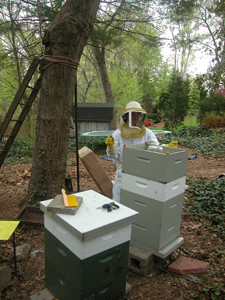
 Which brings me to my next great excuse for prolonged absence: I've been out trying to give what guidance I can to even newer beekeepers! The picture at left is my friend Jane in her apiary. I've been out there a couple of times (mostly because she worries too much!) and she has helped out at the mill, too. But I have also helped two new beekeepers set up at the Monastery (Joe and Joseph, with 2 and one hives respectively) and had a look into the hives of Bill, Andrea, and Jill. Mostly, new beekeepers just need a more experienced set of eyes to say "that's drone brood" or "this is a 3-day old egg) or "there's your queen" while they educate their own visual databanks. Sometimes there is an issue (like a crowded brood chamber) so I show them a few easy steps to sort things out. It's the kind of help I needed and got, and it is my duty to get out there myself.
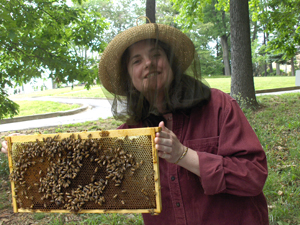
 Excuse number three boils down to even more doings in the world of humans, rather than bees, though it is the girls' fault to some extent. This picture shows my non-beekeeper cousin holding a frame of monastery bees (note this people: NO GLOVES!) We were on the road together for a week, celebrating her completion of another year of college on her way to becoming the teacher we all wish we had. She also helped me out with a surprisingly stressful commitment to volunteer in three different capacities (am I a moron, or what?) at the bicentennial of a historic site where I walk my dogs. This is the same place where we had the yellowjacket adventure last year, so the bees are really responsible for my rise to prominence (and exhaustion :-) ) over there.
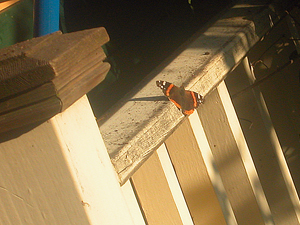
 Which brings me to the last figleaf of this post, but it is one to which you new beekeepers might want to pay attention: if you start looking out for bees and flowers, you are not very far off from butterflies and bats, and maybe snapping turtles and birds and ladybugs. Just after I began keeping honeybees, the world suddenly seemed to contain astoundingly more flowers and smells. This year, the yard seems to contain a remarkable selection of butterflies, birds, and native plants (which might have been simple weeds just a couple of years ago). When you open a door in your life, it's amazing the company you start to keep.
The Roof Bees
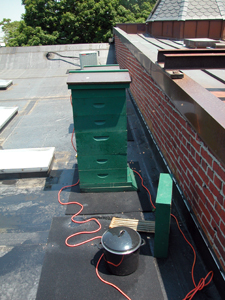
 But you are probably more interested in bees than excuses, so perhaps you would like to know what is happening up on the roof. After losing the mill bees to mite-borne illness (or so I think today: ask me again in a few months...) I decided to get serious about Spring varroa mite treatment. Around here, the weather does not cooperate with the methods I like the best: I won't use the neurotoxin pesticides, and the essential oil and formic acid treatments have exacting temperature requirements. The roof bees were most similar to the colony that died in terms of persistent mite loads and the type of treatment they received last year, so I was VERY worried. I did not want to use oxalic acid again, and the confectioner's sugar treatment (more on that below) would result in a layer of frosting on my roof.
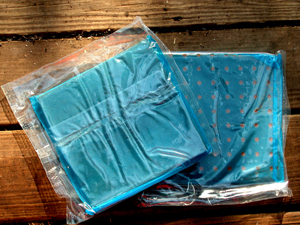
 My solution was this: formic acid pads —"Mite Away II," in fact. As treatments go, it is pretty convenient and non-toxic. The temperature has to stay above 50 degrees F, and below 79 degrees F (at least during the first week), though. Around here, Spring is a bumpy time, and nights in the 50s quickly turn into days in the 80s. The pads have to be on for 21 days, and you have to get them out of there before the honey flow (in other words, May) so you can see that timing is everything. The heavy dose of formic acid which is release in the first week also hurts uncapped brood, which can put a hole in the workforce just before the honey flow here. The pads went on April 26 and came off on May 17. I've never tried a Spring mite treatment before, and truly hope this will make a major contribution to the health of the girls this season. They need every break they can get.
 With apologies for the smear on the lens, here is the latest rooftop plot twist. These are supercedure cells in Wilde, my crazy Carniolan tribe. There were also THREE capped queen cells in the swarm position at the same time. We found them just as my cousin and I had to leave for our trip, so the next morning in the car, I sat there wondering whether they had left, and whether the formic acid treatment gave them a better chance of surviving if they did set up shop on their own. MaryEllen told me that the swarming impulse was considerably muted during the honeyflow, so maybe they would not go at all. As of today, it appears that they did not go. Perhaps they superceded, though their mom (a supercedure queen herself) is doing a great job.
The workers may have blamed her for the brood break that came with the formic, or they may have called it all off later. I am not sure, but I can tell you that there are three medium supers of honey on that colony, and probably 60,000 bees, so it is nonetheless a good year so far.
But what about Twain, you might ask? That hive superceded last year, too, and is still standing. The colony has fewer bees and less honey than Wilde, but it is definitely happy and strong. I was just in there today, giving another honey super to them. Even though most beekeepers here think that the main nectar flow is over, we have lots of linden trees planted along the streets, bursting with blooms. I hope that they will continue collecting actively for at least another week. While in the hive, I saw the darkest honey ever: tulip poplar, probably. There was no evidence of swarm cells, and lots of new eggs. While not as dramatic as the Carnies, Twain's Italian honeybees are buzzing along just fine.
The Monastery Bees
 The Franciscan bees have presented the biggest scare and largest challenge of the year, so far. Sometime in late Winter, both queens became drone layers, and I had to pull all sorts of drone brood and requeen. Unfortunately, the Minnesota Hygienic queens that were available so early turned out to have problems. MaryEllen had several, none of which worked out, and one of mine ended up dying at my hand.
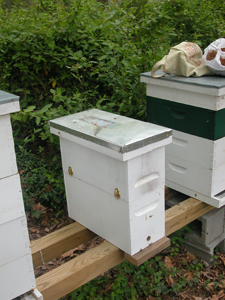
When the package bees I won arrived, I installed them in a nuc box at the Monastery as well. You can see the box at the left, with another upside down nuc box on top (to function as a feeder box). Those bees took off at once, with the queen laying wall-to-wall and happy bees flying to and fro all day long.
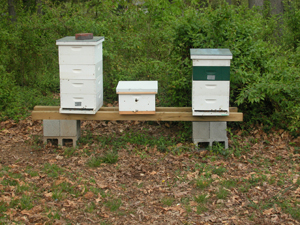
 For several weeks, I went to the Monastery to monitor how the Minnesota queens were doing, from being released through initial laying. The queen in the Doug colony (furthest right in all of these pictures) came online relatively well, but the MaryEllen-the-Hive queen produced just a very few brood cells, then would stop, then would start, and I could never find eggs. For a month, I would go every few days, planning that "today is the day" I would kill the weak queen and unite the remaining bees with the nuc. You can see from this picture that the package had grown so big that they had been expanded into a full hive body.
  Then, in the next picture, you can see that they actually grew larger than MaryEllen-the-Hive.
Finally, I opened up the colony, and found that wax moths had started to breed, and that the bees had been too weak to fight them off. The time had come, as much as I hated to kill a poor, innocent creature who had earned no blame. To let her live, all her children would die, and a hive that could give life to thousands of wild plants (and the creatures that depend on them) would cease to exist. It was my responsibility, and I did it, but I wish she had not seemed so terrified and confused. It was not her fault.
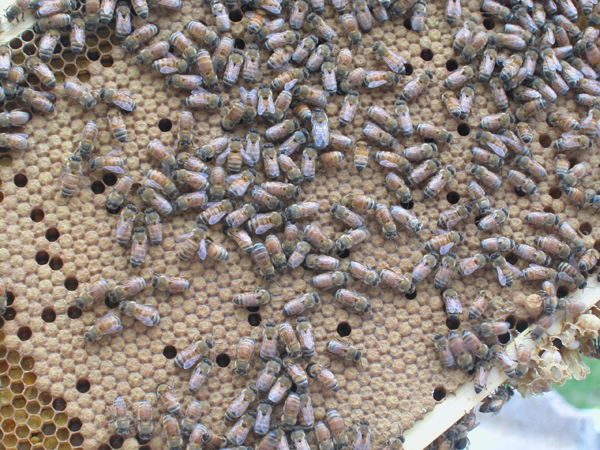
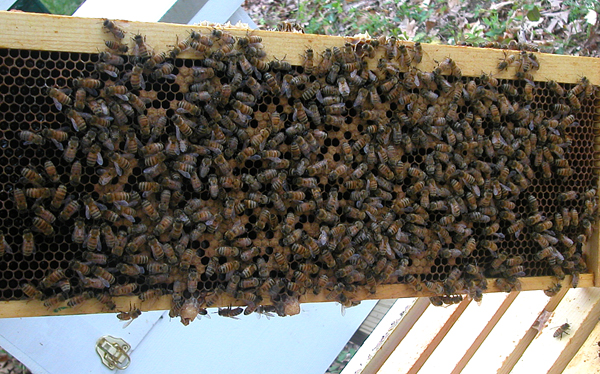
 But let me try to explain what I saw. Here's a shot of a really great brood pattern. Do you see how there are very few open cells? The edges of the frame hold nectar and pollen for the nurse bees to use in taking care of the brood. The queen began laying in the center of this frame, and little by little, cell by cell, spiraled outward, laying. The cells in the middle will hatch first: some of the empties near the edges may actually be brood that has not been capped yet. The queen will come back later and lay again in these cells, once they are cleaned and ready to go again.
 This is a not-so-great pattern. If you click on this picture, you will get a bigger-than-normal photo, an attempt to show you something which is a little hard to see. This is a medium frame, but it is not even filled out top-to-bottom. There are more empties than filled holes. Finally, do you see the queen cups on the bottom? These workers know that they need a new mom, and are trying to get one. The cups are actually in a swarm position, but the hive is so low on population that there is no way they will swarm. I think they are just trying to get a new queen any way they can, and they are not succeeding.
So in early May I united the nuc and MaryEllen-the-Hive, and they seem to be doing really well now. I still need to watch Doug, because that hive still has a hygienic queen, the last among all the queens that MaryEllen and I installed from that shipment that still appears to be reigning over a hive. Therefore, there is reason to worry that she will peter out. But so far, so good.
You might wonder why I am not talking about varroa treatments at the Monastery, and you would be a smartie if you did. The reason that I did not do a Spring treatment is this: the drone laying and drone larvae removal was one massive IPM-style varroa treatment. The mites are attracted to drone larvae preferentially, and when you remove the boys, you generally whallop the varroa population. Also, requeening caused a big disruption in the hives' brood cycles, also depressing the varroa population. Therefore, I am holding off until Fall, trying not to interfere too much in these very messed-with hives.
The Historic Mill Bees
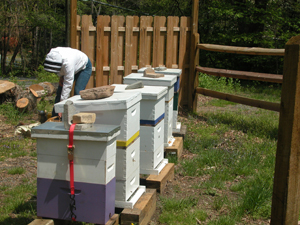
 In a way, I've saved the simplest, most rewarding story for last. Here is the Mill apiary, with 4 hives and a nuc (the small colony with a red strap around it). MaryEllen-the-Beekeeper is having her swarmiest year ever, so she keeps having to stash a nuc of captured wanderers at the Mill while she plans her next move. Since last year, a big old tree that overshadowed the apiary had to be removed (or it would fall down) and you can see me in the background in front of our new privacy fence. The extra sunlight seems to have done wonders for the girls, because we are all doing really well so far.
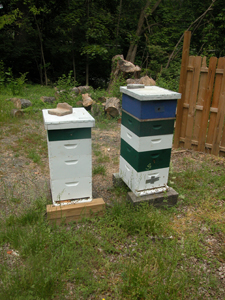
 Here are my two colonies. I am trying to replace all the green boxes with white to get away from the stripey look and to keep better track of my gear inventory, but you see how it is. These two big colonies were actually started from packages just two months ago, and they took off like a rocket. The packages were installed onto comb that the girls who died left behind, somethig that worried me. But there is no evidence of disease so far, and a general vibe of health and happiness seems to spread from those boxes. There were three medium supers of not-yet-capped honey on each hive when I visited a couple of days ago, really wonderful for colonies started from packages this year!
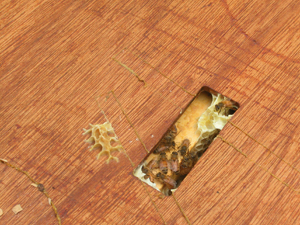
 This is just a gratuitous art shot of bees through the inner cover on the day I replaced it with a screened cover (for better ventilation and heat reduction). I just love to look at them.
 And also a bit unnecessarily, here is a picture of some mill nurse bees taking care of new eggs. It is more important to see eggs than to track down the queen, and these hives have made it very easy for me this year. They have grown fabulously and happily, and I just hope to stay ahead of them in meeting their needs, including varroa management. The mites killed their predecessors, and I want to do better this year.
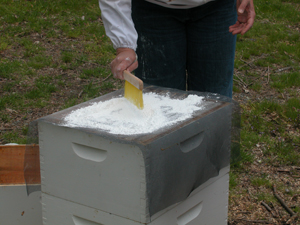
 After going to a state beekeeping meeting where the role of all kinds of chemicals was a concern in the recent Colony Collapse Disorder crisis, I became convinced that I should try a completely non-toxic, non-chemical approach to control at the Mill. Here you see two cups of confectioners' sugar ladled onto the screened top of a hive.
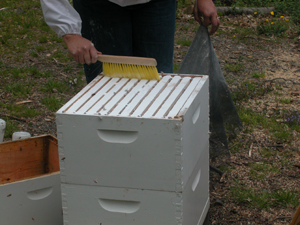
 By brushing the powdered sugar into the hive, I can cause the varroa mites to lose their footing and fall off the bees. The powdered sugar literally clogs up the little hooks and hairs they use to grab bees, and the motes fall down to the waiting ants. The bees can actually eat any extra sugar, and the grooming behavior they use to remove it also helps in mite control.
 The only problem with this treatment is that it needs to be repeated regularly and many many times besides. I know a beekeeper who used this treatment exclusively, and nonetheless lost her bees. Therefore, I need to watch for any signs of an infestation, and have another plan just in case one erupts. I have formic pads set aside as a fall treatment even now, but my jury is out on what to do if an infestation erupts during hot weather.

 It can actually be a little entertaining to apply this treatment. The bees change their buzz as soon as you drop the sugar, and they begin flying around in a somewhat disoriented fashion, looking like little ghost bees. Here's a whitened bee lifting her nasanoff gland, followed by another grooming herself on a fencepost. Notice the little white spot she left when she landed!

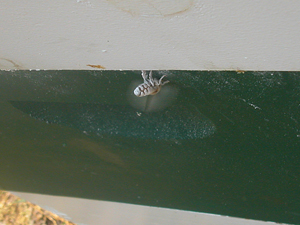
 The bees probably do not see so well with sugar in their eyes, and in the left picture you can see a bee that drifted into the hive next door during the mere 10 minutes between when I opened the first one and then the second to apply the treatment. The right picture shows a hapless bee that has been captured by a "Daring Jumping Spider," kind of a cool looking beastie itself. I know this may sound odd or wrong to you, but I am actually glad to see the bees become a part of ALL portions of the cycle of life where they are located. Honeybees are not native to North America, but if they can slip into an integrated role in a balanced ecology, they can provide tremendous benefit. I am sorry to kill bees, but not sorry to see life be succeeded by death and renewed life in the natural order of things.
 Finally, while there I actually saw one of the Mill queens cruising around, measuring a cell, and laying an egg. Unfortunately, I smeared my lens again, so this is the best I could do. It was a treat to see an utterly unbothered queen, healthily going about her regal business, supporting a family that is doing well.
 Hi all, it's me, the "secret" beekeeper who has a problem with actually remaining quiet. Except for the past two months (or more), when I have had a hard time figuring out what to tell you. But there are a few things I can clear up right away, and we can all relax.

 Perhaps you know this already, but the brothers at the Monastery were kind enough to welcome three beekeepers this year: me, Joe (the president of the Monastery Garden Guild), and Joseph (a hapless dogwalker I snagged with bee tales last year). Both Joe and Joseph have been my "mentees" this year (a.k.a. I am their beekeeping mentor), but I have not been on top of them about their mite treatments.
 This is a geeky hive-management report, the kind of post that I cannot imagine someone else reading. Since it is also the sort of thing that has been preoccupying me lately, and you have not heard much (sorry), well, here goes. You know, I would welcome your feedback on this kind of subject matter, either in comments (below) or emails to me (phang@tonitoni.org). Questions are also welcome!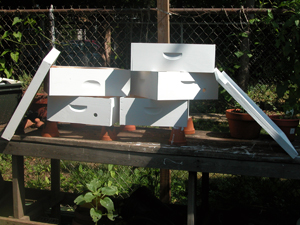




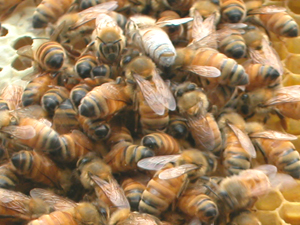
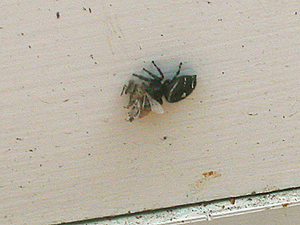
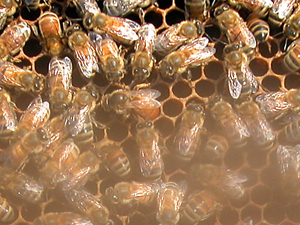
 Today I checked my hives after days of hard wind and rain. A honeybee pulled out a young, deformed worker, and dropped her a few yards away. The sick bee moved a little, but had no hope to live. Her sister took no time for pity. I did, but couldn't know whether a short tap from my toe would end her misery or shorten her only moment of sunshine. So it is with bees.
 Sorry that it has been a while folks, but as a local apiary inspector told me in a (late) email this week, it's the time of year when beekeepers tend to be digging in beehives, not tickling mice!
 On March 25, we did a simple thing that should not be overrated: we installed 4 packages of bees! Jane (another club member, who worries way too much about how she handles her bees) came along to help and to get more experience. Watch the sidebar for a detailed run-down of how we did it: I messed up a lot less than I did two years ago! My girls went onto drawn comb left by the deceased colony: this should help them get a much quicker start because the queen can begin to lay right away, and there is already honey in the hive for nurses to feed the young. MaryEllen checked a couple of days later, and said it all looked like a living apiary again. I will name one of the hives "Cockrill" again (hey, no superstition here) but am currently stumped for the other hive's name. I'm thinking about perhaps the current miller on the site...
 When some people arrive at this page via search engines, I can sometimes see the query which brought them here (sorry if that freaks anyone out). Lately, several poor souls have arrived here on the the heels of the search term, "bee death." I am sorry to welcome you, fellow beekeepers, to a woebegone club.
 You've seen me going on and one about the two main winter beekeeping issues around here: food stores and mites. This is the most interesting picture I could show you about how I've been trying to look after both.
 Very soon after sugaring up the bees, white-covered bees began emerging from the hive entrances, though this is just a close up from the top of a hive. To properly apply the sugar, you should remove each box, powder the top, place the next box on top, powder it, and so on. I am afraid to manipulate the bees much in cold weather: I could break the cluster, or expose the queen, or do some other typically awkward thing at a time when the bees have few options. So, for the sake of doing something, I put on the powder and then made another oxalic acid application.
  The granulated sugar is a winter feeding method suggested by a beekeeper at the state meeting last month. Bees often stop taking sugar syrup when the temperature reaches freezing, but they will (apparently) creep up on the inner cover and grab some dry sugar when the need arises. You can put a shim on top of the cover, and then place the telescoping cover. I'm a little unsure of whether this is worthwhile, for a couple of reasons. The first is that I don't personally know any beekeeper who does this, and the second is that the bees will need some source of liquid water in order to access the sugar as a food source. This latter is also a concern when offering them fondant (


 First of all, I want to tell you that the State Bee Inspector came by the historic mill on Tuesday, and he gave us the all-clear on American Foul Brood. In other words, we don't have it, or at least don't have it yet. He pointed out the big mite infestation in my hive there, though, and made various suggestions, including the use of Food Grade Mineral Oil (FGMO) to make those mites go slip-sliding away. I'll probably give it a whirl (there's no harm in it) but I have already completed two oxalic acid fumigations, and will make the third one on Monday. I think I am going to study up on how to double up on mite treatments, without unintentionally poisoning the girls with too much of a good thing.
 This picture shows such a bag two weeks later, The girls have cleaned it off, and actually started chewing the bag. The yellow stuff is propolis (no Carniolan party is ever complete without propolis). As of today, they got a chance to start over on a second and final dose.
 While working here today, the rain gauge on the roof informed me that today, September first, we have just received twice as much rain as we did during the entire month of August. Far from using this as an (admittedly tempting) opportunity to kvetch about the weather, I'd like to thank you intrepid urban gardeners out there...the ones who planted salvia, chives, lavender, Russian sage, crepe myrtle, augustache, Japanese Pagoda trees, and those few other late-summer bloomers that offer up nectar and life to the bees. And even more, who water them more per acre than any farmer could.
  The wind has been whipping fiercely, too (over 30 MPH around 3 PM), so I went up to look at the girls, and this is where today's pictures come from. You may remember that I drilled extra entrance/exit and ventilation holes in many of my hive boxes to spare the girls extra work in coming, going, and cooling the hive. When I went up to peer into the holes on the windward side today, I saw no bees, and could not even arouse a guard bee's interest by sticking in a finger. This was worrying. Checking the wall-ward side of the hive, there were the girls, mighty crowded, too. The wind was affecting them badly, and they were trying to get far from it.
 So I searched around the roof to find something with which to temporarily block the holes, and found wind-blown maple and sycamore leaves. The first couple of attempts, using somewhat limp leaves, resulted in near immediate removal. Then some crisper specimens arrived with a blast of rain, and the deed was done. The last picture is the leaf protecting the box with the brood nest.
 One of my major beekeeping shortcomings is taking counts of varroa mites on a regular basis. The reason for this is not laziness (or so I think). There are two main ways to count mites, one is a mite drop onto a board slid beneath a screen bottom board, and the other is a "sugar shake," where you trap a coupla hundred bees in a mason jar with a screened lid, put in a quarter cup or so of confectioners sugar, and shake it out over a bowl of water. The sugar knocks mites off of the bees, and the water makes it easy to count them as they drop. On a board, you just put it in, wait three days, pull it out, count mites, and divide by three.
  Back on
  The picture up top shows bees recovering from what I am doing in this picture: spraying sucrocide from a pump sprayer onto each side of every single frame in the hive, as well as the sides. We try not to spray Queen Maud or any open brood. By the way, this exercse has to be repeated 3 times, at one week (or so) intervals. Hard work.
  When applying the sucrocide, though, we found ourselves disassembling hives full of bees in hot weather, and reassembling them into hives of sodden bees who just wanted to climb up out of the box to catch some rays and dry off. Kind of a bee-cano, since my colony out there is just brimming with bees, easily a peak sort of population for a hive around here. This picture is actually MaryEllen's colony, though. Those boxes get heavy at midsummer, and they are very heavy to settle down gently, one on top of the other, while trying to gently convince wet bees to move along. Thank goodness we did this together!
 And on the fifth day (which would have been Friday), she counted. And what did she count? Nasty little pin-head sized mites, my dears. By the hundreds.
 On Sunday, my husband helped me apply the second round of oxalic acid treatments to my varroa-mite infested colonies of honeybees. We were actually a couple of days overdue, because the whole idea is to time at least 3 different treatments to catch every cell in the bees' brood nest at least once while it is open. This is an actual real-life picture of me with my genuine propane torch doing the deed. You can see a movie which demonstrates the low flame and positioning in either Quicktime (
 In case you are wondering what the copper thingum in my hand really looks like, this is the version I whipped up from