Friday, June 19, 2009

Swarm Catching for Dummies

swarm on branchWell into my fifth summer of beekeeping, here's the report: I have become the person about whom I used to scratch my head.
Back in 2005, soon after we finished the beginner's "short course," our club sponsored a field day at an orchard apiary in Burtonsville. Just as a coupla dozen students and maybe 6 experienced beekeepers closed up the last hive, a swarm from somewhere else began to settle in one of the trees under which we were standing.
OK, so this is one heck of a coincidence! It was also quite a show.
Before any beginner hive-minders could say, "Um, what?" middle-aged beekeepers sprang into action! Some ran for ladders, some ran for hive parts, one grabbed (I kid you not) a small saw, a 50 foot rope, and a bedsheet from out of his car (just happens to keep them around: don't you?) Another started dinging two pieces of metal together: an old wives' tale says you can get a swarm to settle if you bang pans.
A father of three soon sprang 20-feet-plus up the side of that tree, from which he sawed off a limb with a large swarm on it. Compatriots caught the branch in the sheet, and then set the hive entrance near the swarm. David, the tree climber, was down in a flash, and picked the queen out of that mess of bees and saw her inside. Swarm hived!
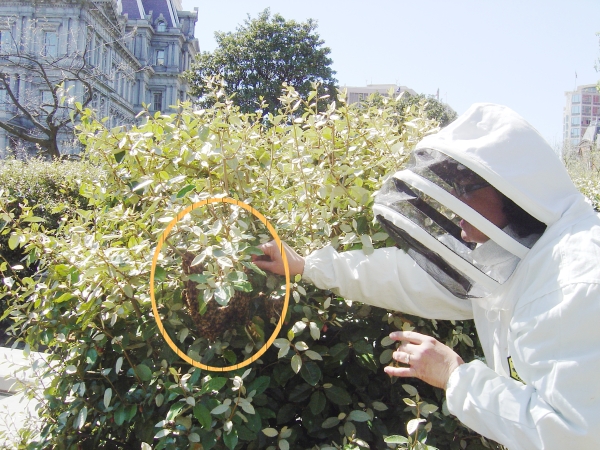
Four years and a bit later, I still cannot pick out the queen from a loose mass of bees, but I nonetheless hardly recognize myself. I've caught three swarms this Spring: one mine (*sigh*), one at the White House, and this one.
hand in swarmI actually object to the title for this post, but it is hard to find a better way to put it. Compared to the story above, the craziest thing about my adventure was a 20-mile trip across metro Washington at rush hour, though the decision was based merely on a non-expert's assessment that a whole lot of bees were hanging out in a convenient bunch right at eye level.
The thing about swarm-catching is that non-beekeepers always say the same few things:
  1. It's definitely bees;
  2. There are an enormous number; and
  3. The safety of the known universe is at stake

The usual case is that it is either yellowjackets, there are only a handful of bees, or they have disappeared by the time you arrive.
In spite of this track record, why did I drive to Reston on June 8 at 5 PM with two sets of bee catching gear (a nuc box for a small swarm, a deep hive body and all the trimmings in case the size was as-billed)? Three more things:
  1. Karen, the woman who called me, did not seem like the freaky sort, and she had gone to the trouble of calling over to Colvin Run Mill, where my Virginia bees live, to find a beekeeper just because she remembered the apiary there;
  2. Karen also asked her husband not to call an exterminator before she tried to find a beekeeper in order to give these critters a chance; and
  3. She swore that the swarm, whatever it's size, was hanging on the lower limb of a really young Maple tree in her front yard, so no ladders, drywall removal, or other shenanigans were required.

The picture of me, above, shows my ungloved hand, near my unveiled head, featuring an uncensored smile, next to a honking huge swarm of bees that somebody out there must sorely miss! I was able to pull my car up within 6 feet of the swarm, which would be considered "shoulder length" if we were all at the hair salon!
grabbing the swarmHere you can see the whole set up: there I am with my bed sheet on the ground, my clippers in hand, my hive body at the ready. Yes, I had most of the stuff in the car before Karen even made the call. I was hoping that, since it was after 6 PM by now, that most of the bees had returned from the field. I sat around for a while making sure that everyone was heading into my hive body, but it turns out that another couple thousand bees returned later, and I came back the next day to get them, too.
Because my two new Monastery hives are not doing well, I thought about bringing these bees all the way into the city, but I decided that they belonged out at Colvin Run Mill, all things considered. When I got them there, I peeked inside to be sure all was well, and the bees were already festooning all over the place, beginning to draw comb and make themselves at home. When I brought their laggard sisters the next day, I also brought another hive body and some feeders to help them along with all that wax production.
All in all, I would have done better to leave my capture hive out there that first night, returning back during early early rush hour the next day to ensure that I got more of the bees all at once. I feel sorry for the scouts that got left behind, and hope they managed to wrangle their way back into their home hive, or some other.
And the back of the car in the picture above still houses a small saw, pruners, a bed sheet, and a transportation strap. Just in case, you know?

Wednesday, June 03, 2009

No Such Thing as a Solitary Bee

Ok, so the truth is that there are lots of solitary bees, but they are not the honeybees that have lived and worked beside people for millennia. Why mention this? Because here in my no-longer-secret hometown, my picture is on the front of an article about beekeeping. I'm glad I'm in a veil, because I would never have had the opportunity to even open a hive without the help and friendship and wisdom of many others, and perhaps a few can be imagined in my place instead.
Some of them are beekeepers who are ready to tell others all about it, others enjoy a more private relationship with their bees, but it is a rare beekeeper indeed who does not rely on his or her connection to the rest of our community.
I like to tell people new to beekeeping that there is no such thing as a solo honeybee: a bee on its own is simply doomed. The dependencies are deep and complex: all the bees depend on the one indispensable Queen who is their mother, but she is the most helpless bee of all. The workers, who make the whole hive run, have nowhere to live and no food for the future without the existence of thousands of sisters back home who build and clean and guard and feed all day. Those lazy, fuzzy, funny drone boys cannot even feed themselves when their sisters close the doors to them.
And so many of us have opened our lives to them, some of us because we want to connect with our food supply, others to save the bees who are so essential to our agriculture, some for the love of honey, and some for the love of the green world around us.
Whether we planned on it or not, one of the windows that the bees seem always to open looks out on a world of natural miracles and wonder. And worries and responsibilities and joy as we try to help them thrive in a world that seems just packed full of challenges and threats and flowery opportunities.
Newspaper articles appearing now will perhaps make many more thousands of people aware of the bees on my roof and in yards and in flowers all over this city. My own personal hives have never been so exposed, and I hope I have not done wrong by them in sharing them with you. We live in a world that is full of fear, and I can certainly understand why something so unknown and seemingly out of place could cause concern. But we are in so much more danger without ties to the world and each other, without a community to turn to and ties that reach all the way into the world of bugs, plants, and critters.
I cannot tell you how good it feels to have a relationship that links me to a world of flowers and sunshine.

Friday, April 17, 2009

A Visit With the First Bees

vent at top of first hiveIf there is one eternal truth in beekeeping, it's that committed beekeepers always get a bit nervous when someone else inspects their hive, especially if that someone else has kept bees even one week longer. I've got a few years on Charlie, bee-wise, but not that many. Even so, it makes my heart get all warm to see such concerns, because only people who really care have them. And the bees do so much better in the hands of those who care. Which is my way of saying that Charlie let me have a look at the White House honeybees today. Thanks, Charlie!

Before I go on, this needs to be said: everything touching on that particular place tends to get wrapped up in spotlights and drama, and there is a real danger of feeling self-important or personally special just because of that place and this time. When I share this with you, please keep in mind what this is really about: the bees, and their way of both supporting our environment and inspiring great wonder in those who look after them. I feel that we all owe Charlie a whole lot, and I want him and the Obamas (remember, it's their back yard right now!) and Sam Kass (whose garden project makes it all possible) to get their credit, too.

But I bet you want a look in, too.

how to work first hiveWith apologies for the rough crop of the photo, this is how you work the White House bees: on a board set on two sawhorses. It helps to coordinate your movements and to balance anything you are up to with the other person up there! It is a surprisingly stable solution, with the plus that the bees that fall during a manipulation don't end up getting stomped, and you don't have to tuck in your socks to keep them from crawling up a pants leg! The groovy piece of woodenware (the one shielded by some plexiglass near the holes) is a vent of Charlie's own design. The plexi helps moderate high winds, whether natural or from helicopters. One unforeseen benefit of the hive scaffold: it is really easy to look up through the screened bottom board to see where/how tight the bees are clustering.

As you might imagine, a couple of key concerns for bees in this location are swarm control, and monitoring temperament. Our visit today was mostly around the former: to keep tabs on how they are building up and reverse the hive bodies if that seemed useful, and to make sure there were enough supers in place for the current and soon-to-be-upcoming nectar flow.

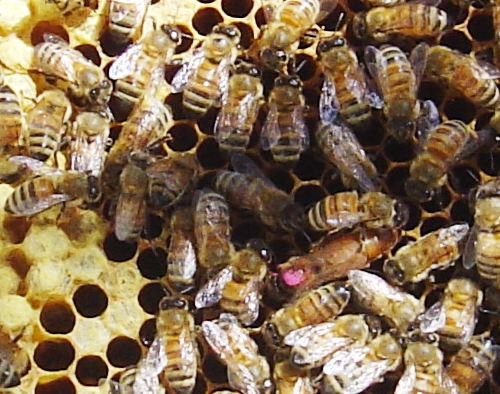
First Queen BeeTo my mind, Charlie's queen is a good one for the job. The bees were extremely peaceful and gentle, and her pattern was OK, though not gangbusters. In a situation like this, I am all for the happy medium in terms of brood production! The drone brood was in the right place, she seemed to lay more from right to left than in a spiral starting in the center of the frame. You can click that picture of her for a slightly larger version.

When we opened some drone brood, there was a minimal presence of varroa. There were no k-wings and I saw no mites on bees. The hive has three medium supers with drawn comb, there is a fair amount of nectar in the first two, so Charlie is out ahead of this one. They had put aside some honey down below, but I am seeing that at home, too. Nice white cappings.

small swarmFinally, as I was saying goodbye, Charlie got a call aboutanother swarm at the north gate! I said I would take it if accessible. So we checked it out. It was clearly a second swarm, probably thrown off of the same nearby hive that produced the famous one last week: about 2 pounds (1 kg) of bees (image is clickable for a better view). Since I am giving away a split this weekend, I thought my friend might want this queen to go with it!

Charlie got me a box, poked some holes in it with a nail, and we borrowed some bolt cutters from the carpentry shop to lop a small limb off the swarm bush. Sorry bush! He sealed the box shut with blue gaffer's tape, and in a supporting page (a bit later) I will tell you about my hapless adventures in hiving it when I got home.

So once again, thank you for including me in this adventure, for doing such a wonderful thing, and for taking care of those girls the way any one of us would hope our own home hives get tended. I hope you get as much help as you could possibly need in helping them thrive so close to the heart of our nation!

Wednesday, April 15, 2009

Public Beekeeping and Rainy Days

honeycomb decorated hive bodiesThis is the second of two cold, rainy days in a row, and I must finally be catching up because this poor blog is getting some attention. You can see, in this picture, what Spring can bring when the only ways of working for the bees involve paint brushes, newspaper, and a fair amount of cursing.

This next note is probably only interesting to me, but over the past week or so this blog was visited by thousands of people, all of a sudden. That's because one of my friends, Charlie, is the beekeeper at the White House. But it is Spring for my bees, too, and it is time to stop being dazzled by the limelight and to get back to the sunshine of my own beeyard (once the Sun does come back again).

Basically, I've got a lot more apiaries to visit this year, though not the one at 1600 Pennsylvania Avenue NW (Charlie might have me over at some point, if some skilled free labor is ever necessary).

This Spring, I've come out as a beekeeper to the Office of the Mayor and to my City Council representative, figuring this is the year to make beekeeping more legally welcome in the city. In response, the District of Columbia has invited me to place hives in two Parks Department-run youth gardens, and USDA has opened some doors at the National Arboretum. Two other beekeepers will take one of the DC gardens, a mentee and one of the staff at the Arboretum will (tentatively) have bees there, and I will cover the other D.C. park. We'll be placing hives and giving presentations to Summer camps. This is in addition to the sessions at Colvin Run Mill, where I am planning to put two new hives from packages.

observation hive
All of this means that there will be lots of summmer camps, at four locations, plus whatever comes up along the way. So I finally bought my own Observation Hive, this one from Betterbee.

I have borrowed many observation hives in my day, and think that MaryEllen's Ulster hive has been the best so far. I wish it could show more than one frame, however, and I am not really looking for a hive where the bees can live all season, so I decided to try this format. Most observation hives require you to slip a frame of bees into the equivalent of glass envelope, and most of the time some bees get squished. Inevitably, the smartest, nicest kid you present to points this out, too.

This observation hive works more like a narrow glass closet, and shows two frames. Let's see how it goes. Right now I am cursing the fact that I have one more complicated thing to paint.

The hive bodies you see way above will house the nucs that will begin hives on the roof of the Fairmont Hotel here. Those girls are due on April 23rd.

I was going to get packages for the hotel, too, but my go-to-guy, Larry, ended up with a more successful nuc progam than predicted this Spring, and I thought they offered a better chance for early success, and a partial harvest, which seemed a big goal for the hotel. The chefs at the Fairmont (whom I will be teaching-by-doing) seem a little hesitant all of a sudden, but I am willing to take their bees and this cute-i-fied equipment if they bail out.

But let's hope they don't read this blog, right?

My bees have wintered well: I lost just the nuc which was an experiment. Six mature hives survived.It seems to be a trend here to try to winter nucs, and accomplished beekeepers do it, but I'm missing the point, I guess. And missing those lost bees.Three of my hives are monsters that need to be split, and there are three OK ones. I'm giving one split to Joe at the monastery, because he lost some girls this winter and he is a good beekeeper.

Everyone has their first supers on, there have been several hive operations this Spring, and I will post more details on a supporting page in a bit. With the order of three nucs and five packages to cover all this, I will have 10 hives in my own apiaries, two in a city park, and four being managed by mentees.

I believe I have lost my mind.

This is the year for urban beekeeping, though, and as fearful as I am of taking a public role, there has never been so much public support, interest from new beekeepers, emphasis on "greening" the city, and coverage in the press (even a sidebar on city beekeeping in Scientific American!) I might get shut down, at least downtown, but I have the chance to reach thousands of childrens (and their parents) before that happens, if it happens. My friends in the 'burbs will help me find a place to hide out, if necessary! Please keep my girls in your thoughts as we begin this new phase of adventure.

Please keep all of us, famous, shy, winged, walking, and looking forward to the Sun, in your thoughts as this important season arrives.

Sunday, March 29, 2009

An Excellent White House Bee Adventure

yes, there they are on the White House LawnOK folks, I'm not the White House beekeeper, but I got a front row seat at the creation, and am so grateful for the experience that I have to share.

And for those of you who just can't wait, I have some additional photos on one of the supporting pages here.

On Tuesday, March 24, the first known hive of bees at the White House arrived at their location on the South Lawn. You don't have to count on my crummy photo to see them: just stop by the fence on the Ellipse (south) side: two deeps and a medium of Maryland mixed breed bees, with known Russian and Caucasian genetics.

The White House beekeeper is Charlie Brandts, someone who has been a quiet beekeeper in this area for three years now. His reserve is probably why he asked me to do some of the talking about his idea to include bees in the White House Victory Garden project.

During the 2008 campaign, Michelle Obama emphasized healthy, local food, and since arriving here has tasked her family's personal chef, Sam Kass, with putting a garden in to supply fresh produce for the Executive Mansion and educational events for the community. Charlie realized that this was a chance to include bees, and to show their important role in putting one of every three bites on your plate. Charlie allocated (free of charge, people!) one of his own hives for the White House Victory Garden, and it will both provide hive products and an teaching opportunities.

Why are you hearing this from me? Even though I am supposed to be a secret beekeeper, I am actually the noisiest hive-minder in Washington. I was invited to meet with the staff, and to tell folks how we get it done in DC! The folks who run the place had some questions about urban beekeeping, but I have spoken to garden clubs who were more resistant to pollination. I think they were just looking for a reason to say "Yes!"

It takes more than ideas, excitement and a presentation to make things happen at such a special place, however. It took a few weeks and approvals from everyone from the First Family to, of course, the lawyers. We've been wanting to tell everyone, and finally, a little while ago, the news broke.

Needless to say, many beekeepers are very excited, and some of them think that Charlie has the responsibility to be some kind of spokesperson for beekeeping in THEIR area. I disagree: he has done his part, it is time for us to do ours.

Now that you know some of the details, it would be great if we would all calm down and use the fact that bees are at the White House to advocate and educate about beekeeping in the wide range of communities and contexts that make up our country.

Don't let this news fade: use this moment to make bees shine in the spotlight, and to tie them to the place where your families live. It is hard for me to imagine a location with more special requirements and available excuses for not including honeybees.

If they can make it there, we can take them anywhere.

Oh yes we can!

Monday, March 02, 2009

Snow Day, Spring, and City Hives on the Rise

bees in the snow, with deck and neighborsIf October marks the end of one yearly cycle of beekeeping in this city, late February and the beginning of March are when we anxiously watch our hives to see if life will return after the trials and tribulations of winter.
Last week, temperatures hit 70 degrees F (21 degrees Celsius). Today at noon it is 23 degrees F (-5 degrees Celsius). This kind of variation is brutal for the bees.
When it is warmer, they form a rather large, loose cluster over the bottom edge of their honey supply. As it gets colder, that cluster contracts smaller and tighter over a diminishing amount of supplies. They can starve to death if the cold spate lasts a while, because too many bees (who cannot shift) are concentrated too far from where the top edge of the cluster (and the fresh honey supply) used to be. This sort of challenge is what keeps beekeepers biting their nails as our increasingly shifty winters begin to fade.

Local Update

As for my girls, the henbit (Lamium amplexicaule) is out, the willow and maple pollen has started to come in, and the short courses around here will soon be opening their doors, despite all the snow you see above.
To recap, six hives and a nuc (nuclear colony) started the winter, and there are still still six hives today. I tried to winter the nuc as an experiment, one many beekeepers around here are doing, and have found it to be a fine way to provide cold-weather homes to white-footed deer mice.
As a last part of my personal report, I wanted to apologize for the quiet on this blog: I've been out with the bees and the beekeepers, and a little ashamed of some of my mistakes.

Spring Brings Newbees

There's a video (from Meerkat Media) embedded below as a flagrant attempt to reach out to newbees, because interest in beekeeping in my city is growing, with at least 8 hives going up on hotels, offices, roofs and back yards. I'll have new neighbors at the monastery, and new beeks to mentor.
Just for you curious ones who are wondering if it is possible too have bees on the streets where you live, I know beekeepers in Atlanta and Philadelphia and Baltimore and San Francisco and London who are all on their trajectories toward Spring. The video shows happy beekeepers working in Chicago and New York, as well as more traditional places.
Some renegade beekeepers in Manhattan, The Gotham City Beekeepers, have also asked me for a shout-out and you for your support as they attempt to come out of the shadows and contribute in the sunshine (like the bees).

title screen of film

Tuesday, January 13, 2009

Soapmaking Resources

With apologies to everyone who has no interest in this, some networking problems require me to post this information here!

For handouts and links related to soapmaking, please go to

Soap Downloads

Monday, November 10, 2008

I was on the radio

design of festival button saying I am a Maryland BeekeeperI'm not very good at being a secret beekeeper, despite my plunge into silence here over the past few months.

You see, sometime in April (I think) I guiltily called into a Bee Association meeting via static-filled conference call (instead of taking the time to drive over there). Guilt about my laziness and a bad phone line resulted in me volunteering with a slight miscomprehension of the dimensions of the task at hand, the 100th Anniversary Festival for my local State Beekeeping Association. A VERY big deal! I ended up running the whole thing, and losing a fair amount of sleep (and peace of mind).

Officially, 2,085 people came, and with equal certainty I promise you that:

  1. I will never do this again; and
  2. I want to go into seclusion.

About three dozen beekeepers volunteered for the day, however, in addition to the Amercian Beekeeping Federation Honey Princess, and Haagen-Daz donated free ice cream.

And my bees are still alive, though perilously low on stores (except the roof girls, who are just rocking along). Updates and photos *are" coming, but I want you to know that David Furst, the guy who interviewed me for the show you can hear by clicking the link above, was very kind to me and I am proud of how the whole thing turned out.

Wednesday, July 02, 2008

Bees in High Clover

honeybee working white cloverThe nectar flow ended here between two and three weeks ago, though we still have many flowers in gardens doing their best to keep the girls busy. One thing I have been taught to look for, but which has eluded me in the three beekeeping Springs before this one, is a secondary nectar flow from white clover.

Beekeepers tend to be unpopular neighbors in the suburbs: we like many of the broadleaf weeds, like dandelions and clover, that mar the upper middle class ideal of plushy green turf. In the city we aren't so picky about our greens, glad to have the photosynthesis that nature can push between the cracks. This photo shows a bee working a plentiful bloom of white clover that was all over the historic cemetery where I walk my dogs.

Often, a lack of rain or too much early summer heat dries up the clover: you can see some browned-out blooms in this photo (another fine example of cell phone photography!) So clover is an unreliable source, from opportunistic places, wiped out too easily by excess sun, a shortage of rain, or an enthusiasm for Roundup.

Interestingly, the bees were not working the purple clover at all. At a state beekeepers' lecture, I remember hearing that the purple ones are only good during their second year. Hmmm. Well why were there no second year blooms around?

street planting of Russian Sage/PerovskiaSadly but predictably, just today it appears that the mowers came to the cemetery, and wiped out at least an acre of bobbing white heads of clover. Well, it is mostly a cemetery, not a dog park and nature lab. Besides, there are still many millions of plants all around the neighborhood, though not where I could so easily visit with them. The picture at right shows one of many stands of Russian Sage that are already delivering the goods to the bees, and they are likely to keep doing so right through August.

street planted with lavender and salviaThis year the lavender is very bloom-y here in the neighborhood as well. I wonder if this year's honey will have additional sharp sweetness from the clover, and some extra floral dimension from the lavender. Hey, I like it just fine in its basic Tulip Poplar, Black Locust, and Basswood formulation, but life always rolls out a new angle.

Tuesday, June 24, 2008

Getting Dramatic About Beekeeping

With apologies for its irrelevance to many of you, I wanted to flag a performance of note to beekeepers in the Mid-Altantic Region, as well as a chance to help a fellow beekeeper "dramatically" raise awareness about beekeeping and its history.

A long-time beekeeper I know named Marc Hoffman will present a one-hour, one-man show called "Bee Man" concerning the life of L.L. Langstroth as part of the Washington, DC Capital Fringe Festival on July 17, 19, 20, 24, 25, and 27 in the Dupont Circle neighborhood of the city. His website for the production is www.lorenzolangstroth.com (is that a cool URL or what?) In case you were not aware, the bicentennial of the inventor of the movable frame hive is 2010, and I'm kind of hoping Marc's production will work out and perhaps travel in celebration of that anniversary.

If you are in the Washington, DC area, the production could still use a couple of volunteer hands (especially for the last three performances). It's not a big commitment, as the show is really short, and the venue is really tiny, and it's just a little fringe festival, after all! If you'd like to help, let me know and I will put you in touch.

Sunday, June 15, 2008

Six Live Hives

roof hives in mid-June 2008Hey there, remember me? Truth is, I almost wish you didn't (*if* you do remember, that is). I've spent the past 6 months just wondering what to say about the bees and my beekeeping and this whole great adventure. Just like a letter you keep meaning to write, knowing what to tell you has grown more difficult with each passing day. I started this post on March 5, 2008, more than three months ago. And I still can't decide what was going on then (or now).

But what anyone would probably want to know first is, "How are the bees?" The simple answer is that I still manage six live hives, and everyone that went into the winter came out again: no small victory! The harder-to-explain answer is that I have never been less sure of myself as a beekeeper. The picture above shows Wilde, the roof hive that worried the most during my first year. Right now, that hive is on track to deliver perhaps 200 lbs of honey when we harvest in 2 to 3 weeks. That equals last year's entire harvest. You can see a light colored line across the middle of the hive. That's a queen excluder, my first year using them. Below the excluder is the brood nest of over 60,000 bees, but a really narrow chimney of a brood nest. There is almost as much honey below as above!

tulip poplar at congressional cemeteryI can tell you one story after another about this year, each one ending with "In about a week when I check back in I hope to be able to give you an answer." This picture was taken on April 24, the date of the first tulip poplar bloom in my neighborhood, and the official beginning of the one great flow of nectar goodness that the bees enjoy each year. It also marks the last time I saw eggs in any of my in-town hives. Let me show you what I mean...

3-5 day old brood no eggsI'm wearing even stronger glasses this year, so at first I thought my eyes were failing me, and I used my camera to take close ups of the frames — back at my desk I can look at them at high resolution and often see things that get by me in real life. The camera only saw what I did, though: over and over again, I found only 3+ day old brood in the city colonies. All four colonies.

I need to see eggs to see if the queens are doing well, and to figure out whether the bees need space, and where they need it (Brood nest? Honey super?). It makes no sense to come back time after time and see older brood, but never the new stuff.

Warning: Geeky Beekeeper Speculation Ensues

fresh pollen storesMaryEllen hazarded an explanation based on our weird Winter and the pattern of Spring weather: the bees came through strong and populous because the cold weather was not that cold, and they ate alot of the stored pollen. She knows that I have never supplemented pollen (yes, kids, you can actually buy pollen supplements), because we are basically awash in it, and for the first time I had actually culled pollen bound frames in the autumn. This picture shows brand-spanking new pollen recently stored when I opened the hive. In other words, the only pollen I found was so new that it appears true that the bees had run through everything they had until very recently.

We had a very rainy pattern this Spring. Days of rain and cold, followed by a brief sunny opening when a person could visit a hive. MaryEllen pointed out that, in times of pollen dearth, the bees can cannibalize eggs in order to focus what they have on older larvae. They have more invested in the older brood, and perhaps my pattern of inspecting the hives so closely reflected the intervals when weather kept the forager bees inside that I never had the hive open on a day when the queen had the opportunity to lay some new eggs that had a chance to be fed.

I was not really buying this: I was sure I'd messed something up. But I have now seen no eggs in two months, yet I continue to see capped brood and new bees, so there's no other explanation I can figure. Other beekeepers who have no reason to pity me have found this theory plausible!

Swarms: The Big Story of 2008

Even if "The Mystery of the Missing Eggs" had not cost me some sleep, my yearly inability to prevent swarms would. But then again, it happened to everyone this year. Everyone's bees came through the Winter strong, got to feeling crowded when trapped inside, hit an all-at-once flow of all the early, mid, and late-season nectar sources, and decided to swarm.

The beekeepers of this region have, as a group, made the best effort in decades to re-establish the feral honeybee population, as involuntary as it was.

But I had sworn this year to be a better beekeeper: to keep better records, to do all the reversals and frame rearrangements and overall space management necessary to keep the girls home and safe, and I failed. I did my first reversals — re-ordering the boxes so that there was always a bunch of extra brood space above the queen's location — in March, my first checkerboardings (inserting empty comb into crowded brood areas) in April. It basically did not matter.

Three of my six hives swarmed, mostly after the nectar flow, though. The big hive pictured above was stopped only when I inadvertently made a split with the old queen in it. This was unfortunate because I was intending to make a new colony to house a locally bred queen I had just purchased from a beekeeper I really like. (Sorry, Leigh: I could not bring myself to tell you any other way). I had reached into that monster hive to grab just 5 varied frames from the over 60 that were in there, and somehow I missed the fact that I had grabbed the queen on one of them. The workers in the new nuc killed my new local queen in the introduction cage. I am such an oaf, so irresponsible, in such a rush. It was just terrible to see how I had sentenced her to die in fear. And she was such a carefully produced monarch from a thoughtful fellow beekeeper!

It appears, however, that by taking the old queen, I stopped the Wilde colony from swarming like practically everybody else did, so there will be a harvest this year. Wouldn't it be nice if some forethought and care had something to do with it?

This is enough updating for now. I will try to tell you more about the monastery, mill, and mentee colonies that have also needed some care this year. This post might not measure up any more than I feel my beekeeping does, but I hope that those of you who were worried aren't anymore, and those of you who are rooting for the bees are only working harder at it in the light of my mistakes!

Saturday, January 12, 2008

Do Bee, Newbie, Do!

a bee in handIt's January, about the time that some queens around here are ramping up to begin laying again, coinciding with the first stirrings of the would-be bee people.

I've been getting emails from all around (and before you get the idea that this is a problem, please be aware that hearing from other would-be beekeepers absolutely makes my day). In California, in Oregon, and even around here, city and suburban folks have had some questions. From what goes on in face-to-face bee presentations and courses, this means that many, many others are too shy to step forward.

Well, you should, because you have friends out here, friends who are deeply committed to helping you and our six-legged (five-eyed, four winged…)friends.

To provide more immediate help, I want to mention some common threads that are emerging this year:
  1. Siting an urban or suburban hive;
  2. Choosing a race of bees;
  3. What about Top Bar Hives (TBH)?
  4. Finding local help; and
  5. What about the neighbors?

Before taking any of my advice, though, you should do two things: buy a good book (here's a good one, but it could use an update), and meet a local beekeeper. When it all comes together in front of the hive, all the decisions will be yours, but you should expose yourself to as many sources of info as possible to make your choices as good as they can be(e).

1. Siting Your Hive
The place you put your bees' home is an important question for everyone, but beekeepers in crowded locations face special extra concerns. The idyllic bee location is in a spot with strong morning sun, a bit of afternoon shade, facing South, near water, but not in a moist place. It should be out of sight of well-travelled roads or paths, and should not be in the same place as cows, horses, or other critters who can knock hives over or be trapped and stung up. Read your book to learn more about these particulars…

But, for the urban beekeeper, compromise is more likely. But be(e) of good cheer: some studies show that urban bees are thriving when their rural or even suburban sisters are struggling a bit more.

Your priorities may differ, but mine go like this:
  • determining whether bees can live in my neighborhood
  • keeping bees and people from ruining each others' day
  • ensuring that my access to the bees is safe for me; and
  • perfecting (as well as I can) the location that meets the criteria above.

Can bees live with you? Almost certainly: people raise bees from the hot roofs of Texas to the cold plains of Alberta and beyond. So climate is probably not a problem. But it might not be legal to keep bees in your community: in many places it isn't. My commitment to the bees is such that I don't worry much about this, and am working to change laws and minds. In some places, especially those where Africanized bees are a real threat, you might not take it so casually. So if beekeeping is a shady business where you are, take precautions to stay below the radar, and try to understand why before moving forward.

bees on roofStaying on the down-low plays into my next point: find a place where your bees cannot be seen easily from public pathways or roads if at all possible. Vandalism (and theft!) are major sources of bee losses. Consider investing in potted shrubs or privacy fencing, if possible. If you have no place on your property which is suitably private, I strongly suggest finding an "outyard" nearby. Beekeeping clubs get calls all the time from people seeking bees for their gardens or parks, etc. I have bees in two such locations, and they are a real resource when I have to manage the roof girls.

Next, sun versus shade, and the direction in which the hive faces are usually not 100% in control of the urban dweller, and your bees can cope. Your first concerns, the safety of passersby and the security of your bees, will probably limit this choice, anyway. I suggest that ANY sun is better than none, and situating a hive entrance AWAY from the wind can help with a lack of sun. My home hives don't have a southern exposure, and they are fine. If you think your site will be unusually hot, consider available cooling options (provide shade artificially, or use a Bee-Cool, for instance).

Finally, it can be useful to get your bees to fly upwards as soon as possible—above person height—by placing the hive entrance opposite (maybe 2 feet away from) a fence or a hedge or some other vertical obstacle. The less time the bees spent below 6 feet (or two meters) the better. By the way, getting the bees to fly high is one reason why balconies and porches, as well as your roof, can make great hive locations. Just remember, you have to be able to get to the location while carrying many pounds of tools and supplies (like sugar water). While you are there you will be manipulating woodenware and (eventually) carrying away 60-90 pound honey supers!

Some of you may wonder why I did not put anything in here about placing certain plants around the hives, or ensuring that your yard has a garden, etc. The reason is this, oh urban dweller: your bees will forage for 2 miles in every direction, making millions of trips to hundreds of thousands of plants. What you can plant in your city yard could not support one tenth of a hive. When you place your hive(s) in your city backyard, you are placing a bet on the viability of your entire environment, and the planting choices of your neighbors, your city park managers, and the people who water the tree boxes along the streets. Gulp! But it seems to work.

2. What Race of Bees?
There are lots of races, but there are only two I know much about: Italians and Carniolans. If there was a third, it might be "local," but those are genetics I am only just learning about, and you should, too. I've heard good and bad things about Russian stock, but that's all hearsay, and I can give a shout out to this one beekeeper in Philadelphia who keeps Buckfast bees, but this is what I have to say.

Italian bees seem to require higher temperatures in order to work than the Carnies, and they need to winter over in larger numbers, but they are less likely to swarm and they are really gentle. A good starter bee. They are easy to find.

But I have had Carnies, too, and they have done well. They come from Eastern Europe, where growing seasons are short and temperatures are lower. Because the weather is easier here, the bees tend to build up large populations and, therefore, to swarm. This can be tricky for a new beekeeper to avoid.

Now, there are other things beyond race to think about. You can get hygienic stock: I have worked with Hygienic Kona Carniolans, with good luck. Hygienic bees have been bred to be clean freaks, and get some disease resistance that way. Keep in mind, the time that the bees spend cleaning is not used for foraging or raising young, etc. That means somewhat less productive hives.

Finally, if you can possibly get locally bred bees, whatever your locale might be, that is the best thing to do. As Colony Collapse Disorder ravages the beekeeping business, regions that are able to produce stock adapted to their place and plants and weather will also be ensuring that the biosphere will have a surviving stock of bees to keep things blooming.

3. Top Bar Hives (TBH)
This section will be much shorter. New beekeepers seem to be very into the idea of TBH this year, and it worries me. I am intrigued by TBH and am interested in experimenting, but thus far have found that beginning beekeepers need immediate, practical access to other experienced beekeepers in order to get themselves up to speed and their hives up to stable population and health. There is MUCH less help around for TBH, and the format is native to places that are extremely different from where I live. Since having the bees here, I have continuously called on other beekeepers to borrow some equipment, to get advice, or to compare notes.

That being said, there are helpful people online, and maybe near you. Michael Bush at Bush Bee Farms has helped alot of people, and knows much more about TBH. Folks, I'm not sure why all you have such an interest, though. You can do organic beekeeping in a Langstroth hive, after all, and the girls are fascinating in any housing arrangement.

4. Finding Local Help
If there is one law of beekeeping, it should be this: no one should get their hands on bees before spending time with a beekeeper. Hey, I was a smarty-pants college kid with good homework habits once myself, and I can assure you that book learning is no great comfort the first time you go about installing a package of bees. Then in the panicky weeks after, when I assure you that at least 60% of new beekeepers become convinced that they have killed their queen, you will want someone to call. Or several someones. And maybe someone to come over and have a look (and a beer). Folks: this is the truth I am telling you.

So find a local club. Take a local short course: they are cheap or free, will hook you up with local bee suppliers, and will give you a basic clue about what to expect in your first year and all the seasons to follow. I don't care if you are shy (believe it or not, I'm an introvert). Just go. And try to be brave enough to ask questions: it is an incredible public service to the many people who will be more shy than you.

How to find a local club? In the US, I would check out the links at the Eastern Apicultural Society (www.easternapiculture.org) if you live east of the Mississippi. In the west, you should google your state beekeeper association. Anywhere else in the world, check out www.beehoo.com. If you run into trouble, ask me for a hand.

5. What About the Neighbors?
This was the single most worrisome topic for me, and rightly so. I decided not to tell anyone, because my bees were a minority of the stinging insects on my block, they were placed responsibly, and I was worried that in these freaky times that people would carry on like, well, freaks.

In my case, I needn't have worried. I mostly got found out, there were no problems (so far). Right now, the amount of news coverage devoted to the plight of the honeybee is definitely a support for your decision to keep bees. If you know your neighbors well, and think you might get a good collaboration/cooperation going with them on this, it might be worth the risk of telling them. In my experience though, more than 50% of the public absolutely believes that they are the 1 in 10,000 who will go into anaphylactic shock if stung by a honeybee. They have probably never even been landed on by a honeybee, but have had some nasty past pas-de-deux with a yellowjacket. It takes a lot of talking and a good personal relationship to get beyond that kind of fear. At this point, I am very glad to have outyards available to me, should I need to move my bees (and yes, moving bees is possible—it happens all the time). If you are worried about the neighbors, consider arranging an outyard.

Finally, the End
This got very long, and very bossy, it seems. I hope it did not dissuade you. One of the things about beekeeping is that there can suddenly be alot to know, and you can feel overwhelmed.

But you DON'T need to know everything at once, and if you work alongside another person who has been through many of these things, it makes sense rather than seeming like a dreadfully long list of things to memorize.

Even this long post is really a series of "if then, then this/if not, then that." It can be dizzying.

But your case will be rather more specific, and special to you. Your honeybees will integrate in an important and beautiful way with that particular environment around you, and you will get a wonderful chance to learn its ins-and-outs. For anyone like me to spin out a series of guesses about how things might work out for you is necessarily confusing and ugly. But your honeybees will be anything but ugly: golden angels with a world made out of flowers and a wake made up of growth.

Thursday, December 27, 2007

A Late Season Save?

bees in top box in December!My Romanian beekeeper friend George Tamas (his blog is linked at right, "Happy Apiary") once told me about the benefits of knocking on beehives. Most of you might question the sanity of walking up to a perfectly peaceful hive of honeybees, rapping smartly on the side, and then pressing your cheek tight up against it to hear what you can hear.

Well, the reason is this: during the winter, you don't see much of your bees. And when the temperatures are low, you really should not be smoking them, opening up their home, and poking around. You can very easily kill the creatures about whom you are curious.

One cheap-and-cheerful way to see if they are still alive, whether they are near the end of their seasonal stores, and whether a more intrusive visit is warranted is to knock and to listen. George says he can tell by the type of sound that the queen is OK, and maybe a few other things. Myself, I just listen to hear whether there are a lot of bees, and where they are positioned in the hive.

If I knock, and very clearly hear a big BUZZ, I know there are a lot of bees in there. I can also tell whether my ear is placed somewhere near their winter cluster, where the bees are all keeping each other warm. The position of that cluster tells me where the bees are with respect to their food supply.

bees eating fondant in WildeWhen I put them to bed in the autumn, all my bees were in the bottom box of the stack, and I had placed supers full of honey above them. Because I am the worrying kind, I also put additional food above that. This is a picture of the Wilde bees chewing on some fondant I had put on earlier.

bird poop on the roofThe Wilde hive had been worrying me for a while. There wasn't as much action out the front door as I like, and my knocking seemed to indicate very few bees in any one box, with the majority, perhaps, very high up! I did not see alot of dead bees around, but the presence of some concentrated crow poop meant that the birds may have finally taken to cleaning up departed buzzers, and I could have dying bees without a lot of visual clues.

Don't get me wrong about this: I am very pleased to see this kind of interaction between species. I know you all might expect me to be horrified that anything would eat honeybees, but when you have 50,000 of the girls going into the winter, there are going to be some dead bees around later. If other critters can turn this grim reality into sustenance, this means that the bees have done yet another service to the health of the world.

When knocking on the hives got me to thinking something might be wrong, I decided to do something that no one recommends: opening up a hive just before New Years Eve.

The very first picture above shows you what I found: almost the entire cluster was in the top box. Bees eat their way up all winter: they will not usually go back down for food they overlooked. This means that all those upper-level bees were facing starvation.

Having lost bees in the past, I can tell you that there is some comfort in knowing that you cannot control every force in nature. Disease will sometimes beat you. But I can also tell you this: I will have a hard time sleeping the day that my bees starve on my watch. Disease is tricky, but food is easy.

I don't have many more pictures from inside Wilde that day. It was only 47 degrees F, right at the edge of feasibility, and I needed to get in and out quickly. This is what I found...

The Wilde colony was clustering ABOVE its honey supply. Probably because I had fed so vigorously, they seem to have stored food all throughout the brood area on the warmer days. Bees have a hard time clustering over full cells of stores: it takes extra energy to warm up the diluted fondant, and it creates gaps between the shivering bees. My theory is that on cold days, they moved up over capped or empty cells, and clustered there.

My job was, therefore, to put that top box (and the one directly under it, which also held a bunch of bees) on the bottom of the stack, and move the honey bound boxes back up above. In other words, totally disassemble a winter beehive, reshuffle the boxes, and re-stack them. And a deep full of stores weighs a ton, my friends. Why do I *always* end up stacking an 80 pound full deep box on top of all the mediums? Is Mother Nature that committed to building my upper body strength?

And that really is the whole story. I was paying attention, thank goodness. The weather cooperated a little, as well, and with a little exertion and a few curse words, the bees got another chance.

Saturday, December 01, 2007

Sunshine in Late Autumn

This is officially the "holiday season" around here, a time about which I am somewhat skeptical, but I have already received a terrific gift!

In mid-November, a local elementary school asked me to give a last-minute presentation about honeybees to the whole first grade. I cringed a little: the month had been full of talks to garden clubs, a suburban 3rd grade, a church fair, and … well, you get the idea. I was tired, temperatures were getting lower and lower each day, and the bees were not in a good place to recover from late-season mistakes. So, of course, I agreed to do it. They gave me a late afternoon time slot, agreed to do it bees-or-no-bees, and I began to prepare. Again.

I like to bring an observation colony to school presentations, but late November is not usually an appropriate time. Though the presence of the bees immediately focuses kids' attention, spurs more detailed and insightful questions, and demonstrates concepts in real life, it is awfully cold for opening hives, and it is foolish to even consider bringing a queen along: the workers can't replace her now that all the drones are gone! So I watched the temperatures, and we got to over 60 degrees. I packed up a deep frame of broodnest (without much brood) and a medium frame of honey (nicely full and capped), and took my borrowed observation hive to school.

Where I immediately broke one pane of glass with my car door upon arrival!

But I am finally becoming a true beekeeper, folks! I now travel with pliers and glue and old bed sheets and thumbtacks and window screen and, most importantly in this case, duct tape and printer paper to cover over the cracks. Several worker bees got out, but this time the school was less than two miles from my house, so I know that the girls were able to get home.

In case you were wondering, my husband chronically despairs over the condition of my car nowadays.

So, after arriving with two deep boxes, as well as a bottom board and telecover, and a skep, and bee-pollinated fruits and veggies (including a ten pound pumpkin), and honey samples, and gummy bears (they are coated with beeswax, if you want to use that gimmick yourself someday), and hive tools, and a smoker with fuel, and some handouts, I got to work.

We were scheduled to be together for 45 minutes, but in what seemed a short while I started losing my train of thought. The kids' attention was waning, too, so it seemed to be a lackluster session. There just wasn't enough bee passion in me to make it through November! At that point, however, one of the teachers mentioned that we had been talking about bees for an hour and a half, and the kids needed to get ready to go home.

Okay, then!

As we began the laborious process of packing my car up, I brought the observation colony back outside — and groups of parents-picking-up and children-going-home quickly gathered around. No one, it seems, can resist a close look at a honeybee. There were lots of questions, but before very long the first-graders were all about, and I let them answer most of the queries. Way to warm a beekeeper's heart, kids!

After 20 minutes or so, the bees really needed to get home, and I really needed to get horizontal, so we left. And that, apparently, was that.

Except a couple of weeks later, one of the teachers left a thank-you scroll on my doorstep. If you click on the link, you will get a new window containing my prideful, precious presentation of their lovely gift. My husband and I hung it just inside the front door, ensuring that everyone who visits us would be required to look. :-)

Rock on, first graders! I hope to see you next November, too.

Wednesday, November 28, 2007

After Long Silence

press clippingHi all, it's me, the "secret" beekeeper who has a problem with actually remaining quiet. Except for the past two months (or more), when I have had a hard time figuring out what to tell you. But there are a few things I can clear up right away, and we can all relax.

First of all, here at the dawn of true winter, all six hives appear to be fine. Everyone in this area is a little light on stores for the cold days ahead, but we've been feeding, feeding, feeding, and don't intend to stop.

Second, as I sit here today I am hoping that the girls have gulped down their last serving of pre-freeze bee medicine. The only "unnatural" medication I apply is Fumidil, an antibiotic that helps the girls deal with Nosema (a digestive ailment that you might get, too, if you had to hold your poop for as long as the outside temp hovers below 50degrees F (10 degrees C)! I might have skipped it this year, but the roof girls are still suffering the after effects of the mighty mite battle of over a year ago (some deformed abdomens) and I want to give them the help I can.

Third, my blog life and my face to face life have become hopelessly muddled, and I am not sure what to do about it (Hi everybody! Yes, I could be referring to you...) The clipping you see above is from the October 2007 issue of Bee Culture, an honor my whole club knows about. I'm one of a distinguished company of bee bloggers, most of them much better beekeepers. And I could be very dramatic about being found out, etc., except I have been telling so many people about my blogly efforts for so long, it's hardly a surprise that SOMEONE would stop by!

But you know, this whole beekeeping thing is deeply personal and concerning, and to stand in front of someone you barely know discussing your deepest worries and failings and foolishness is, well, harder than telling folks on the other side of the world. Also, I cannot gossip effectively...

You know what, it is also very hard to stand in front of people I know *very well* and feel my heart out there on my sleeve, potentially receiving the odd bruise.

Suffice it to say that enough is enough, you have heard enough about my crowing and my cowardice, and that I promise to catch you up on stuff. I'm going to try to fill in a few entries from earlier dates (I have been taking pictures and thinking of you all, you know) and I apologize for any resulting confusion.

To say something final (and it does somehow seem required), I still love the sight, smell, and sound of a humming hive, and I care deeply for the bees. It was easier when it was a more private passion, but perhaps there comes a time to announce one's love out loud.

Saturday, October 06, 2007

Mighty Miteless Joseph

joseph returns sugar shake bees to hivePerhaps you know this already, but the brothers at the Monastery were kind enough to welcome three beekeepers this year: me, Joe (the president of the Monastery Garden Guild), and Joseph (a hapless dogwalker I snagged with bee tales last year). Both Joe and Joseph have been my "mentees" this year (a.k.a. I am their beekeeping mentor), but I have not been on top of them about their mite treatments.

So even though it is a little late, I have showed Joseph how to perform a sugar shake. This is a way to non-destructively (mostly) test your bee colony for the presence of mites. You can get pretty clear, short directions from Betterbee, but the upshot is that you cover a couple of hundred bees with powdered sugar, shake 'em until the varroa mites fall off, then count the mites. If you get a lot of mites, you have to treat, if you don't, you get to worry about whether you should treat.

Except for Joseph. We shook and shook, not one mite! So we pulled his bottom board. It had been in for WEEKS: maybe 2 mites.

Joseph does not have to treat for mites. Next year, however, Joseph does have to give me a daughter of the most hygienic queen I have ever seen.

Tuesday, October 02, 2007

Nature Loves a Bee

praying mantis on bee hiveOK, looking at this image, what is the reaction you expect? Horror? outrage? Morbid curiousity? Would you be terribly disillusioned if what I told you instead was "How cool is that?!"

Beyond the fact that you really should respect any bug that can turn its head and look you in the eye, both this type of mantis (Tenodera Sinensis) and the honeybee are not natives of North America. But they have both made their homes here, and nature continues on in her colorful, red-in-tooth-and-claw way. This hive is actually at MaryEllen's house, and she has a picture of a more succesful mantis, with a disappointed-seeming bee clutched in her claws. And so it goes: all living things take, all living things give, all living things pass...the tapestry of life weaves another row.

MaryEllen and I were supposed to be labelling the honey we pulled for the Mill apiary, but it was sunny outside, and you can see what really happened. In less than two weeks, we will have a presentation session there. The harvest was not huge this year: once again, we pulled the boxes in August, and then the weather (drought) caused the bees to burn through more of their stores than we bargained for.

I think we will have a few dozen jars in maybe 5 sizes for the Mill store, pretty good for hives started from packages this Spring. My hives were started on drawn comb, which was my rationale for harvesting at all. Once again, we will see how well our bets were placed. I can tell you this: we did not place enough labels on jars today!

Friday, September 14, 2007

Road Trip Tips and Other Bee Treats

henna tattoo from Byward Market OttawaEvery August, we seem to hit the road. For a beekeeper around here, this is a wise thing to do. The flowers are dried up, the bees are bored and a bit defensive, and it is time just to load up those hive top feeders with sugar syrup, squish as few of the teeming girls as I can, and head off to other buzzing bits of the world.

It's a bit of a frenzy. Within 48 hours of packing up my stuff, reassuring the dogs (the cat pretends not to care), buttoning down the house, and jumping in the car, I also needed (psychologically as well as apiarily) to go through each of 6 hives in three locations, right down to the bottom board, in order to see what was what.

The good part is this: in each and every hive, it's as if about 60,000 complacent girls sat there, waving their antennae, saying "Go, go! Get out of here! See you in a coupla weeks!" They were peaceful, well-stocked, and busy with a bunch of late-summer babies to raise. Heck, they even put the honey in all the right places.

honey store in Toronto St Lawrence MarketAnd so off we went. We usually hop a plane and go someplace expensive and exciting, but this year we figured out that there was a 600 mile stretch heading north that neither of us had every really explored, and so we went on a road trip. This also needs to be said: my cousin and I had an excellent road trip in May, so my husband seemed to want a bigger, better one for the two of us (everybody should be smiling at this, ok?)

The picture you see above comes from the St. Lawrence Market (you know, cheese stalls, vegetable stands, butcher shops) in Toronto. But this shop, staffed by an insistent Russian honey-sample pusher, is awash with bee-ly delights! I found propolis lollipops for MaryEllen, and exotic honeys from New Zealand that nearly made my eyes pop out! My blood sugar was a little high, because in all politeness I had accepted more than a dozen teaspoons of varietal honey samples before beating a retreat (almost purely in self-defense). Truly a lovely interlude, one where my suitcase got several jars heavier!

honey wine from Montezuma WineryNow, in the Finger Lakes, we discovered a "Wine Trail" on which we located a cidery, a winery, and a meadery! Click the picture to go to the latter. I met and talked to Martin the Mead Guy, and you truly need to try his Cherry Melomel. Really. I am a young punk, wet-behind-the-ears, bee-grubber compared to Martin. He has "only" about 150 hives right now, and used to be a commercial pollinator. He told me a lot about that life: how difficult it is to make up costs on transport, and how increasingly hard it was to keep the bees alive. So now he makes mead next to a beautiful wild wetland park in an area full of lakes and rivers. You gotta go.

from Michael Rogers Murmur of the Bees at CMOGNow, I have had a hard time keeping up with this blog, partly because I have so much to tell you. For instance, the first picture up there is a henna tattoo from the Byward Market in Ottawa, where the nice young man had to be asked to include a thorax on his bee, and this last picture is from an impossible-to-describe glass bee artwork by Michael Rogers at the Corning Museum of Glass in New York. But let this be enough for now: there will be more.

Tuesday, July 24, 2007

Midsummer Bees

looking at inner cover at monasteryThis is a geeky hive-management report, the kind of post that I cannot imagine someone else reading. Since it is also the sort of thing that has been preoccupying me lately, and you have not heard much (sorry), well, here goes. You know, I would welcome your feedback on this kind of subject matter, either in comments (below) or emails to me (phang@tonitoni.org). Questions are also welcome!

That being said, we are having a nice respite here: these are usually the hottest days of the year, but they are more like early September. Therefore, it seems like a good idea to visit all six hives and get a picture of how these colonies are doing. I've learned one thing, though: the best way to ensure a short, heavy rain during this period of drought is to be up on the roof with a colony open! It rained hard, but only for 10 minutes. Harrumph. Hardly any nectar will come from that!

So you know my six hives, right? Twain and Wilde on the roof (#1 and #2), Doug and MaryEllen at the Monastery (#3 and #4), and the Cockrills and the Mallards (#5 and #6, named respectively for the family that ran the General Store and the duck family on the mill pond — and a play on the name of the family that used to run the mill, the Millards).

There are a number of story lines about which you have been in the dark (sorry again). The most dramatic is the sighting of small hive beetles (or so I think) in the Doug colony over at the Franciscan Monastery. In 5 visits, I have seen them twice, but I am pretty sure it's them. It would be best to capture a specimen and put it under the microscope, but until then it seemed prudent to install West Small Beetle Traps — one of the few options that did not require any kind of pesticide (one of the most common treatments involves soaking the area around your bees with permethrin, a substance that kills bees, and many wild things. Seems like a bad idea to me, and hardly in the Franciscan tradition!)

The beetle lays its eggs in the hive, but its nasty larvae need to climb out and pupate in the ground. Therefore, on their way out they will now have to negotiate a tray on the bottom board covered with diatomaceous earth (wicked scratchy stuff with no chemical action). The tray is also covered by a screen with holes too small for the bees, so they won't get exfoliated. This is going to make taking Varroa mite counts harder, but I wonder if Varroa will be suppressed at all if they fall into diatomaceous earth? I'll try to let you know.

Monastery Round Up

Getting new gear on the bottom board means, of course, that a full voyage through each Monastery Hive was required. Here's what I found.

Doug had lots of bees, with a brood nest of three mediums and another medium full of honey. They had stored a lot of nectar in the brood nest, which made the discovery of swarm cells (!!) no surprise. But oddly, two of the queen cells, including one in the supercedure position, appeared to have released queens already. I thought, "Perhaps a swarm has already left?" but then I saw this Spring's queen, the yellow-dotted Minnesota hygienic. Do you think the bees changed their minds about swarming or superceding?

There were brood babies at all stages, maybe not as many eggs as I would like, but we are in a dearth now. I installed the West trap, put the box with the queen on the bottom, put the empty-ish old bottom box in the middle, and the former middle brood box on the top, then closed up. The bee boxes needed to be draped by the time I got into the second one: the bees are a bit antsy now.

I did Doug first because I worked the neighbors in MaryEllen more recently. I decided to stop feeding until I could get the extracted honey supers back on. Later I will do my usual going-berserk- with-syrup- ahead-of-winter. I bagged up the hive top feeder where I had seen beetles, replaced the screened inner cover, and closed 'em.

Of course, right after this successful operation (only one sting, and my fault for pinching her!) I dropped my camera, telescoping lens down, and destroyed it. So that's it for photos today...

MaryEllen was its usual picture of health, but I spent less time poking around because by then I was starting to smell like the alarm pheromone from the hive next door. MaryEllen is a little tight for space: they only have a deep and a medium for brood space, and a medium super pretty full of honey. So I gave them a medium full of foundation last week, but it is not much help. I need to give them back a box of extracted frames, space they can use! Right now, they have more stores than brood, so I need to sort that out.

Even so, there were no swarm cells (I have been reversing regularly). I got to the bottom, installed the West trap, collected three stings for my trouble (not completely my fault this time!) There was a huge beard on the hive as I left, and a guard bee hassled me for quite a long time. I put the now-unused feeders in the car, and went home to do roof duty.

Roof Bee News

The Twain hive has been mighty quiet lately, so it seemed prudent to start there. It also seemed prudent to first wash my veil after that Monastery guard bee pheromone-d all over it, so I washed and waited.

When I finally got to the roof, toting all that gear up the spiral staircase, it quickly became clear that there is something odd about Twain (the hive that was strongest last year!) There was not a single cell of brood, but there was a good population and appropriate mix of workers and drones. I looked for a queen, and could not find one. I wonder if they threw a swarm, and the virgin queen left behind either failed to mate or failed to come back from her mating flight? But there was no laying worker, and the bees were in a good mood. That seems to indicate that a queen is in there somewhere. I'm going to ask Larry what he thinks, but my friend Jane is giving me a queen to put in there tomorrow anyway.

But oh! Wilde is a different picture indeed! There are two more supers of honey to gather, ample brood at every stage, and lots of activity out the front door! I will probably use some of that strength to bolster Twain during the queen introduction — a reversal of my first year! Wilde was the hive that was supposed to swarm in May, but I just don't think it happened. Don't ask me why: I showed you the pictures of the swarm cells, after all!

Two boxes up from the bottom in Wilde, the rain came, and I closed up. I would have liked to reverse those two boxes, and maybe had a look at the queen if she was evident, but that was not to be. I'll be back in a couple of days for sure, anyway.

Since I have not been feeding them (yet), it is clear that both colonies have found a decent source of nectar in the neighborhood — do you think a few pumpkin plants could provide so much? There is also a lot of Russian sage, and some other neighborhood garden plants that make me raise my heart in thanks (truly: I am considering whether or not to leave a jar of honey at certain very garden-y doors, but fear possible outing of my apiary to the authorities).

And tomorrow: Mill Bee Day!

Monday, July 23, 2007

Pollination Redux

honeybee in pumpkin flowerEvery flower is an invitation, people. Perfectly respectable plants swallow up a bunch of energy, generate a bud and a bloom, and then bang out an explosion of color and scent and pollen and nectar. There has to be an important reason to go to this much effort, to divert this many resources from the business of photosynthesizing and growing, and wouldn't you just know that it has to be sex?

honeybee in pumpkin flower and pumpkin fruitI'm being bombastic here, but it's caused by just a bit of (non- reproductive) frustration. With the impact that Colony Collapse Disorder (CCD) has had on the news in this country, and the opportunity it has given to truly show people the most important part of the honeybee-human relationship, I'm still having trouble explaining pollination to kids. It's basically the way in which plants get the male bit (pollen on the stamens) over to the female bit (the ovaries in the pistils), hopefully on a different plant. They overproduce the pollen to guarantee coverage and offer a protein food, they produce nectar THEY DON'T EVEN USE down near the bottom to get the dusty bees to go where the action is. This picture shows the act in progress at the right, and the fruit of the deed at the left.

Flowers truly are miracles: tell me, if the only kind of intelligence is the human kind, how did every plant that sets a seed come to (successfully) open up its reproductive process to third-party participation? I don't mean to say that plants are out there secretly hedging foreign currency markets, but that our ways of gathering and leveraging knowledge are based on the space we live in. The fish in the pond out front are smart in finny ways, my dogs are good at sniffing and stealing, and people excel at thinking about themselves.

But if you do somehow find yourself thinking about flowers, you can easily see the wonderful shopping experience they represent for the bees. Every one is attempting to cut the deal that gets the pollination done. Some, like apple trees, are hard bargainers: each bloom is pip-squeaky about how much nectar and pollen it doles out, but there are tons of flowers, all nearby, and not much else going at the time. The honeybee in my back yard, in the picture up there, is just about drunk as a skunk in a puddle of nectar on the bottom of THAT bloom. The deal is probably like this: "I know you have lots of places to go, and things to do, but I will fill you up in one swell stop, and invite you to root around ALOT by offering tons of nectar and pollen. Unfortunately, I am only open mornings, so I need to get you here right away (so I will make a huge, bright flower)." You know all those seeds inside a pumpkin? Each one required a pollen grain delivery, so you can see that the plant wants that bee in there a long time, rolling around.

So each plant develops its marketing strategy of size, color, smell, rewards, and even configuration to attract the right kind of pollination. Some even concoct little landing strips that you can see in UV light: they kind of point at the good stuff. So next time you walk in a garden, or a flowery field, experience the sales pitch. A whiff of wonderful scent turns your head one way, a glorious bloom makes your head tilt right, a carpet of color draws your eye down. It reminds me of walking in markets in the Middle East, where vendors and merchants call to you, invite you to dicker, and serve you a cup of sweet tea.

But don't try to deal with the corn. The wind-pollinated crops, like grasses, don't even try. They just shake their tassles in a self-satisfied way.