 Today I checked my hives after days of hard wind and rain. A honeybee pulled out a young, deformed worker, and dropped her a few yards away. The sick bee moved a little, but had no hope to live. Her sister took no time for pity. I did, but couldn't know whether a short tap from my toe would end her misery or shorten her only moment of sunshine. So it is with bees.
I'm a hobbyist beekeeper, but my companions are a theme of my days. I speak to youth groups, summer camps, and festivals about the miracle and importance of honeybees — how they can plug a jaded urbanite into a world of sun, rain, and blossom. Kids and adults respond with wonder. The bees are the living embodiment of sunshine, dependent on plants and their blooms to flourish, a need which is returned by the wild plants — as well as crops — that depend on pollinators for another generation of seeds and flowers.
In the city, I live like a yuppie but think like a farmer. I know the temperatures of the past 6 months and the forecast for this week. I know how much rain we've had, and how much we need. Since the bees arrived, I've smelled the blanket of sweetness that the linden trees lay down in June. Have these been extra-fragrant years, or did I just never notice before?
The bees are Tinkerbell vegetarians, less than 1 inch long and hanging from borrowed-looking wings. You can see gold sunshine through their bodies, as if the sweetness of honey starts inside. Being a ham-handed mammal pawing through the delicate home of 50,000 bees has underscored the clumsy truth about power: it's impossible not to kill or injure on the way to staving off disease and starvation. I'm wrong from time to time about how to fight those foes. Size and strength are no help in fixing my mistakes, made by clumsy fingers 20 times the size of any bee, by limits on what I can see and understand about their lives.
Bees live in a tight family communities, something many of us crave. Workers that stow honey in May will never meet the December sisters who eat it. Yet the bees are ruthless: the ill are cast out, and the old try to die outside the hive. They can't change how they live, even with the new illnesses and parasites that humans brought. Paradoxically, they need us more, since they can't survive alone. We need them more, too, as other pollinators disappear with their habitats.
Living with honeybees, I see the life force of sunlight streaming through our lives, in sweetness and danger. I don't know if the bees and I are within the cascade of warmth, or if it is in us. But I know we are together just the same, and our very different worlds will have their stories written in the same light.
An explanation for this essay:
One of the public radio networks in the United States regularly runs a segment called "This I Believe," where listeners can contribute a personal statement of belief. The program hopes to get people thinking and talking about faith and belief, during these times when we are all so likely to tear each other apart over these subjects. Friends have suggested, from time to time, that the honeybees are an appropriate subject for such an essay from me, and I resisted until now. I've learned as much about what I don't believe as about where my faith resides, you see.
So I uploaded this essay, "500 words or less," and realize that it's a poor fit. Like a beekeeper with a particular way of looking after the hives, these folks have a unique project and a specific method in mind, and I did not follow the directions. But I am glad I did it, anyway.
Maybe the best part is this: after your no-more-than-500-word submission, they give you 800 words to reflect upon the exercise of writing your belief statement! This, my friends, may seem silly — but it is actually quite cool. This is what I wrote:
This is not the first time I have written about bees: they seem to provide the doorway to a deeper understanding of how to be a unique, living being in a nonetheless teeming world. I go back again and again to learn what I really think and feel and sometimes to change my mind.
Politically, I am a biased person, but the bees actually make me confront some of the principles I hold for convenience and comfort, rather than for the sake of truth. It splits apart the relationship with truth and false faith, where you cleave to a belief for reasons other than thinking that the force of life within you really supports it.
"This I Believe" was a necessary activity for me because it made me confront so many things about power and responsibility and limitations and life and death in this little community where my role is so important but not omnipotent. I cannot love the bees without accepting their brutality, I cannot understand the cruelty without the beauty. How else can a person understand themselves?


 Sorry that it has been a while folks, but as a local apiary inspector told me in a (late) email this week, it's the time of year when beekeepers tend to be digging in beehives, not tickling mice!
 On March 25, we did a simple thing that should not be overrated: we installed 4 packages of bees! Jane (another club member, who worries way too much about how she handles her bees) came along to help and to get more experience. Watch the sidebar for a detailed run-down of how we did it: I messed up a lot less than I did two years ago! My girls went onto drawn comb left by the deceased colony: this should help them get a much quicker start because the queen can begin to lay right away, and there is already honey in the hive for nurses to feed the young. MaryEllen checked a couple of days later, and said it all looked like a living apiary again. I will name one of the hives "Cockrill" again (hey, no superstition here) but am currently stumped for the other hive's name. I'm thinking about perhaps the current miller on the site...
 We are in Israel, prompted to another adventure by a wedding invitation, and what is any trip without casting an eye about for bees? In this case, Sam found me a beekeeper who runs a visitors' center for busloads of children, with room for straggling adults like us on holidays and Saturdays (www.tour-galilee.co.il). We took a tour (in Hebrew) with a really good guide named Yasmin, and though we struggled to follow, it was absolutely clear that everyone always laughs at the same part of the presentation: the bit about (ahem) limited role of the drone...
 After that, we got to spend some time with Yigal, who runs the place. He has spent much of his life touring the world: he taught shepherding in Iran, and they taught him how to raise silkworms. He was stuck in NYC on 9/11, and is (understandably) reluctant to return to the states, even to see my roof bees. And one other thing: the universal rule that beekeepers will always find something about which to disagree (in this case, the likely role of hybridization on the temperament of Africanized honeybees) is absolutely intact!
 So I was all abuzz, as they say, when we left and were driving through the gorgeous agricultural area of the Galilee. Yigal says that there are about 5,000 beekeepers in Israel, and that they are extremely important for much of the food produced there (think Jaffa oranges). I made Sam pull the car over (and drive it back about a kilometer) when we found this picture-perfect setting for honeybee pollination of a young fruit orchard.
 As I took the picture, however, I realized that the yellow flowers all around me were buzzing. These wildflowers, which I'll try to identify for you later, line almost every roadside. In fact, incredible wildflowers of many sorts (including, I think, papaver somniferum) are on roadsides, empty lots, and mountainsides all around the country just now. I laughed to think that the girls had been placed there to work the fruit trees, but were wallowing in the sun-baked wildflowers instead. It's Spring, it's beautiful, and I guess we are all on a vacation of sorts!
 With apologies for the crummy, telephone - photographed image, here's a plant that I think the bees go to, blooming profusely in my neighborhood. No honeybees were here quite yet, but it's a glorious day and, and hope blooms, too. I believe this is "henbit" and that it *is* a bee plant, though I cannot check it just now. My husband and I are on the road again, this time to Israel. I hope to find some Galilee bees, and to see who is flying in the Negev.
 As the weather warms, some beekeepers make see piles of dead bees like this near the entrance to the hive. This is right after a cold cold time, and the bees have a lot of dead sisters to get out of the hive all of a sudden. They usually carry their sisters farther away, but in this case they have to push 'em out quick. This is frightening to find, but not unusual. I hate to show you this picture, but the numbers of people worried about be death make me think you need to see it. I have been in this hive, and monitored its progress over a few more good days, and the death has not continued at least up to now). They are still in there, taking sugar.
  Let's confess this up front: I did not want to visit my hives today, because it seemed inevitable that the news would not be good. MaryEllen lost a hive yesterday, and she found out that 10 of the 12 hives at the University of Delaware had also perished. This truly bent me out of shape, because I went to a talk by the UDel head apiarist last Fall, and he appeared to be doing everything right as he tucked his bees in for the Winter. I know I did not do as much, so I feared that Twain and MaryEllen-the-Beehive might be dead.
 But, my dear friends, I cannot tell you what it does to my heart to see all those thousands of golden girls still buzzing! The bees were clearly in flight this morning, because my yard was full of scouts, looking for blooms. That meant one of the roof colonies was certainly alive, but could I hope for both? Well, the photo on the left shows the top of the cluster still peeking out at the Twain hive, and there were not very many new dead bees around (I have not been showing you the pictures, but since the worst of the cold snap ended, I have removed thousands of bees from in front of Twain, and have taken photos at one day intervals to see if a crash — like the one at the Mill — might be taking place).
 At the Monastery, I had grave fears for the MaryEllen colony. Their hive entrance had been almost stopped up with dead bees when I visited there last week. I cleared it, opened the entrance reducer a bit more, and gave them additional dry cane sugar (they had eaten a bit). Then I officially began to worry. It's hard to know exactly when worrying is warranted, especially since I do so much of it here. I tried to remember that, during the cold snap, the bees could not clean their home: they would have had to leave the cluster of warm bees to do it, and would have died themselves. Therefore a few weeks of deceased bees had piled up. What is too much? Only Spring can tell.
 But today, I took the picture (way) above of the bees in the Doug colony, munching sugar for all they are worth, as well as this shot of the MaryEllen bees lining up for landing (like jets following I-95 to Newark...) packing pollen in three colors (one willow-grey, one maple-yellow, and one mystery-neon-orange). The Doug hive is clearly stronger, but I think there is reason to hope they both will make it.


 When some people arrive at this page via search engines, I can sometimes see the query which brought them here (sorry if that freaks anyone out). Lately, several poor souls have arrived here on the the heels of the search term, "bee death." I am sorry to welcome you, fellow beekeepers, to a woebegone club.
 As much as I like to show you bees, on January 23, this is what I like to see.
 Now offered for your consideration: honeybees up top. This is the Twain family, big and bustling in the Fall, and perhaps too numerous for its own good now. They have burned through just about all the honey they had stored, but scarily have only taken two quarts of sugar syrup since the last time I came by. It's so cold, they may not be able to access enough of the food to keep from starving.
 I decided to refill the two empty feeders in Twain, and to use the two feeder bases left over to hold dry dugar. The bases are stuck with propolis to the frames below, and I do not like knocking frames around when bees are clustered all over them.
  Few things in daily life hurt my heart like the cold, wet body of a honeybee victim of winter. There seem to be many more of them these days, in part because all of the beekeepers around here have to work hard now to keep putting sugar syrup out. The bees are running through their stores this winter because it is warm(er), they are more active, but there are no more flowers.
 Place the towels carefully over a heating register or other gentle source of heat (a blow dryer would be too rough). I hold down the edges with heavy books.
  This is one very, very warm winter, apparently the warmest in over a century so far. The bees fly every day, so I fret over whether or not I can keep them fed until the flowers bloom (unless they bloom early, and risk death by frost when, or if, the winter arrives). I last fed the roof bees 6 days ago, so I trooped up there to see what they had eaten and refill the feeders.
 The second, but more heartbreaking sight was the return of dead bees around the Twain hive. The picture here is of dead bees in front of the Mill hive out in the 'burbs, though. Why is it here? Because I think that the two hives have a lot in common, including difficult-to-manage varroa infestations and signs of Paralytic Mite Syndrome (PMS). The varroa have probably been knocked down by now, which means their larval habit of crippling baby bee wings is less obvious. But the virus they have already imparted to the bees may be shortening lives. Both hives share the unique characteristic of major K-wings earlier in the season. I think it's PMS.
 But back to the out-of-season drone. Here's what his underside looks like. Can you see how lovely and fuzzy he is, particularly around his front legs? I'm kind of wowed by the scalloped pattern of his exoskeleton under there, so pretty. Do you notice that the base of his abdomen has a little golden cone-shaped outcropping rather than a stinger? That's why I could be so free in photographing him: he can only buzz at me. But I have a kind of freaky curiousity to show you, too.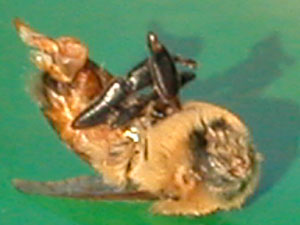
 You've seen me going on and one about the two main winter beekeeping issues around here: food stores and mites. This is the most interesting picture I could show you about how I've been trying to look after both.
 Very soon after sugaring up the bees, white-covered bees began emerging from the hive entrances, though this is just a close up from the top of a hive. To properly apply the sugar, you should remove each box, powder the top, place the next box on top, powder it, and so on. I am afraid to manipulate the bees much in cold weather: I could break the cluster, or expose the queen, or do some other typically awkward thing at a time when the bees have few options. So, for the sake of doing something, I put on the powder and then made another oxalic acid application.
  The granulated sugar is a winter feeding method suggested by a beekeeper at the state meeting last month. Bees often stop taking sugar syrup when the temperature reaches freezing, but they will (apparently) creep up on the inner cover and grab some dry sugar when the need arises. You can put a shim on top of the cover, and then place the telescoping cover. I'm a little unsure of whether this is worthwhile, for a couple of reasons. The first is that I don't personally know any beekeeper who does this, and the second is that the bees will need some source of liquid water in order to access the sugar as a food source. This latter is also a concern when offering them fondant (


 Surprise, surprise: the bees are the lens through which I see the midwinter festivities now, and our celebrations are brightened (even literally) by the bees' presence and presents.
 But we have an equal opportunity attitude to holidays around here, so I was also noodling around with bee-based gift baskets, and figured out an interesting way to present the three different colors of honey produced by the roof, monastery, and mill apiaries this year. MaryEllen gave me some special pastry plastic, and I taped together "flights" of honey: the lightest from the monastery, the medium from the roof, and the darkest from the mill. I also labeled some single-source jars for people whom might just like to have a usable amount of a single honey (rather than three somewhat impractical samples).
  With apologies for the blown-out quality of these pictures, here's our final result. The menorah looked homey and glorious with the beeswax candles, though they did not burn as long as expected. The gift baskets included honey, candles, soaps, and a bag of Honey Pecan "Crackerjack," a first-time thing for me that seems to have come out OK. The recipe is below (with instructions about embellishments in parentheses).
 All this craftiness was intended to simplify and refocus this special time, though it must be said that gift baskets are way more time consuming and kitchen-destroying than a trip to the mall. It's hard not to hope rather TOO hard that people will particularly like the effort, and perhaps to get too personally wrapped up in it all. After all, even when the goodies come from the girls, it is not about the stuff.

 Both of my cousins, Maria (shown here) and Anna (taking the picture) are teachers, and they immediately expressed interest in the bees as a learning tool for kids (I guess it's genetic for us to immediately decide "the kids gotta hear about this!") As I went back to put away the honey frame, Maria came along to take a peek. Note the lack of veil, fear, gloves, etc. She even leaned over and took a good long sniff of wonderful bee essence. One of my favorite things, and something missed in winter, is the warm sweet cloud of scent that wafts up whenever you open a beehive. Now she knows what I mean, too.
 Blue comes in a coupla forms, actually. First, something I meant to mention this weekend: on Saturday, we had the state beekeeping association meeting, complete with a mini honey show. After scoping out whether there were any ants present, the judges gave the monastery honey a first in the beginner category for light color. The rooftop honey got a third for medium color in the same category. It is beginning to granulate, actually (more reason to eat it right away). This makes my collection of ribbons include a second (in a class of two), two fourths (in a class of four and of five), a third, and a first – a complete set, the last two actually meaning something. Interestingly, the wife of the judge who gave me the fourths said that
  In August of last year, roofers next door outed the bees to our south-side neighbors, resulting in just 4 months of undetected beekeeping. Luckily, those neighbors are a little paranoid, too; they also thought the bees were cool, and decided to keep the matter to themselves. Then, this Spring, the north side neighbor got a new roof, and I became really worried, because Kathy is a normal, well-adjusted person with children and her reactions would therefore be alien to me. But it turns out that her roofers never told her, and as a result I outed myself last month (sort of) and she was kind of happy about the whole thing.
 But you might be asking, what about the bees today? Well, they had to be moved onto the deck (which is not being messed with) and they had to be sealed in, because otherwise they would get lost.
 So last night, after sunset (when all the field bees should be back home) I went up and blocked the entrances with plastic window screen material and duct tape, and covered the top with a screen that is usually used for added summer ventilation. Then you run a
  Yesterday was another feeding day, and Twain was the lucky colony... well, sort of. Remember how there seems to be a lot of bees robbing bees this year? Maybe I know why.
 Robbing bees make a different noise than your usual buzzing, and they tend to land all over you, checking to see if perhaps YOU might be a sticky pool of undeserved sugar forming directly in front of them. It's hard to move around without crushing bees, and besides the sadness of that, crushed bee smell is a motivator to get upset: just what you don't want in the middle of a cloud of over-stimulated felon bees.
 On the up side, while I was wading around the clingy bees, trying to develop a plan, I got a picture of this bee flying at me straight on. I was not trying for her picture: the camera tends to choose its own focal point, and she apparently was it. It's not great, but you can see her antenna on the left if you squint real hard.
 One pot, one kettle, and one ten pound bag of sugar equals a late autumn meal for one hive of bees. As the year winds down, beekeepers who want to ensure that the honeybees have enough stores for the winter mix 2 parts granulated cane sugar to one part hot water in order to make a heavy, honey-like syrup for the bees to sock away in the dwindling days left. The heavier syrup is supposed to signal to the queen that she should stop laying (if she hasn't already: some beekeepers around here say that in our climate she always lays a little through the winter) and the girls should get ready to cluster up and stay warm. By now, the drones are all gone, and things have become serious.
 When at loose ends, I make food for the girls. This photo shows what 10 pounds of sugar looks like in about 5 pints of water, just out of the kettle. It's cloudly, and must be stirred for a while. The water must be hot to make such a super-saturated solution, and I boil it before pouring. You must never heat the sugar directly on the burner, however, because the bees cannot digest carmelized sugar and can get potentially deadly dysentery in that manner.
 In just ten minutes or so, the mixture becomes crystal clear. It has to cool before you use it, and once it does you sometimes get little floes of sugar ice floating on the top. It helps that my counters are stone and this pot is a thin, cheap one, because I can move it around on the countertop to make it cool faster.